

Lebanese student Roy Abi Raad secured Harvard World MUN’s Diplomacy Award, showcasing Lebanon’s strong presence and resilience on the global academic diplomacy stage.
Lebanon wins Harvard World MUN Diplomacy Award
Lebanon wins Harvard World MUN Diplomacy Award
By The Beiruter | April 05, 2026

Reading time: 4 min
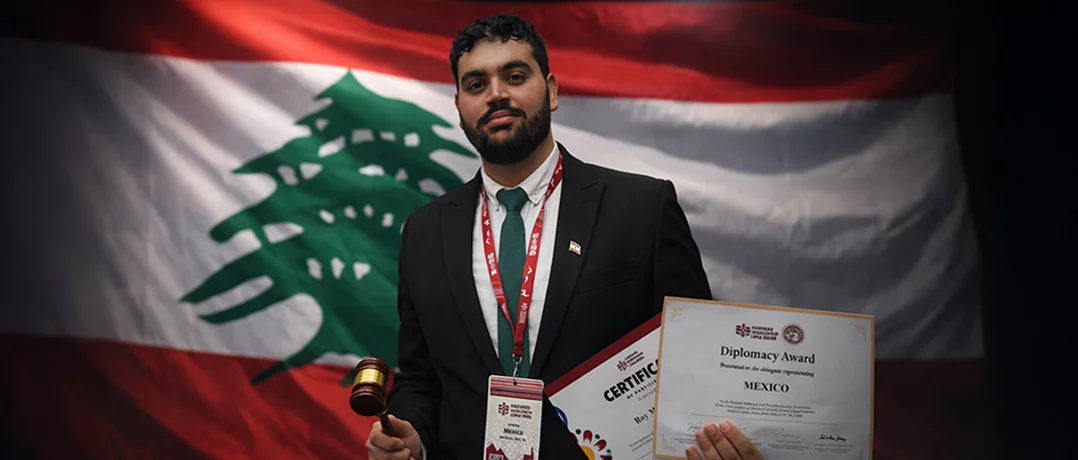
In a remarkable achievement for Lebanese youth on the global stage, Roy Abi Raad, a student at the Lebanese American University (LAU), has been awarded the prestigious Diplomacy Award at Harvard World Model United Nations (MUN). Often described as the “Olympics of Model United Nations,” the conference gathers top university delegations from around the world, making his accomplishment significant.
In this interview, Abi Raad recounts the demanding journey, from preparation in Lebanon to the challenges of international travel and high-stakes diplomacy, that culminated in this success.
A competitive path to the global stage
Abi Raad’s journey began months before the conference itself. Selected as part of a 7-member delegation from LAU, he underwent a rigorous internal competition followed by 4 months of intensive training. The university’s selection process ensured that capable students represented Lebanon in what is widely regarded as the most competitive Model UN conference globally.
Training sessions were held weekly, focusing on policy research, negotiation techniques, and public speaking. “It’s not a regular Model UN,” Abi Raad explains.
You are competing with the finest delegates from top universities worldwide.
This level of preparation proved essential, as the conference brings together over a thousand participants from more than a hundred universities across continents.
Notably, the LAU delegation stood as the sole representative of the Middle East and North Africa (MENA) region at this year’s edition; an achievement in itself amid ongoing regional war.
Logistical hurdles amid crisis
Beyond academic preparation, the delegation faced significant logistical challenges. This year’s conference was held in Lima, Peru, a destination that posed considerable bureaucratic obstacles for Lebanese participants. With no Peruvian consulate in Lebanon, students were required to process their visas through Egypt.
This process proved both costly and time-consuming. Passports had to be shipped abroad under strict conditions, incurring high fees and delays that stretched over a month. At one point, the delegation received their passports only days before departure, despite having submitted them nearly 2 months earlier.
Travel complications compounded the difficulty. Initial flight bookings were canceled due to regional war, forcing the team to rebook alternative routes at additional expense. The journey ultimately took nearly 48 hours, involving multiple layovers across several countries before reaching Lima.
These challenges were exhausting, but they made us even more determined to represent Lebanon.
Diplomacy in action
At the conference, Abi Raad served on the Special Political and Decolonization Committee, focusing on the issue of non-self-governing territories. His delegation represented Mexico, a country whose foreign policy positions, he observed, closely aligned with Lebanon’s perspectives on several key issues.
This alignment allowed the team to engage more authentically with the debates, blending formal diplomatic positions with a deeper personal understanding of the topics at hand. Abi Raad stressed the importance of maintaining professionalism and composure, particularly in a highly competitive environment where delegates often attempt to provoke one another strategically.
The challenge is not just to argue your position, but to remain diplomatic under pressure.
Tensions and resilience
Despite the academic nature of the conference, Abi Raad recounts moments of tension with other participants. He describes instances of verbal provocation and subtle harassment from individuals aware of the Lebanese delegation’s identity. These encounters, while not officially part of the proceedings, added another layer of difficulty to the experience.
Such challenges required careful navigation. Delegates had to remain composed and avoid escalation, as emotional reactions could undermine their performance. Abi Raad highlights this as a critical aspect of diplomacy: the ability to respond calmly and strategically in the face of provocation.
A landmark achievement
After several days of intense debate, negotiation, and collaboration, Abi Raad was awarded the Diplomacy Award; one of the highest honors given within his committee. The recognition reflects not only his individual performance but also the broader efforts of the LAU delegation. Another Lebanese delegate, Junaid Shia, received an award for verbal communication, further underscoring the team’s overall excellence.
For Abi Raad, the achievement carries symbolic weight. “We raised Lebanon’s name internationally,” he says, noting the surprise of many participants upon learning that a Lebanese delegation had made the journey despite the circumstances.
Hence, Roy Abi Raad’s success at Harvard World MUN is more than a personal milestone; it is a testament to perseverance, institutional support, and the enduring potential of Lebanese students. Despite logistical challenges, regional instability, and intense global competition, his achievement demonstrates that dedication and resilience can overcome even the most formidable obstacles.
-
-

-
The Beiruter
-
