



New-car registrations are up almost a quarter this year, but the market remains 46% below its 2019 level. The rebound is taking place in a market with little access to bank financing, where cash and off-bank payments have become increasingly important.
Lebanon's car market is recovering, slowly
Lebanon's car market is recovering, slowly
By Chelsea Al Arif | October 11, 2026

Reading time: 6 min
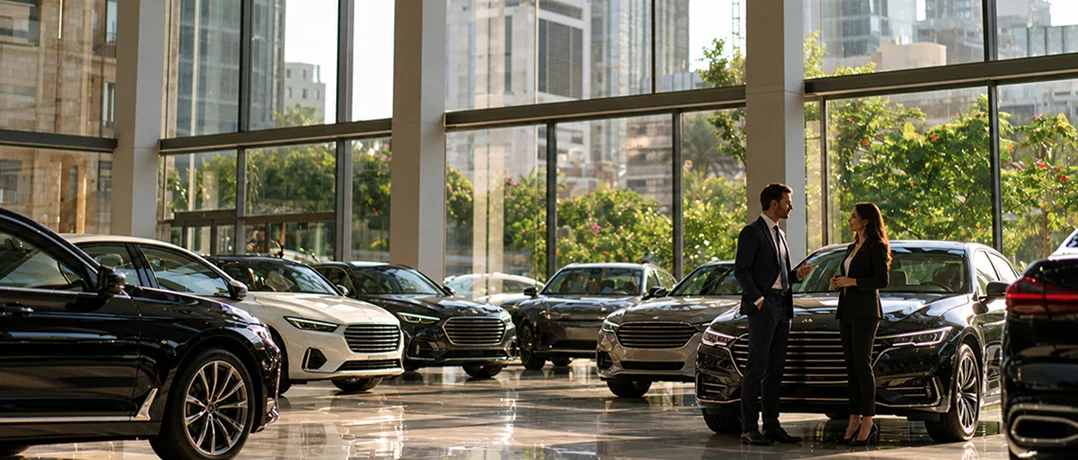
Lebanon's new-car market grew by 23.32% year-on-year in the first eight months of 2026, reaching 9,885 vehicles, according to market data compiled by BLOMINVEST Bank.
It is the latest step in a steady climb. Over the same eight months in 2025, registrations had already risen 39.19% to 8,016 cars. In 2024, the total was 5,759. This year's figure is therefore about 72% higher than it was two years ago.
Yet the comparison that matters most is with the period before the collapse. In the first eight months of 2019, 18,165 new cars were registered. This year's total is still 46% below that level.
Put differently, after nearly seven years, the market has recovered only about 54% of the volume recorded during the first eight months of 2019.
From 39,361 cars to 4,702: measuring the fall
The market was shrinking well before the banking crisis fully took hold. AIA data show that new-car sales peaked at 39,361 vehicles in 2015, before falling to 36,326 in 2016, 37,222 in 2017 and 33,012 in 2018.
In 2019, sales fell another 33.4% to 21,991 vehicles.
Then the collapse accelerated. Full-year new-car sales fell 72.02% in 2020 to 6,152 vehicles. The decline was linked to the foreign-currency liquidity squeeze in the banking sector, which left buyers unable to access the dollars needed to meet dealers' new payment requirements.
The impact was also felt by the state. According to the AIA, taxes paid by car importers fell to around $33 million in 2020, from $178 million in 2019 and $265 million in 2018.
In 2021, the market sank further, with only 4,702 new cars sold for the full year. Compared with 2019, sales had fallen by almost 79%.
The crisis affected more than just demand. Banks had sharply restricted car lending, while restrictions on access to foreign currency made it increasingly difficult for buyers to finance purchases through the banking system. The Beirut port explosion in August 2020 also caused major losses for car dealerships, many of which were located near the port.
6,563, 6,578, 8,226, 13,379: the four-year climb
The recovery that followed was slow, then accelerated.
BLOMINVEST data show that the market sold 6,563 cars in 2022 and 6,578 in 2023, an increase of just 0.23%.
Momentum returned in 2024, when registrations rose 25.05% to 8,226 cars. The real jump came in 2025, when the full-year total increased 62.64% to 13,379 cars.
That 2025 figure was about 61% of the 2019 total and about 40% of the 33,012 cars sold in 2018. Even after the strongest post-crisis year on record, the market was selling only around four new cars for every ten sold in 2018.
The 2025 rebound also coincided with a broader economic recovery. The World Bank estimated that Lebanon's real GDP grew 4.2% in 2025, its fastest growth since the onset of the 2019 financial crisis, supported by stronger consumption, investment, tourism and improved high-frequency indicators.
1,166, 958, 728, 1,869, 1,521: a year interrupted by war
The monthly figures for 2026 show how fragile that momentum remains.
The year began with 1,166 registrations in January. In March, the renewed escalation between Hezbollah and Israel weakened consumer confidence and discouraged high-value and non-essential purchases such as vehicles, according to BLOMINVEST. Sales fell 16% that month to 958 cars.
April was worse. Sales dropped another 24% to 728 vehicles, the weakest monthly figure of the year.
Demand then recovered. May sales rose 33.52% to 972 vehicles. July brought another 22.16% increase, reaching 1,869 cars, the strongest month of the year so far. August then fell back 18.62% to 1,521.
Even that July peak remains below the level that was common before the crisis. The 18,165 cars registered between January and August 2019 represent an average of about 2,270 cars a month. The 9,885 registered during the same period this year represent about 1,236 a month.
$54.5 billion in private-sector loans, and a banking system that no longer finances the market
The biggest structural difference between today's car market and the pre-crisis market is financing.
Before the crisis, bank lending was an important part of the Lebanese consumer economy. By September 2019, commercial-bank loans to the private sector stood at $54.5 billion, according to Fransabank's economic bulletin.
That system has since largely disappeared. Banque du Liban's latest data show claims on the private sector at LBP 501.9 trillion at the end of July 2026. The figures are reported in Lebanese pounds and are not directly comparable with the historical dollar-denominated loan figure without accounting for exchange-rate and valuation differences.
The effect on the car market is clearer in the industry data. BLOMINVEST repeatedly identifies the absence of financing options and lower purchasing power as major constraints on demand.
The 2019 baseline was also shaped by an unusual payment mechanism. BLOMINVEST notes that many cars were still being purchased through bank checks at the time, allowing some buyers to use deposits that would later become trapped in the banking system.
By 2022, dealers were increasingly accepting cash payments instead. As bank lending disappeared and the value of salaries paid in Lebanese pounds collapsed, the pool of buyers able to finance a new car narrowed sharply.
+23% in car sales, -6.4% in GDP: what the recovery says about the market
The most striking feature of 2026 is that car registrations are rising while the wider economy is expected to contract.
The World Bank projects that Lebanon's real GDP will shrink by 6.4% in 2026 following the renewed conflict. It expects inflation to reach 17.5%, while the conflict has displaced around 1.2 million people and disrupted tourism, domestic demand, infrastructure and supply chains.
Against that backdrop, the 23% rise in new-car registrations does not necessarily point to a broad recovery in household purchasing power. Combined with the lack of bank financing identified by BLOMINVEST, the data are more consistent with a recovery concentrated among buyers who can finance purchases outside the traditional banking system.
The composition of sales also shows a market adapting to changing consumer preferences.
Chinese brands accounted for 171 of the 1,255 cars sold in August 2025, or 14% of the monthly market. By December, Chinese vehicles represented 25% of monthly sales.
In August 2026, the three best-selling brands were Toyota, MG and Hyundai.
Electrified vehicles are also taking a larger share of the market. Hybrid, plug-in hybrid and fully electric models accounted for 437 of the 1,521 cars sold in August 2026, around 29%. A year earlier, the same categories accounted for 203 of 1,255 sales, or about 16%.
The shift is taking place against a much older existing fleet. AIA data cited by industry sources show that 42% of Lebanon's vehicles are more than 20 years old, while almost 60% are at least 15 years old.
That points to substantial replacement needs. But replacement demand alone is not enough to restore the market to its pre-crisis size.
Lebanon's new-car market has recovered from its post-crisis floor, but it remains far from its previous scale. With bank financing still severely constrained and purchasing power under pressure, the recovery is likely to remain dependent on buyers who can pay outside the banking system.
-
-

-
Chelsea Al ArifJournalistMultimedia Data Journalist and Analyst.
-
