



Lebanon’s coastline is facing a growing environmental crisis as sewage, plastic waste, and chemical pollution threaten marine ecosystems and public health.
Lebanon's drowning coastline

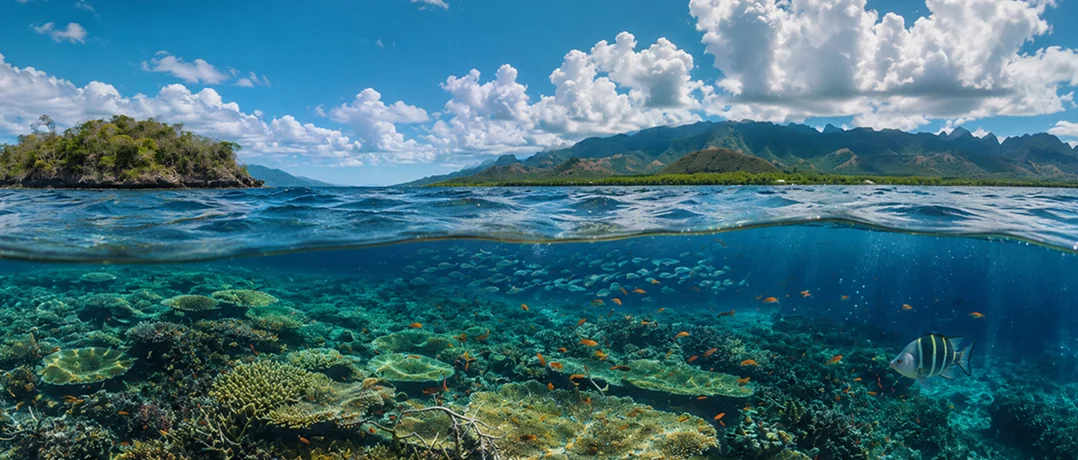
With 225 kilometres of Mediterranean shoreline, Lebanon should be a maritime jewel. Instead, decades of sewage dumping and recklessness have pushed its coastal waters to a breaking point. Pollution levels are rising, beaches are closing, and the systems meant to protect public health and marine life remain either broken or nonexistent. The degradation is the accumulated result of neglect and an economy that has repeatedly treated the environment as an afterthought.
A 2025 report by the National Center for Marine Sciences (NCSM), part of Lebanon's National Council for Scientific Research (CNRS) revealed that of 38 monitored stations, only 24m 63%, are deemed safe for swimming. Eight fall into the "marginal to unsafe" category, and six are classified as heavily polluted. Compared to 2024, nine stations recorded a deterioration in water quality, with one downgraded outright from safe to heavily polluted.
The hardest-hit zones are public beaches: Tripoli's main beach, Jounieh, the Antelias river mouth, the North Dbayeh Marina, and, most troublingly, two of Beirut's most iconic waterfronts, Manara and Ramlet el Bayda. These are places where children swim in summer and families gather at sunset. Meanwhile, Lebanon scored 89.6% on the 2025 Global Pollution Index, placing it among the worst-ranked countries on earth and at the top of the regional list.
What is killing the sea
The primary culprit is not industrial sabotage or a single catastrophic spill, it is the grinding, daily reality of untreated sewage. Most Lebanese rivers carry raw sewage and organic waste directly into the Mediterranean, especially near urban centers. Lebanon has virtually no functioning wastewater treatment infrastructure at scale. The CNRS has linked the elevated bacteriological contamination found at polluted beaches directly to this wastewater and to leachate, toxic liquid that seeps from coastal dumpsites and landfills into the water.
Then there is the plastic. The 2025 CNRS study found that solid waste on surveyed beaches can exceed 20,000 pieces per 100 metres of coastline. The threshold recommended by the international OSPAR Commission is 20 items per 100 metres. Lebanon is one thousand times over the limit in some areas. The country's most polluted coastlines sit adjacent to its worst-managed landfills: the Bourj Hammoud-Jdeideh and Costa Brava sites, both built on reclaimed land jutting directly into the sea, continue expanding today.
Invisible poisons: Heavy metals and microplastics
Bacteriological pollution is visible enough to close beaches. What is harder to see, and in some ways more alarming, is the chemical contamination spreading through Lebanon's coastal waters. A 2025 study by researchers at the Lebanese American University sampled waters near the Palm Islands Nature Reserve, a protected area off the coast of Tripoli. What they found should not be present in a marine reserve: chromium, arsenic, lead, and cadmium, with cadmium levels exceeding permissible limits set by environmental regulators. Phthalates, chemicals leaching from plastics, were also detected in concentrations raising serious concerns about their effects on marine species.
The good news, for now, is partial. The CNRS found that heavy metal concentrations in the tissue of eleven local fish species caught from Tyre, Beirut, and Tripoli all remained below international safety thresholds. Fish caught away from sewage outfalls and industrial discharge points are still considered safe to eat. But researchers frame this as a provisional reassurance, not a clean bill of health, and the trajectory is not encouraging.
Environmental expert to The Beiruter
The Beiruter spoke with expert Kamal Sioufi, a consulting electromechanical engineer with 45 years of experience, and a member of the Operations Committee of the Order of Engineers in Beirut.
For Sioufi, the crisis has a clear starting point: factories and industrial facilities across Lebanon discharge their waste without any treatment, channelling it directly into stormwater drains. "Everything has sediment, from factories and beyond, and none of it is filtered or processed," he explains. "These stormwater channels flow into the sea or into waterways that are also used for irrigation." The consequences are twofold: the sea is contaminated at the point of discharge, and agricultural land fed by those same waterways produces food that carries the pollution further along the chain.
The second and most structural problem, in Sioufi's view, is the near-total absence of functional wastewater treatment plants. Lebanon has received substantial international aid over the years to build and equip such facilities, yet most either do not operate or function far below capacity. "The big question is: why don't these stations work?" he asks. "And the ones that do work are very weak." He points to a pattern of waste, mismanagement, and outright theft in how these funds have been handled, with money disappearing before infrastructure could be built or maintained.
The third dimension he raises goes beyond contamination and touches on quantity. Lebanon's water resources are being depleted at a rate that compounds every other crisis, less water flowing through rivers and waterways means less natural dilution of pollutants, and higher concentrations of contaminants reaching both the sea and agricultural land.
On solutions, Sioufi is direct. The priority must be a comprehensive monitoring programme for all industrial discharge, run jointly by the Ministry of Environment, the Ministry of Energy, and municipal authorities. Every factory in Lebanon should be tracked, its waste accounted for, and its compliance verified. Crucially, he insists the technical capacity to do this already exists in Lebanon, the obstacle is not knowledge or equipment, but political will and institutional integrity. "If there is honesty and transparency," he says, "the process is actually quite simple."
A source of life
Lebanon's coastline is a national treasure, a source of life, identity, and livelihood for generations. Yet rising pollution, failing infrastructure, and years of neglect are pushing its waters toward a breaking point. Protecting Lebanon's Mediterranean coast will require more than studies and warnings; it demands urgent action, accountability, and long-term investment. The sea has sustained Lebanon for centuries. Now, it is Lebanon's turn to save its sea.
-
-

-
The Beiruter
-
