



Lebanon’s golden generation is aiming to qualify for the 2027 FIBA Basketball World Cup and build on its historic achievements in Arab and Asian basketball.
Lebanon's golden generation wants to keep making history
Lebanon's golden generation wants to keep making history
By Khalil Hatem | November 25, 2026

Reading time: 7 min
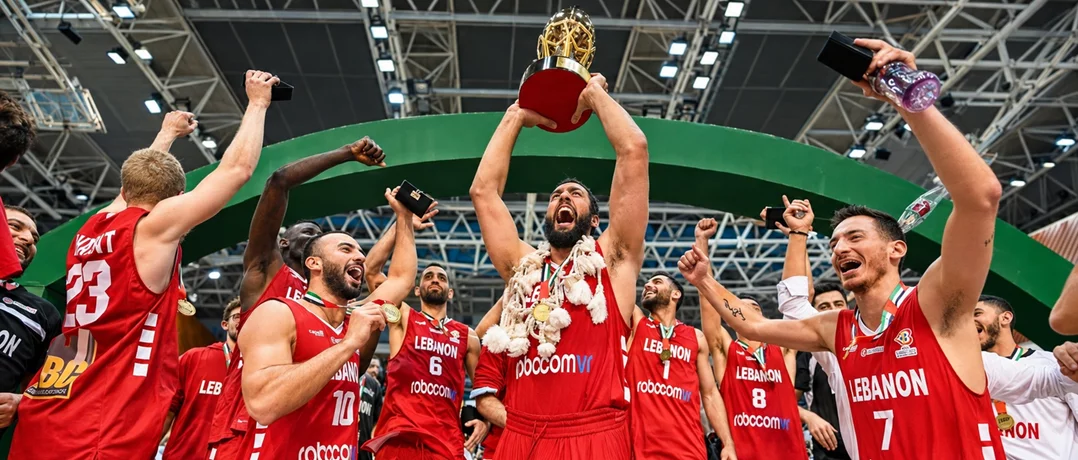
The Lebanese national basketball team is well on its way to qualifying for a second consecutive FIBA Basketball World Cup in 2027, following its participation in 2023. While qualifying for a second straight World Cup would already be a remarkable achievement in itself, this generation will be eager to make even more history for Lebanese basketball, having won the Arab Basketball Nations Championship in 2022, finished runners-up at the FIBA Asia Cup in 2022 and secured 23rd place at the 2023 World Cup. Although the 2025 FIBA Asia Cup marked a certain decline, with Lebanon eliminated in the quarter-finals, this generation is not yet at the end of its cycle. Led by Wael Arakji, Sergio Darwich and Ali Haidar (the latter having been left out by current head coach Ahmad Farran for technical reasons in the 2027 World Cup qualifiers), it is already making a strong case for being considered the greatest generation in the history of Lebanese basketball.
A generation that has already made its mark on Lebanese basketball
First and foremost, this generation won the 2022 Arab Basketball Nations Championship, held in the UAE. It was the first time Lebanon had ever won the title, and Wael Arakji was named the tournament's Most Valuable Player (MVP). Lebanon's starting five in that historic final consisted of Wael Arakji, Jad Khalil, Sergio Darwich, Ali Haidar and naturalized player Ater Majok. Before this 2022 triumph, Lebanon's best results in the competition had been a fourth-place finish in 1997, with the pioneering generation featuring, among others, Elie Mechantaf, Walid Doumyati, Yasser el-Hage, Ghazi Boustani and Elie Nasr, and a runner-up finish in 2010 with the intermediate (in this successful 30 years period) generation, which included Fadi el-Khatib, Jean Abdelnour and Rony Fahed. The current generation's achievement in 2022 is all the more special given that the 1997 and 2010 editions were both held in Lebanon.
Beyond its 2022 Arab title, this generation's major achievement was finishing runners-up at the 2022 FIBA Asia Cup in Indonesia. Wael Arakji was also named tournament MVP, having notably scored the game-winning basket with 22 seconds remaining in the semi-final against Jordan. In the final against Australia, Lebanon made a poor start, and it was only in the fourth quarter that the team coached by Jad el-Hajj produced its best basketball, thanks in particular to a series of three-pointers from Wael Arakji, Elie Chamoun and Sergio Darwich. However, the late comeback proved insufficient, and Lebanon finished second in the Asian Cup for the fourth time in its history, following its previous runner-up finishes in 2001, 2005 and 2007. Unlike the Arab championship title, this runner-up finish was not a first. However, during those three earlier finals, Asia and Oceania had not yet been combined into a single qualification region, as has been the case since 2019. This gives Lebanon's 2022 achievement, with a loss in the final against Australia added significance.
Nevertheless, the sporting value of the 2022 edition should also be put into perspective, as the tournament no longer served as a qualifying competition for the FIBA Basketball World Cup, unlike previous editions. Lebanon's runners-up finish in 2001, for instance, had also secured the team's place at the 2002 World Cup, alongside China, who won the Asian title that year.
At the World Cup, this generation succeeded in ending Lebanon's 13-year absence from the competition, between 2010 and 2023. After a difficult first round, in which Lebanon suffered three defeats in as many games, the team bounced back in the classification round with victories over Côte d'Ivoire and Iran, finishing 23rd out of 32 participating teams. Amir Saoud's performance against Côte d'Ivoire will remain in the history books. Saoud was named Player of the Game, thanks in particular to several crucial shots at decisive moments. He therefore played a major role in improving Lebanon's overall record at the tournament.
However, Lebanon's 2002 performance, despite finishing 16th out of 16 participating teams, remains the Cedars' best World Cup achievement in terms of the difficulty of qualifying. At the time, Asia had only two qualifying spots, compared with four in 2006 and 2010, and eight in 2023 and 2027.
For the current generation to genuinely take Lebanese basketball to another level and be unequivocally regarded as the greatest in the country's history, it will probably need to reach the Round of 16 at the 2027 tournament and win at least one classification game following a potential elimination in that round. Reaching the quarter-finals would be an extraordinary achievement. But before any of that, Lebanon must first secure its qualification.
The immediate priority: Securing qualification for Doha 2027
Lebanon is currently ranked 33rd in the FIBA World Ranking and sixth in the Asia-Oceania region. The Cedars face two important games at the Nohad Nawfal Stadium in Zouk on Thursday, November 26, against Japan (22nd in the FIBA World Ranking and the second-ranked team in Asia-Oceania, behind Australia), followed by China on Sunday, November 29 (30th in the world and fifth in Asia-Oceania). Both games are part of the final group stage of the 2027 World Cup qualifiers, with the tournament scheduled to take place in Qatar from August 27 to September 12, 2027. Lebanon is targeting its fifth World Cup appearance, following its previous participations in 2002, 2006, 2010 and 2023.
Lebanon is in a very strong position after eight of the twelve games in this qualifying campaign, currently sitting second in its group behind Japan. Both teams have the same number of points, with six wins and two defeats, but Japan has a better points differential (points scored minus points conceded). The top three teams from each of the two groups in the final qualifying phase will secure their World Cup spots, along with the best fourth-placed team. Qatar, although taking part in the qualifying campaign, is already guaranteed a place as host nation.
Beyond securing World Cup qualification, these two home games will be crucial in the race to finish top of the group. This would help improve Lebanon's FIBA ranking and, consequently, increase its chances of receiving a more favorable draw in the first round of the 2027 World Cup.
Lebanon is currently on a run of ten consecutive home wins in World Cup qualifying games: six during the 2023 qualifying campaign and four in the ongoing 2027 campaign. The Cedars' last defeat in a World Cup qualifying campaign dates back to February 2019, when they lost 84–72 to South Korea. On that occasion, Lebanon made a strong start, winning the first quarter 29–18, before gradually surrendering its advantage and eventually losing by twelve points. Wael Arakji (19 points), Amir Saoud (16 points), Jad Khalil and Ali Mezher were the four players on Lebanon's 12-man roster for that game who are still regularly called up to the national team today.
Lebanon will start as the favorite against Japan on Thursday
Thursday's game against Japan will be the first meeting between the two teams since their Round of 16 encounter at the most recent FIBA Asia Cup, which Lebanon won 97–73. Ali Mansour delivered an outstanding performance at point guard on that occasion, making 15 assists. After an average first round at the Asian Championship, Lebanon produced a strong performance that day when its back was against the wall.
Japan, now ranked higher than Lebanon in the FIBA World Ranking, is nevertheless a team the Cedars must take very seriously. It is worth recalling that Japan finished as the highest-ranked Asian team at the 2023 World Cup, an achievement that earned it direct qualification for the 2024 Olympic Games.
In the current qualifying campaign, Lebanon is coming off an 89–87 away defeat against China, sealed by a clutch basket from Yang Hansen. The Cedars will need to bounce back quickly with a victory if they are to maintain their push for top spot in the group.
A unique generation that continues to make history
Thursday's game is therefore another step forward in this generation's journey, which is not yet nearing its end. Of the 16 Lebanese players who have featured in at least one of this generation's three major campaigns — the 2022 Arab Championship, the 2022 FIBA Asia Cup and the 2023 World Cup — 14 are still in contention for a place in the national team.
The continued development of Karim Zeinoun (27), an accurate shooter and excellent defender who featured in all three successful campaigns, will be particularly interesting to follow. Youssef Khayyat (23), who was already part of the team at the 2022 Asian Championship, and Jihad el-Khatib (21) are the two most promising young Lebanese players in the squad. They will need to make a consistent individual contribution while maintaining the team's collective cohesion.
This is a team whose foundations were laid by head coach Jad el-Hajj, who was in charge from 2022 to 2024, and which current coach Ahmad Farran must now build on and strengthen. It is also worth noting that Farran succeeded in convincing Hayk Gyokchyan to reverse his decision to retire from international basketball.
