



Lebanese jazz transformed war, exile, and identity into a distinct sound that resonates far beyond Beirut.
Lebanon's jazz soul

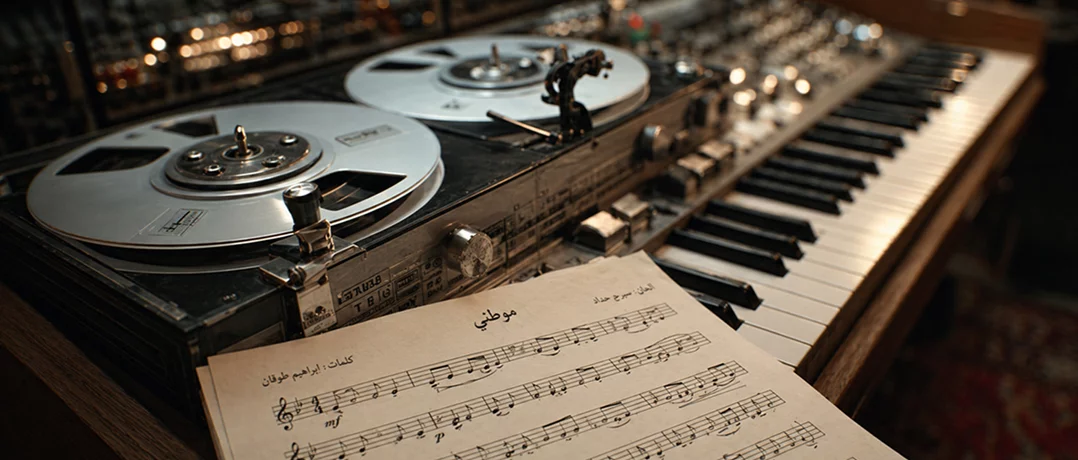
Lebanese jazz has carved out a sound that is both deeply local and globally resonant, one that filters the dissonance of civil war, the longing of exile, and the stubborn resilience of Beirut. In Beirut, where Western records arrived alongside political upheaval and shifting identities, jazz found unexpected ground. It blended with Arabic maqam, absorbed the rhythms of the Levant, and emerged as something neither fully imported nor entirely traditional.
By the time the civil war erupted in 1975, music had already become a parallel archive of the country’s fragmentation and survival. Amid the noise of conflict and migration, Beirut’s artistic circles became laboratories for hybrid sound: political theatre, satire, and improvisation folded into one another. At its center, unmovable, stands Ziad Rahbani.
Ziad Rahbani: Architect of the Lebanese jazz idiom
Born in 1956 to Fairouz and Assi Rahbani, Ziad inherited a dynasty and then immediately set about dismantling its conventions. Inspired by Charlie Parker and Stan Getz, and the Brazilian bossa nova, he coined his sound: “Oriental jazz.” He lived in Hamra, between his infamous Nota studio, the Piccadilly theatre, and jazz bars like Blue Note. His work became the soundtrack of a generation shaped by the Lebanese Civil War, restless, ironic, and disillusioned.
Musically, he internalized Jazz. In tracks like “Abu Ali”, the groove leans into funk-inflected basslines and loose, conversational phrasing, while “Bema Enno” plays with timing and tonal ambiguity in ways that echo modal jazz. His instrumental work, including pieces like “Ballad of the Sad Young Men” (which he reinterpreted in his own idiom), reveals a deep engagement with American jazz standards, filtered through a distinctly Beirut sensibility.
His collaborations with Fairouz marked a turning point in Arabic music. Songs like “Kifak Inta”, “Bala Wala Chi”, and “Wahdon” carry his signature harmonic layering, unexpected chord progressions, restrained piano lines, and subtle jazz phrasing that expanded the emotional register of her voice.
Ziad’s theatre work further cemented his role as a cultural disruptor. In plays like “Bennesbeh Labokra Chou?” and “Film Ameriki Taweel”, music became inseparable from political critique, jazz functioning almost as a narrative device, mirroring chaos, absurdity, and fragmentation.
What Ziad ultimately built was not a genre, but a language: one where Arabic maqam could coexist with jazz improvisation, where a melancholic oud line could sit over a swung rhythm section, and where Beirut, fractured, ironic, alive, could finally hear itself.
Rabih Abou-Khalil: Rewriting the Oud’s place in jazz
Rabih Abou-Khalil globalized Lebanese jazz. Leaving Lebanon during the civil war and settling in Europe, Abou-Khalil built a body of work with the oud at its center, as a lead, improvisational force equal to any saxophone or piano.
Albums like Blue Camel (1992) and Arabian Waltz (1996) are now considered foundational in cross-cultural jazz. In “Blue Camel,” the dialogue between oud and horns unfolds over shifting time signatures, creating a tension between swing and asymmetry. “Arabian Waltz” leans into orchestral arrangements, where Arabic melodic sensibilities stretch across jazz phrasing without losing their identity. Abou-Khalil’s compositions are meticulous yet fluid. In doing so, he inserted Arabic sound into jazz and challenged jazz itself to expand.
Ibrahim Maalouf: Expanding the trumpet’s vocabulary
Ibrahim Maalouf represents a different kind of departure, one that is both technical and deeply personal. The son of trumpeter Nassim Maalouf, he inherited and mastered the quarter-tone trumpet, an instrument modified to play the microtones essential to Arabic music. With it, he carved out a sound that moves seamlessly between jazz improvisation, classical composition, and cinematic scale. In 2022, he became the first Lebanese instrumentalist nominated at the Grammy Awards for his album Queen of Sheba in collaboration with Angélique Kidjo.
His albums often carry an emotional narrative shaped by displacement and identity. In Diasporas (2007), tracks like “Beirut” blend melancholic phrasing with expansive arrangements, evoking both distance and attachment. Later works like Illusions and S3NS push further into genre fusion, incorporating funk, electronic elements, and even Latin influences, while maintaining a core rooted in improvisation. Live performances, especially pieces like “True Sorry,” showcase his ability to move from delicate, almost fragile passages into powerful, soaring crescendos. Maalouf he dissolves genres’ boundaries, carrying Lebanese musicality into a global, contemporary soundscape.
Toufic Farroukh: The horn that bridges continents
Born in 1963 and educated between Beirut and Paris, Toufic Farroukh embodies the transnational condition of Lebanese music, at once a conservatory-trained jazz musician and a devoted student of the Arab maqam tradition. His albums Mashreq and Jazzarak established a fluent cross-cultural conversation, layering saxophone improvisation over rhythms drawn from the Levant.
Farroukh has collaborated with French, Moroccan, and West African musicians, demonstrating that Lebanese jazz is not a closed regional dialect but a connective tissue capable of linking disparate musical cultures. His live performances at Beirut's Monnot Theatre and international festivals alike have earned him recognition as one of the Arab world's most complete jazz voices.
The sound of a generation and what endures
Lebanese jazz is an ongoing argument, between tradition and rupture, between the Arabic melodic line and the Western harmonic grid, between the desire to document suffering and the insistence on joy. What unites its practitioners across generations is a willingness to carry contradiction without resolving it.
Ziad's genius was to make irresolution feel like the only honest response to Lebanese life. His heirs, and those still emerging from the rubble of a city that keeps rebuilding itself, have inherited both the burden and the freedom of that honesty. The music that results is, improbably, among the most vital jazz being made anywhere in the world.
-
-

-
The Beiruter
-
