



Lebanon’s Jewish property legacy spans synagogues, cemeteries, religious endowments and private holdings, raising questions about ownership, legal protection and the rights of Lebanese Jewish families.
Lebanon's Jewish properties

Source: Nida Al Watan
Any discussion of the return of Lebanese Jews to their homeland remains incomplete without first undertaking a serious examination of their property holdings and real estate rights. So how can their return be discussed before addressing the status of their land, properties and ensuring that their rights are restored in accordance with the law? This issue extends beyond property ownership alone; it touches on the very essence of citizenship and equality before the law, as well as the state's responsibility to safeguard the rights of all its citizens without religious or sectarian discrimination. Return does not begin with slogans or political positions, but with addressing people's rights, foremost among them the right to property ownership. Accordingly, resolving the issue of Lebanese Jewish property constitutes the first step toward any genuine return to their homeland.
Over several decades, Lebanon's Jewish community left a visible mark on a number of Lebanese cities and regions through its synagogues, cemeteries, and institutions, as well as the religious endowments and properties historically associated with it. Regardless of the significant decline in the community's population, some of these properties remain as evidence of a Jewish presence that extended from Beirut and Sidon to Tripoli, Bhamdoun, Aley, Deir al-Qamar, and other areas.
However, determining the extent of these properties requires distinguishing between two main categories of ownership: religious endowments and real estate belonging to the community and its institutions, on one hand, and private properties once owned by Jewish individuals and families, on the other. According to the available published information, no recent official statistics establish the total area of all Jewish religious endowments in Lebanon.
Sidon: One of the main centers of Jewish property
Sidon has historically been one of the main centers of Jewish property ownership. The city's Jewish community reportedly had a system in place for managing its religious endowments, while disputes over the administration of endowment revenues and lease agreements continued from the Ottoman era through the Mandate period.
Among the most well-documented properties is the Jewish cemetery in the Dekerman neighborhood of Sidon. A plot of land near Abu Rouh Mosque in the neighborhood was purchased in 1868, before Simha Farhi donated it as a religious endowment to the Jewish community.
A map dating back to 1933 indicates that the cemetery covered approximately 45 dunums, while another map from 1969 showed a similar area.
The total number of Jewish-owned properties in Sidon exceeds 300. These properties include houses, commercial shops, a cemetery, and a synagogue. However, these figures refer to Jewish-owned properties in general and do not mean that all of them are religious endowments belonging to the community.
Beirut: The center of Jewish presence
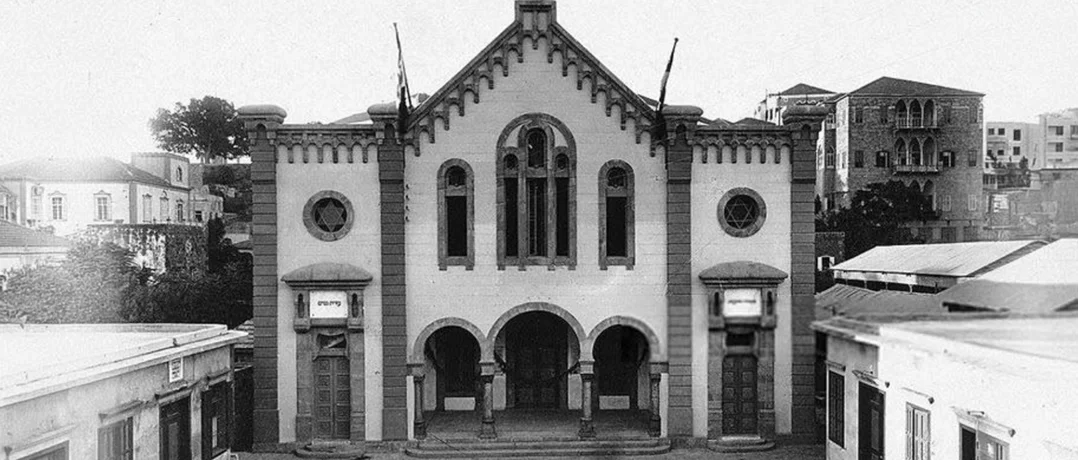
In Beirut, most of the city's historical Jewish presence was concentrated in Wadi Abu Jamil, home to the Magen Abraham Synagogue, as well as schools and other institutions belonging to the community.
The community owned extensive areas of land and buildings in the neighborhood. During the Solidere project to reconstruct downtown Beirut, the properties were divided and reassigned. Ownership of the synagogue's plot and its immediate surroundings was preserved, while most of the other residential properties were sold or compensated for through shares.
As a result, property ownership in the area became mixed, comprising shares held by certain families and specific properties belonging to the religious endowment.
Tripoli: Historical Jewish properties and institutions
Historical records point to the existence of Jewish properties and institutions in Tripoli. Available information indicates that approximately 100 properties once existed in the city, including shops and buildings, in addition to a Jewish cemetery that was later removed.
As in Sidon, this figure refers to Jewish-owned properties in general rather than exclusively to religious endowments.
In northern Lebanon and the Bekaa Valley, information points to the existence of small prayer houses and rooms designated for worship in Tripoli and Hasbaya. However, these properties gradually disappeared from view after the families left the areas before the civil war. Some were legally sold, while others were incorporated into neighboring properties.
Bhamdoun, Aley, and Deir al-Qamar: Traces of Jewish presence in Mount Lebanon
The presence of several Jewish synagogues and properties in Mount Lebanon was closely linked to Jewish families from Beirut who visited the mountain areas to live, conduct business, or spend the summer.
In Bhamdoun, there are at least 60 buildings owned by Jews, including seven mansions and a synagogue. This figure refers to the total number of properties rather than religious endowments alone.
The synagogue in Bhamdoun was built to serve wealthy Jewish families from Beirut who spent the summer in the area. Its exterior structure is still standing, but the building has been abandoned and severely damaged as a result of the events of the Mountain War.
In Aley, the Ohel Yaakov Synagogue stands out. It was established in 1895 by the Yaacoub family. The property is still registered in the community's name, but it is no longer in use and remains closed.
In Deir al-Qamar, there is a synagogue dating back to the 17th century, during the Ottoman era and the rule of Emir Fakhr al-Din II. It is considered the oldest synagogue in Mount Lebanon. But, it no longer belongs to the Jewish community, as it has become public property under the Ministry of Culture and is used as a cultural and tourist landmark open to visitors. Some properties belonging to the Jewish religious endowment in Deir al-Qamar were also used by the French Embassy in Lebanon.
Jewish-owned properties can also be found in Zahle, Dora, Bauchrieh, Broummana, and Jounieh.
More than 20 historical synagogues and prayer houses
The religious presence of Lebanon's Jewish community was not limited to Beirut but extended to several other parts of the country. Historically, Lebanon had more than 20 synagogues and prayer houses serving Jewish communities.
However, most of these buildings were abandoned by their congregations, fell into disrepair, changed ownership, or were repurposed for other uses.
Most notable historically documented synagogues
The Magen Abraham Synagogue in Wadi Abu Jamil: It is considered the largest and most important Jewish synagogue in Beirut. It is also the only synagogue to have undergone a complete restoration, between 2009 and 2010, in an effort to preserve its structure. It stands on a separate plot of land legally owned by the Jewish community. However, it is located within the security zone in downtown Beirut and remains closed.:
Beirut's Historic Synagogues: During the period of prosperity enjoyed by the Jewish community in the 1950s, Beirut was home to approximately 16 synagogues and small prayer houses spread across Zokak el-Blat, Achrafieh, and other neighborhoods. However, they disappeared following the war, leaving only the Magen Abraham Synagogue.
The Bhamdoun Synagogue: It was associated with Jewish families from Beirut who spent their summers in the mountains. Its exterior structure is still standing, but it remains abandoned and severely damaged.
The Ohel Yaakov Synagogue in Aley: Established in 1895 by the Yaacoub family, the property remains registered in the Jewish community's name, but it is no longer in use and is still closed.
The Deir al-Qamar Synagogue: Dating back to the 17th century, it is considered the oldest synagogue in Mount Lebanon. Today, it is public property under the jurisdiction of the Ministry of Culture and the municipality, serving as a cultural and tourist landmark open to visitors..
The Old Sidon Synagogue: Located in the Jewish Quarter of the old city, the property remains officially registered. However, the synagogue building has been leased and temporarily occupied for decades, with parts of it suffering from severe neglect.
The Sodeco Cemetery: One of the most prominent remaining properties in Beirut
The Sodeco Cemetery is located in the Ras al-Nabaa/Sodeco area of Beirut. It occupies an extensive and highly valuable plot of land in the heart of the capital.
The cemetery contains hundreds of historic graves and is considered, according to the available information, the largest and most clearly identifiable property still entirely managed by the Jewish community's religious endowment.
The cemetery belongs to the Lebanese Jewish religious endowment and is legally protected.
The Jewish religious endowment: A historical legacy dating back to the Ottoman era
The Jewish religious endowment system in Lebanon is not a recent development. It dates back to the Ottoman era, when the Jewish community used the waqf system to organize the revenues of its institutions and community. The administration of Jewish religious endowments continued throughout the Mandate period.
It is worth noting that the Jewish religious endowment, established in 1922, reportedly accounted for approximately 35 percent of the community fund's income at a certain point in time.
Schools and educational institutions
The historical presence of Lebanon's Jewish community was not limited to synagogues and property ownership; but it also extended to educational institutions.:
During the community's period of prosperity, four major Jewish educational institutions operated in Lebanon. These included the Alliance Israélite Universelle school complex in Beirut, which had separate sections for boys and girls; the Tiferet Israel boarding school; and several small religious Talmud Torah schools.
Private properties belonging to families who left Lebanon
In addition to properties belonging to the Jewish community and its religious endowment, there are private properties that were once owned by Lebanese Jewish families, particularly in the mountain regions.
Properties in Aley and Bhamdoun include the land on which the two synagogues stand, as well as areas of agricultural land and old residential buildings that were once owned by families, including the Safra, Mizrahi, and Dweik families.
In many cases, the names of the original owners are still recorded in Lebanon's official land registry records. These properties fall under the category of private property belonging to families that emigrated from Lebanon, while many remain legally frozen due to the absence of completed inheritance proceedings.
No recent official statistics on the total area of religious endowments
Despite the numerous references to Jewish religious endowments and properties in various parts of Lebanon, the available information does not make it possible to establish a documented total figure for the area of Jewish religious endowments in the country.
This distinction is important because the figures circulating about hundreds of properties in Sidon, Tripoli, and other areas refer to Jewish-owned properties in general. They cannot automatically be interpreted as figures relating specifically to religious endowments, given the distinction between religious endowments (waqf) and private property.
Accordingly, claims that "Jews own thousands of dunums of religious endowment land in Lebanon," or any attempt to specify a total area without referring to official documentation, are not supported by published, verifiable data.
A more accurate statement would be that the Jewish community has a documented history of religious endowments and property ownership in several parts of Lebanon. Partial records are available for certain sites, most notably the Jewish cemetery in Sidon, which covers approximately 45 dunums, according to a 1933 map. However, no publicly available, up-to-date official database provides a comprehensive inventory of all Jewish religious endowments in Lebanon or records their total area.
Legal complaints over encroachments on properties
In a related context, the Jewish Community Council of Lebanon filed several complaints before the Lebanese judiciary concerning encroachments on land belonging to the community in Tripoli and Sidon.
According to the information provided, no rulings have been issued in these cases, given that the complaints were filed by the Jewish Community Council of Lebanon.
No decision to confiscate the community's properties
According to the information available, the Lebanese state has not issued any decision to confiscate the properties belonging to the Jewish community in Lebanon or Jewish religious endowment lands in the country, unlike what has occurred in other Arab countries.
The available information also indicates that the Lebanese state, through the Directorate General of Civil Status and the Land Registry Offices, does not confiscate these properties but recognizes them instead as legitimate property holdings belonging to Lebanese citizens of the Jewish faith.
One of the main obstacles to managing or disposing of some of these properties is administrative in nature. Heirs residing abroad face difficulties completing inheritance proceedings and land subdivision procedures due to their prolonged absence from Lebanon. As a result, a number of plots of land and buildings remain abandoned, with their owners or heirs unable to manage them or sell them.
-
-

-
The Beiruter
-
