

In an exclusive interview with the Ministry of Energy and Water, Lebanon is facing a deepening water crisis where conflict, drought, and failing infrastructure are leaving millions without safe access to water.
Lebanon's water crisis through conflict and drought
Lebanon's water crisis through conflict and drought
By The Beiruter | March 23, 2026

Reading time: 4 min
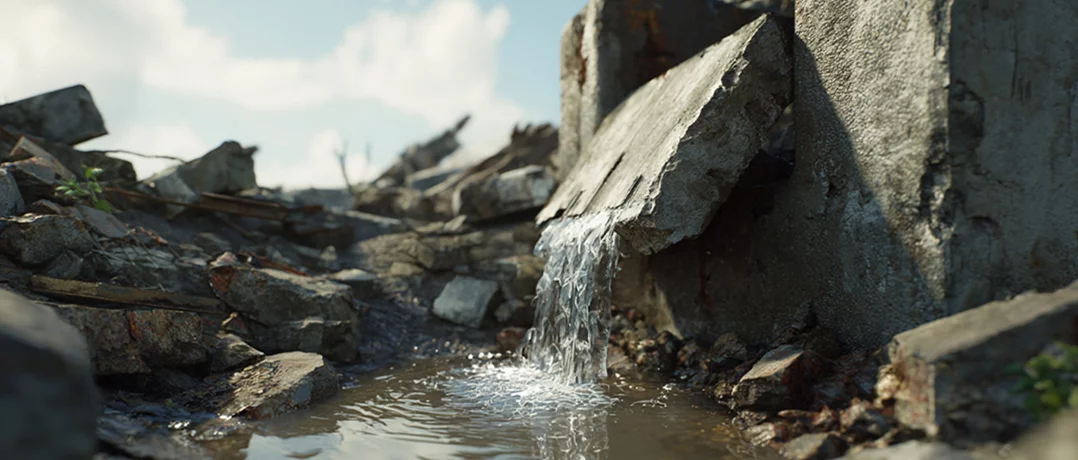
Lebanon is confronting one of the worst water emergencies in decades the result of a devastating collision between armed conflict, historic drought and a long record of institutional neglect.
Access to safe drinking water is becoming more difficult for nearly every community in the country. As conflict continues, debris and chemical remnants from weapons are contaminating rivers and groundwater, threatening both public health and essential resources. Since 2023, at least 34 water facilities have been damaged, placing further pressure on already fragile systems. With more than a million people displaced and hundreds of thousands more living in vulnerable communities, securing clean water is no longer a future concern. It is a daily emergency.
To understand how deep the crisis runs, The Beiruter spoke exclusively with a source inside the Ministry of Energy and Water.
Ministry of Energy and Water: "It's not about the water, it's about the electricity"
Lebanon's Ministry of Energy and Water tells the Beiruter, "The water issue is linked to electricity". "In principle, there is no hurdle unless electricity is cut to southern areas or the southern suburbs. If it is cut completely and you have water intakes that depend on electricity, then they cannot access water normally."
The source was careful to clarify the nature of the crisis.
This is not about the quantity of water or household distribution. It relates to the winter season and the water sources themselves.
Fuel, the source explained, is being secured to keep the pumps running, particularly those serving displacement shelters. "You can still purchase water because fuel is being provided to operate the intakes, especially those supplying areas where people have taken refuge."
But the logistical reality on the ground is more fraught than that framing suggests. Schools repurposed as shelters have seen their water consumption multiply overnight. "Before, there were not many people in those locations," the source acknowledged. "But when 100 families arrived, demand grew significantly." Maintenance, the source added, is another casualty of the conflict.
No one is able to carry out maintenance in those areas.
A perfect storm
Lebanon's water infrastructure was already fragile long before the latest escalation. Into this fragility came two simultaneous blows: conflict and drought. Average rainfall fell by almost half over the past year, pushing reservoirs to critically low levels and placing immense strain on water networks already operating beyond their limits. The country's heavy reliance on diesel-powered pumps, manageable in peacetime, became a critical vulnerability the moment fuel supplies grew uncertain and displacement surged.
The infrastructure in ruins
The conflict has not merely strained Lebanon's water systems. In many places, it has destroyed them. Among the most significantly damaged facilities is the Wazzani spring water pumping station, the largest of its kind in the region. Before its destruction, it was providing a minimum of 12,000 cubic meters of water daily, peaking at 45,000 cubic meters, serving 40 towns across the south.
The military escalation that began on March 2nd, 2026, further worsened an already critical situation. Bombardments struck infrastructure linked to the South Lebanon Water Establishment, including facilities in the Qennarit area already damaged by previous airstrikes in January. Water systems still operational are reporting urgent fuel needs to sustain distribution and wastewater management. Should those supplies run out, the consequences would be immediate: pumps stop, water supply ceases, and disease spreads.
The World Bank estimates these attacks have caused $171 million in damage to Lebanon's water, wastewater, and irrigation systems. Since October 2023, at least 24 public water networks in the south have suffered severe damage, with four more moderately damaged.
One million people, 633 shelters
The scale of displacement has compounded every pressure point. In the first 24 hours following the March 2nd escalation, around 29,000 people were forced to flee their homes. By March 19th, the number of registered displaced people had exceeded 1,049,328, hosted across 633 collective shelters, many already operating beyond capacity, with hundreds of thousands more living in cars, abandoned buildings, and open spaces.
These newly displaced families are arriving in areas already hosting earlier waves of displacement. Water networks designed for modest populations are now serving multiples of their intended capacity. When the public water system collapses, families turn to private water trucking, unregulated, inconsistent, and expensive. For a family already in debt with no income, paying for water can mean going without food. With no alternatives, many are left drinking contaminated water, exposing them to waterborne diseases like cholera and typhoid.
By 2025, prices for trucked water deliveries had risen 60 percent compared with early 2020. In Beirut, a 2,000-liter tank, enough to last a family roughly a week, costs between $10 and $22. For many families, it is now the only option.
What needs to happen
Aid organizations working on the ground are unambiguous about the immediate priorities: keep pumps and treatment plants supplied with fuel and electricity, rapidly repair broken pipes and wells, and introduce basic regulations on private water trucking to ensure it remains safe and affordable. Longer-term fixes, solar-powered infrastructure, governance reform, international reconstruction funding, are equally urgent but require sustained political commitment.
Action Against Hunger has already reached over 35,000 people across all eight of Lebanon's governorates since the March escalation, supporting 139 collective shelters with water, sanitation, and hygiene assistance. But the scale of need dwarfs what humanitarian organizations can absorb alone.
Lebanon's water crisis is no longer a looming threat. It is already here, and for more than a million people displaced, it is the defining reality of every single day.
-
-

-
The Beiruter
-
