



In the early 20th century, Lebanese painting moved beyond religious commissions as pioneering artists established professional studios, trained a new generation and laid the foundations of a modern art scene.
Lebanon’s artistic awakening in the early 20th century
Lebanon’s artistic awakening in the early 20th century
By The Beiruter | October 21, 2026

Reading time: 4 min
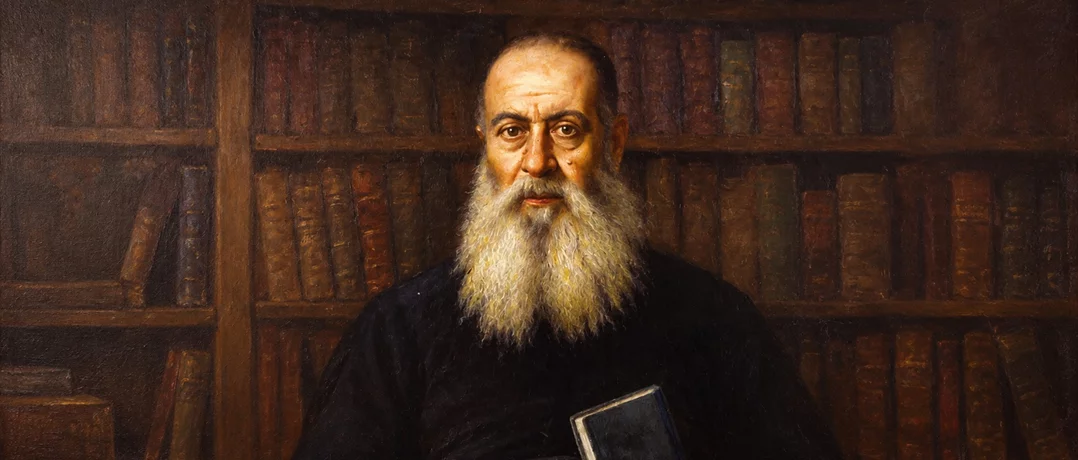
For most of the nineteenth century, painting in Mount Lebanon belonged to the Church. Until about 1900, most native painters learned informally, usually from monks. The “cleric-painters” Musa and Kanaan Dib had trained with Constantin Giusti, an Italian who came with the Jesuit missionaries in 1831. The first two decades of the twentieth century changed this. Painting became a profession with studios, clients, students and shops, and then war interrupted it.
According to Ramzi EL Hafez’s Anthology of Visual Arts in Lebanon, the late nineteenth and early twentieth centuries were the rise of a small circle of intellectuals and patrons who backed a nascent artistic culture. Beirut, increasingly cosmopolitan, became a hub of newspapers, printing presses and cultural associations. It had long drawn foreign Orientalists, and now it began to cultivate its own sons and daughters as creators. Their studios filled with portraits of notables, village and mountain landscapes, and religious scenes.
This first trained generation did not suffer the dislocation of later ones. Their style suited their surroundings, with church commissions, portraits of leaders and recognizable landscapes. Their art mastered universal techniques on local ground.
The professional studio
Daoud Corm (1852-1930) did the most to build this world. He trained in Rome, then painted for the Belgian royal family under Leopold II. After settling in Beirut in 1878, he courted the merchant class, and the Sursocks were among his first aristocratic clients. Scholars credit him with freeing Lebanese religious art from a local neo-gothic style and starting academic art-making in Beirut. In 1912 he opened Maison d’Art, an art supply store and studio near the post office, whose commercial success showed growing interest in making art as well as viewing it.
Habib Serour was his counterpart. Trained at the Accademia di San Luca in Rome, he became a sought-after portraitist for urban elites and Maronite clergy. His trade survived photography because a painted portrait in oil or pastel had become a mark of taste and social standing. In the 1910s, Alfred Sursock lent him space in his Beirut mansion for a studio.
Khalil Saleeby (1870-1928) had the most cosmopolitan training. He lived in Edinburgh, Paris and London before settling in Beirut in 1900, and studied under the symbolist Puvis de Chavannes. He opened an atelier on Bliss Street, beside his alma mater. The audience was used to devotional art and respectful portraits and was not ready for impressionistic explorations of color and light. AUB’s curators add that he also painted nudes at a time when such subjects faced cultural restrictions. He taught as much as he painted, and his students included Saliba Douaihy, César Gemayel and Omar Onsi.
Photography and the portrait market
Painters were competing with the camera, which is why Corm’s Maison d’Art later added a darkroom. Bonfils set up Beirut’s first photographic studio in 1867 and made photography a business. Lydie Bonfils kept the family studio running into the 1910s after her son left the trade in the early 1900s. Photography appears to have made painted portraits more of a status choice. Serour’s biographer notes that as photography grew cheaper, an oil or pastel portrait signaled taste and social standing. Photography also shaped how artists thought about likeness and the faces, places and moments.
Some of the era’s key training happened overseas. Gibran studied in Paris from 1908 to 1910, funded by Mary Haskell. There he met the sculptor Youssef Howayek, and the two studied under Rodin in 1909-1910. Gibran then settled in New York in 1911 and exhibited at the Montross Gallery in 1914 and at Knoedler in 1917.
The war cut the work short. The locust plague of 1915 helped trigger the Great Famine of Mount Lebanon, which killed nearly half the Mutasarrifate’s inhabitants between 1915 and 1918. In Beirut, Djemal Pasha hanged men in the square later named Martyrs’ Square. Art still found work under Ottoman rule. Serour taught at the Imperial Ottoman School of Bashoura, because officials needed people who could do topographic and architectural drawing. After the war he mentored Moustafa Farroukh and Omar Onsi.
Without the pioneers’ pursuit of mastery, their training abroad and their return to apply it in Lebanon, the twentieth-century flowering would not have happened. To this day, their works remain scattered across churches, family collections and museums as emblems of a profound artistic past.
-
-

-
The Beiruter
-
