



More than 33,000 people remain in shelters across Lebanon as authorities work to balance school reopening, safe returns, and long-term recovery amid a fragile ceasefire.
Lebanon’s displacement crisis: Over 33,000 still in shelters
Lebanon’s displacement crisis: Over 33,000 still in shelters
By Vanessa Kallas | July 21, 2026

Reading time: 6 min
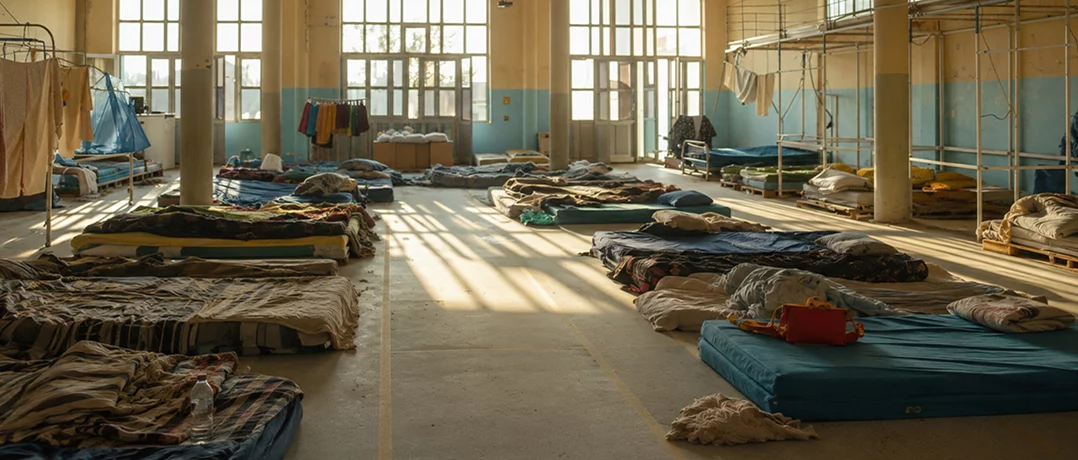
In a displacement shelter in Bechtelida, in the Jbeil district, Amal*, 30, has relied entirely on shelter aid since the war destroyed her modest family business. “There is no income for the family since the café we depended on was destroyed,” she says. Like many displaced people, Amal fears the shelter will close before she and her three children have anywhere else to go.
During the school year, that precarity extended to her children's education: with only one mobile phone between them, her youngest daughter, four, stopped attending school altogether, while the older children logged on when the device was free and the signal held. “It was hard for the children to keep up with school with only one phone,” she says.
Her story is one of many emerging from Lebanon’s displacement crisis after the ceasefire took hold in mid-April 2026, following weeks of Israeli strikes that began in early March. More than 1.2 million people were displaced at the crisis’s peak, and tens of thousands of housing units were destroyed or damaged. Many still cannot go home, either because their houses were destroyed or because Israeli forces remain deployed inside Lebanese territory. As of July 9, 325 collective shelters nationwide were still housing 33,343 people, according to the according to the UN Office for the Coordination of Humanitarian Affairs(OCHA), down sharply from earlier in the crisis as returns have accelerated.
School shelters, and a generation caught in between
With half the summer already gone, Lebanon’s schools are due to reopen in September. For displaced students, and for students whose own schools spent the war sheltering other families, what that return will look like remains an open question.
For much of the crisis, Lebanon’s public schools carried the weight of the emergency response. Dr. Hilda Khoury, Director of Counselling and Guidance at the Ministry of Education and Higher Education (MEHE), said public education facilities were placed at the disposal of the national response. “In the absence of alternative public infrastructure that could be rapidly mobilized nationwide, public schools became the primary facilities for receiving and accommodating internally displaced people,” she said. As of mid-July, 175 MEHE facilities remain in use, hosting close to 17,000 people; 22 private schools shelter nearly 4,000 more.
The educational toll is harder to pin down, but Khoury says the ministry tracked learning modalities closely: in war-affected areas, roughly 23 percent of students relied on online instruction, 54 percent continued on-site, and 6 percent attended alternative locations. MEHE built a digital app to map displaced students and teachers, whitelisted platforms like Microsoft Teams to spare mobile data, and redistributed laptops to those most in need.
Crucially, Khoury said MEHE isn’t planning to simply wait out the crisis. Working with the Emergency Operations Room, the Ministries of Social Affairs and Interior, and humanitarian partners, MEHE has developed a plan to progressively empty schools of displaced families, “enabling schools to be handed back for educational use.” Implementation is expected soon, though its pace depends on how quickly suitable housing becomes available.
Falling through the cracks
However, the gap between policy and reality is sharpest for the most vulnerable: children with disabilities, orphaned dependents, and those with chronic health needs a shelter cannot meet.
In a school turned shelter in Hazzerta, Bekaa, 13-year-old Lina* has a severe physical disability, is non-verbal, and depends entirely on her family for care. She was forced to stop attending school because of her disability; her family says a specialized school could help her, but no steps have been taken to enroll her anywhere.
In another shelter, Khalil* is raising twelve family members alone, ten of them children, including two nephews he took in after his brother’s passing. The war forced him to pull all the children out of school, and his finances have kept them out since. Khalil lives with a physical disability, having lost the fingers of one hand. “We depend almost entirely on assistance, and it is not enough for a family our size,” he says.
Inclusion has been a stated priority of the ministry’s response. Khoury said MEHE’s National Inclusive Education Programme was supporting 6,029 learners with special needs across 180 schools as of April 2026, mobilizing psychologists and referring learners for therapy. But those systems haven’t reached everyone: Lina and Khalil’s children, still outside the school system, show how far implementation lags behind policy.
Recovery plan for a safe return
Getting families out of shelters depends not only on housing; but also on where it’s safe to send them. According to Cynthia Bakkalian, a disaster risk analyst at the UN Development Programme in Lebanon who works with the Ministry of Social Affairs, “the Government of Lebanon is currently developing a comprehensive return and recovery plan to ensure the safe, dignified, and orderly return of internally displaced persons, where conditions allow.” A shelter consolidation plan is also being developed, she added, with the Ministries of Education, Interior, and Social Affairs, “part of broader efforts to establish a more organized shelter system,” the same plan Khoury described.
Roads before homes
The safe return of displaced individuals to their homes also depends on the infrastructure. Rana El Hage, Media Advisor to Lebanon’s Minister of Public Works and Transport, was candid about how limited that effort remains. “Up to this point, the Ministry has not been able to do anything beyond implementing the ‘Reconnecting Lebanon’ plan, which consists of clearing debris from the roads so that people can travel and reach their homes,” she said. Crucially, the ministry is only pushing debris aside, not removing it; it remains legally the property of homeowners. “Some areas are still being bombed, and there is still no full ceasefire, which means we do not have complete freedom of movement,” El Hage said, noting some reopened roads have since been struck again.
What comes next
Lebanon’s ceasefire remains fragile, and officials are candid that a full, lasting truce, not just a pause in fighting, is what recovery now depends on. El Hage said road crews have reopened stretches only to see them struck again, and that freedom of movement cannot begin until hostilities fully end. Khoury said MEHE has strengthened its Education in Emergencies contingency plan precisely because renewed displacement cannot be ruled out.
That uncertainty is why this phase matters. A consolidation plan exists to move families out of classrooms; a return plan exists to send them home; an inclusion framework exists for the most vulnerable. What's needed now is funding, coordination, and follow-through before another escalation resets the clock. Whether displaced families spend another winter in shelters, or go home, depends on what happens next.
-
-

-
Vanessa KallasJournalistCovering socio-political, environmental, and human rights issues.
-
