

Lebanon’s private generator tariffs rose nearly 60% in six months, exposing the growing financial burden of an unreliable public electricity system.
Lebanon’s electricity crisis: Generator bills surge in August
Lebanon’s electricity crisis: Generator bills surge in August
By Christiane Tager | September 10, 2026

Reading time: 8 min
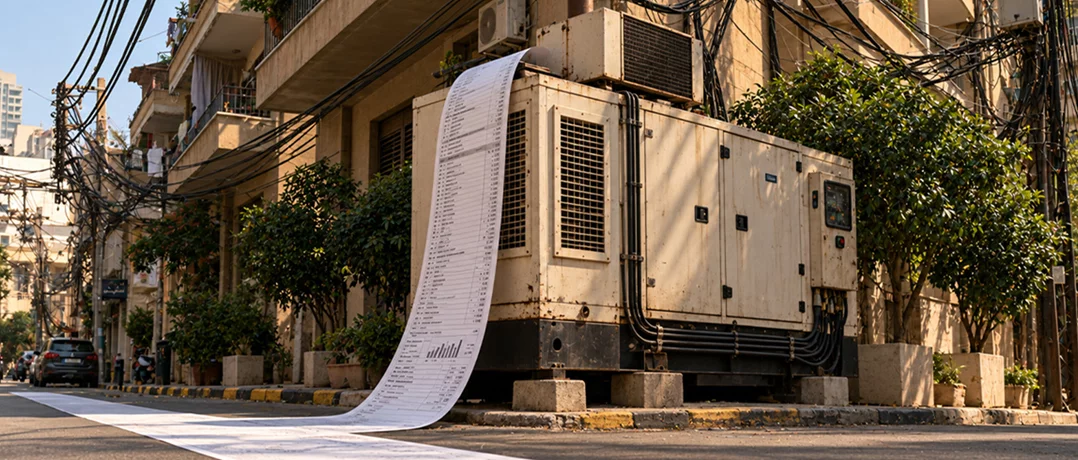
Private generator tariffs rose 19% in a single month and are now almost 60% higher than in February. The increase reflects rising diesel costs, heavy summer
demand and a drop in state electricity production. Generator owners, however, argue that the official pricing formula still underestimates their real operating costs, while the government warns that some operators may be taking advantage of households’ dependence on private power.
For Lebanese households, the summer of 2026 has come with a steep additional cost and much of it is showing up on electricity bills.
As temperatures climbed, air conditioners ran for longer, while public electricity supplies deteriorated in August. At the same time, the cost of relying on neighborhood generators rose sharply.
The official price of a kilowatt-hour increased from LBP 40,746 in July to LBP 48,241 in August, an increase of 18.4% in a single month. In February, the rate stood at just LBP 30,244, meaning that the official tariff has risen by almost 60% in six months.
For many households, the question is no longer simply how much electricity costs, but how much of their monthly income it consumes.
From LBP 30,244 to LBP 48,241: almost 60% higher in six months
The trajectory of electricity tariffs illustrates the scale of the shock.
In February 2026, the Energy Ministry set the price of a kilowatt-hour at LBP 30,244. After a sharp increase linked to higher oil prices and regional tensions, tariffs began to ease during the spring.
By July, the official rate had fallen to LBP 40,746 in coastal and densely populated areas.
August reversed that trend.
The official tariff reached LBP 48,241 per kWh, up 18.4% from July and almost 60% from February. It was the highest level since April.
The increase also came on top of rising household consumption.
Diesel: the main driver behind the increase
Fuel costs are one of the clearest explanations for the higher tariff.
According to the figures used in the ministry’s pricing formula, the price of diesel rose from around $22.2 for 20 liters in July to nearly $27 in August, an increase of about 22%. The price of mazout used in the ministry’s calculations also increased from $1,183.25 to $1,270.04 per ton, or roughly 7.3%.
The mechanism is relatively straightforward: when fuel becomes more expensive, producing each kilowatt-hour costs more, pushing up the official generator tariff.
The Ministry of Energy said its August calculation was based on an average diesel price of LBP 2,415,495 per 20 liters. Its formula also takes into account fuel distribution costs, oil and filter replacement, generator depreciation and the average monthly exchange rate, which stood at LBP 89,700 to the dollar.
But generator operators say this does not tell the whole story.
Generator owners: “The official calculation does not cover our real costs”
Generator owners have pushed back against the government’s criticism, arguing that the official tariff does not fully reflect the cost of keeping their networks running.
According to sources in the syndicate of generator owners, generator operators have been contesting the ministry’s underlying calculation for more than a week. They argue that the cost of producing a kilowatt-hour is closer to LBP 5,900–6,000 than the roughly LBP 5,200 figure used by the ministry.
Their argument is that fuel is only one component of the business.
Operators also have to cover maintenance, oil and filters, spare parts, generator wear and tear, fuel transportation and distribution, as well as the costs associated with operating and maintaining local electricity networks.
The Ministry itself acknowledges that its official formula includes operating and maintenance costs, as well as a profit margin for generator owners. But the dispute is ultimately over whether those assumptions accurately reflect the costs generators face on the ground.
In other words, generator owners see the August increase not as an opportunity to raise prices arbitrarily, but as the unavoidable consequence of higher fuel and operating costs.
That argument, however, does not give operators a free hand.
The government’s position is that a genuine increase in costs is legitimate but that it should already be reflected in the official monthly tariff.
Air conditioners are running while public electricity production is falling
August is traditionally one of the most expensive months for Lebanese households.
High temperatures drive electricity consumption sharply higher, particularly through air conditioning. Yet at the same time, Électricité du Liban (EDL) experienced a significant decline in production during August because of delays in fuel supplies. The result is a double squeeze.
When the public grid supplies less electricity, households turn more heavily to private generators. And when temperatures rise at the same time, they consume more electricity from those generators.
This is precisely how an increase in the price per kilowatt-hour can turn into a much larger monthly bill.
What does a generator actually cost a household?
Consider a household with a 5-ampere subscription in an urban area.
The fixed monthly charge is LBP 385,000, to which the household pays LBP 48,241 for every kilowatt-hour consumed.
At 250 kWh of monthly consumption, the total bill comes to roughly LBP 12.45 million.
At the ministry’s exchange rate of LBP 89,700 to the dollar, that is approximately $139.
For households relying heavily on air- conditioning, consumption can easily go higher.
At 300 kWh, for example, the variable component alone reaches around LBP 14.47 million, before the fixed subscription fee is added.
The government’s concern is that households should not be paying more than the official calculation already allows for particularly through additional charges imposed by operators.
A generator bill can consume almost half the minimum wage
The comparison with household incomes makes the burden even more striking.
Lebanon’s official monthly private-sector minimum wage currently stands at LBP 28 million, after being raised from LBP 18 million in August 2025.
A generator bill of approximately LBP 12.45 million therefore represents around 44% of the minimum monthly wage.
For a minimum-wage worker, that means almost half of a month’s income could be consumed by electricity alone under a relatively high-consumption scenario.
And that comes before housing, food, transportation, water, telecommunications, medicines or school fees.
This is why the generator issue is increasingly an economic and social question, rather than simply an energy problem.
Why is the government talking about “profiteering”?
The government does not dispute that some increase in generator costs is legitimate.
Economy Minister Amer Bsat said the rise was “real and justified” where it reflected higher mazout costs. But he also warned that the increase did not give operators the right to exploit households’ dependence on electricity.
The authorities are particularly concerned about operators charging additional fees to customers on fixed-rate subscriptions, who may not have meters, or about possible manipulation of installed meters.
The government has therefore launched a nationwide inspection campaign in coordination with security forces.
The objective is to determine whether operators are charging beyond the official tariff or adding costs that should already be covered by the ministry’s calculation.
The official tariff is not negotiable
For August, the official rate in cities, densely populated areas and locations below 700 meters was set at LBP 48,241 per kWh.
In villages, sparsely populated areas and locations above 700 meters, the rate rises to LBP 53,065 per kWh, around 10% higher.
For Economy Minister Bsat, the official tariff “is not a proposal”, while the installation of meters “is not an option”. He said operators cannot unilaterally add fees or surcharges to household bills.
A private market that has become indispensable
Lebanon’s electricity paradox is now well established: private generators are both indispensable and increasingly expensive.
For decades, they have filled the gap left by structural shortcomings in EDL’s generation capacity. Their role has become particularly important whenever the public grid cannot provide sufficient electricity.
But the neighborhood-based structure of the generator market also creates a difficult economic dynamic.
In many areas, households have little or no alternative.
The local generator effectively becomes the only reliable electricity supplier during periods of public-grid outages.
That gives operators significant bargaining power and explains why the government is now seeking tighter oversight.
A dispute over costs but also over the model itself
The argument between generator owners and the government ultimately comes down to a question of who is right about the cost of electricity.
Generator owners argue that the official calculation underestimates their real cost base and that a higher kWh price is necessary to keep their businesses viable.
The government counters that the official formula already incorporates fuel, maintenance, operating expenses and a profit margin, and that operators should not use higher costs as a justification for additional charges.
Both sides, however, agree on one point: fuel prices have risen sharply, and that increase inevitably feeds into the cost of generation.
The disagreement is over how much of that cost households should bear and whether the official formula accurately captures the economics of running thousands of private generators across the country.
The deeper problem goes beyond August’s bill
The August spike exposes the fragility of Lebanon’s energy model. When oil prices rise, electricity costs rise. When public electricity production falls, dependence on generators increases. When temperatures climb, consumption rises. And when all three happen at once, household electricity bills can surge. The problem is therefore structural.
As long as the public grid remains unreliable and the necessary investment in generation, transmission and distribution is not made, private generators will continue to play a central role in Lebanon’s economy.
One electricity bill, a snapshot of Lebanon’s energy crisis
The August increase is striking: 18.4% in a single month and almost 60% since February. But behind those percentages lies a much more tangible reality.
For a household consuming 250 kWh with a 5-ampere subscription, the monthly generator bill can exceed LBP 12 million around 44% of the official minimum monthly wage of LBP 28 million.
The government is now moving to crack down on operators who impose unjustified charges, while generator owners insist that their own cost base is being underestimated.
Both arguments point to the same underlying weakness. The long-term solution cannot simply be tighter control of private generators.
It lies in Lebanon’s ability to generate enough electricity, modernise its grid and gradually reduce its dependence on a private system that became essential because the public one could not reliably meet demand.
For Lebanon in 2026, the price of electricity measures more than the cost of energy. It also measures the economic cost of a public service that has yet to become reliable.
