



The Trans-Arabian Pipeline once embedded Lebanon in global oil flows, but its collapse helped shift the country from a transit hub to an import-dependent economy exposed to price shocks and conflict.
Lebanon’s forgotten oil line

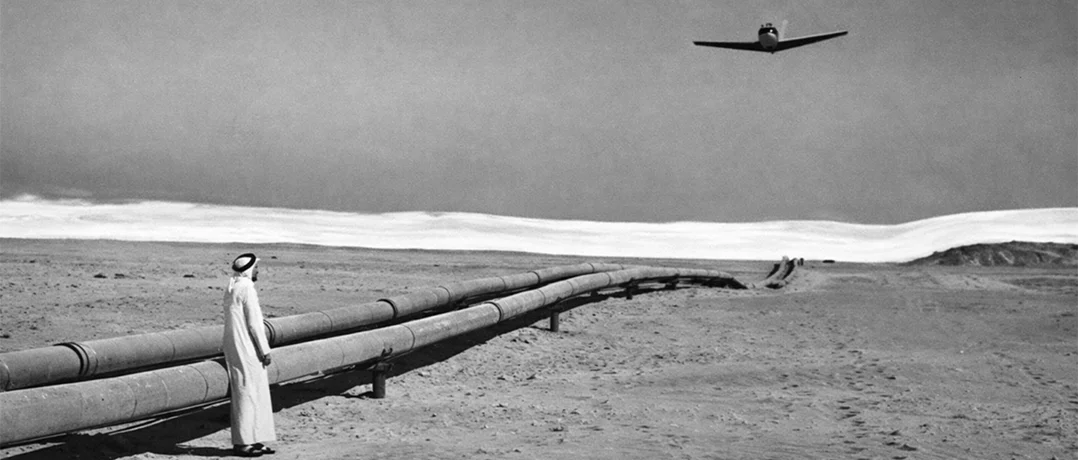
Long before today’s war-driven disruptions to energy routes, Lebanon sat at the western end of the Trans-Arabian Pipeline (Tapline), a corridor that carried Gulf crude oil from eastern Saudi Arabia to the Mediterranean through Sidon. Constructed between 1947 and 1950 by a consortium led by Saudi Aramco, the pipeline stretched more than 1,600 kilometers across Saudi Arabia, Jordan, Syria, and into southern Lebanon.
At the time of its completion, Tapline was one of the longest pipelines in the world and a critical component of postwar oil logistics. By transporting crude directly to the Mediterranean, it reduced reliance on longer tanker routes around the Arabian Peninsula, lowering shipping time and cost for exports to Europe. At its peak, the pipeline carried close to 500,000 barrels per day, linking Gulf production to global markets through Lebanese territory.
For Lebanon, this positioning mattered. The pipeline terminated near Sidon’s Zahrani facilities, where crude was stored and loaded onto tankers. Transit fees, port activity, and associated services tied Lebanon into a broader regional energy system. While not a producer, Lebanon functioned as a conduit within the infrastructure that moved oil across borders.
The economics of a transit state
Tapline’s significance for Lebanon lay less in volume than in function. It placed the country within a system where economic value came from transporting, storing, and exporting oil rather than producing it. In the early decades after independence in 1943, this role aligned with Lebanon’s wider economic model, which cast the country as a service-oriented economy built on trade, finance, and transport and logistics.
Pipeline transit generated revenue through fees and supported ancillary sectors, from port operations to storage and shipping. While precise revenue figures are limited, Aramco records point to sustained high-volume throughput that anchored activity at the Sidon terminal. More broadly, it reinforced Lebanon’s position linking Gulf production to Mediterranean markets at a time when global oil demand was expanding rapidly, rising from roughly 10 million barrels per day in 1950 to more than 45 million by the early 1970s, according to International Energy Agency data.
But transit systems depend on coordination. Academic research on Tapline, including work published in the International Journal of Middle East Studies, shows that its operation required stable agreements across multiple states on transit fees and maintenance. By the 1960s and 1970s, as disputes between transit states intensified and interruptions became more frequent, those conditions eroded. Syria periodically shut down sections of the pipeline over fee disagreements, while broader instability increased operational risk.
At the same time, the economics of oil transport were shifting. The expansion of very large crude carriers (VLCCs) sharply reduced per-barrel shipping costs by sea, making maritime transport increasingly competitive. As those cost advantages narrowed, Tapline’s relevance declined. By the early 1980s, flows to Lebanon had largely ceased, and its role within that export system disappeared.
From infrastructure to absence
The decline of Tapline was gradual, but its implications were lasting. As flows decreased, Lebanon lost not just a revenue stream, but a role within the regional energy system. The infrastructure that once connected it to Gulf production and European markets fell into disuse, and no comparable system replaced it.
This absence is visible in Lebanon’s energy profile today. Unlike neighboring states, the country produces virtually no oil or gas and relies heavily on imports to meet demand. According to World Bank and national data, the country imports the vast majority of its fuel, with hydrocarbons accounting for roughly a quarter of the import bill in recent years.
Electricity generation remains tied to fuel oil and diesel, with limited domestic capacity. A 2023 UN energy assessment describes a system marked by persistent supply gaps, deteriorating infrastructure, and heavy reliance on imported fossil fuels, leaving it highly exposed to global price fluctuations.
The contrast with Tapline is stark. Where Lebanon once facilitated the movement of energy across borders, it now sits as an end consumer, absorbing price shocks rather than mediating them.
Energy systems under strain
That vulnerability has been amplified by Lebanon’s broader economic collapse. Since 2019, the currency has lost more than 95 percent of its value, while GDP has contracted by over a third, according to the World Bank.
The energy sector has been particularly affected, driven by limited generation capacity and near-total dependence on imported fuel oil and diesel. World Bank and UN assessments note that public supply is routinely supplemented by private generation. With fuel imports dependent on scarce foreign currency, the system remains highly exposed to global price swings and supply disruptions.
Recent conflict dynamics have compounded these pressures. Periods of escalation have coincided with slowdowns in economic activity and disruptions to trade flows. As global oil markets tighten amid the Israel-Iran war, Brent crude has surged above $100 per barrel at points of disruption, raising fuel costs across import-dependent economies. For Lebanon, that translates directly into higher energy bills and increased volatility.
A system that unraveled
Tapline’s history offers a reminder that Lebanon’s current position was not inevitable. For a period, the country was integrated into a regional system that moved energy across borders, linking production zones in the Gulf to consumption markets in Europe.
Today, as new energy routes are contested and reshaped under the pressure of conflict, Lebanon’s experience with Tapline underscores a broader point. Infrastructure determines not only how energy moves, but who participates in that movement. In losing its place along that line, Lebanon lost a role within the system itself.
-
-

-
The Beiruter
-
