



Tyre and Saida’s neglected ports face decline, making their revival vital for Lebanon’s southern economy.
Lebanon’s forgotten southern ports

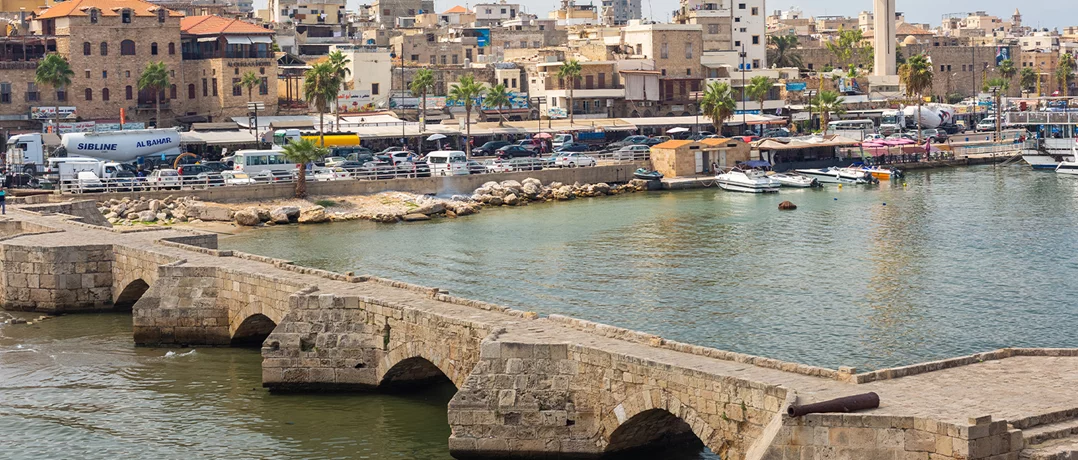
Reviving Tyre and Saida’s Maritime Potential
The economic marginalization of Lebanon’s ports beyond Beirut does not end with Tripoli. To the south of the capital lie two additional maritime gateways whose potential remains largely untapped. Tyre, once the beating heart of the Phoenician trade network, and Saida, the principal port of southern Lebanon, both suffer from chronic neglect and political underinvestment. As a result, Lebanon’s port network operates far below its capacity, constraining development in regions that depend heavily on maritime access.
Tyre: At the Crossroads of Ancient Trade
Few ports along the eastern Mediterranean embody a maritime legacy as enduring as Tyre’s. Originally a fortified island 800 meters offshore, Tyre rose to prominence as a leading Phoenician city-state, famed for its purple dye and expansive trade routes. By the late 19th century, however, as Beirut increasingly became the center of Ottoman economic life, Tyre’s role faded overshadowed by regional rivals, particularly Saida.
A Blockaded, Underfunded Port
Today, Tyre’s port is drastically limited in commercial function and scale compared to Beirut, Tripoli, or Saida. While Tyre may never become a major commercial hub, its economy has been hit hard by two factors:
Israel’s intermittent naval blockade
Decades of underinvestment in fishing infrastructure
Since the Israeli withdrawal from southern Lebanon in 2000, disputes over maritime boundaries have repeatedly disrupted fishing activities. Electricity shortages, inadequate storage facilities, and outdated equipment further undermine local fishermen.
Veteran fishermen Haidar Istambouli and Haysam Salman described a sector on the brink. Due to current restrictions, boats are confined to fishing within a 30 km radius of the port. Naqoura, home to some of Lebanon’s richest fishing grounds, is off-limits, especially at night.
“First warning: flare. Second warning: shots in the air,” Istambouli explained, before mimicking direct fire as the third response.
Most fishermen avoid the area entirely, fearing confrontation. With Tyre’s own fish populations already limited, earnings have collapsed: revenues of $300–$400 a month before the war have dropped to $150–$200 today.
Tourism, once a crucial contributor to Tyre’s economy, has also dwindled. Istambouli attributes the decline to the perception that Hezbollah exercises full control over the city, discouraging visitors since around 2015.
Without targeted investment to modernize the port, Tyre’s fishing culture risks extinction. With the naval blockade unlikely to ease soon, economic recovery will remain distant unless the port receives immediate, sustained support.
Saida: From Phoenician Port to Regional Hub
Saida, Lebanon’s third-largest city, shares Tyre’s Phoenician legacy. Known in antiquity as Sidon, it served as a major maritime power by the 2nd millennium BCE. Like Tyre, its prominence was gradually eclipsed by Beirut in the modern era.
Today, Saida’s port contributes only modestly to Lebanon’s maritime economy. Customs data from 2020–August 2025 show that Beirut accounts for nearly 60% of imports and 50% of exports, while Saida handles just 1–3% of total trade.
Stalled Development
The most significant modernization plan dates back to 2013, when a two-phase port expansion was launched. Phase I, delivered in 2015, added a new quay, dock, and one-kilometer jetty. Phase II was expected to finish by 2020. Instead, bureaucratic paralysis and diminished political will have left the project frozen.
Environmental Pressures and Uneven Growth
At Saida’s port, fishermen Kamal Samak and Bilal Qirsh, now in their 45th year at sea, describe worsening conditions not due to war, but to environmental stress and port expansion.
“Khalid El Quros,” introduced by peers as “the captain,” explained how construction damaged spawning grounds:
- Sand beds vital for egg-laying were removed during expansion
- Fish continue to return to the same grounds, but reproduction now fails
- Species such as Sultan Ibrahim have sharply declined
- Others have disappeared entirely
“If 3 million eggs are laid each year, only 1 million survive,” El Quros noted.
The commercial port’s growth has increasingly jeopardized the fishing sector, a tension evident across the waterfront.
Political activist Mohammad El Baba offers a broader view on Saida’s deteriorating fishing conditions:
- Small-mesh nets cause overfishing, eliminating juveniles before maturation
- Fishermen from neighboring towns reportedly engage in dynamite fishing, killing entire schools to collect a fraction of the catch
- Sewage pollution from the Awali and Zahrani rivers damages marine life
- Traffic emissions from major transit routes add to marine contamination
Waste management failures have intensified the problem. The long-infamous “trash mountain,” once rehabilitated in 2012, returned after Saida became a dumping site for one-third of Beirut’s waste in 2016. Payments promised to the municipality remain incomplete, while pollution again harms coastal waters.
A Port with Real Potential
Despite the setbacks, El Baba remains cautiously optimistic:
A strong commercial port would:
- Boost regional trade
- Reduce Beirut’s overload
- Improve access for southern markets
While the fishing industry is economically small, Lebanon imports ~90% of its seafood it remains vital for local livelihoods. With proper planning, Saida’s commercial expansion can coexist with a protected and modernized fishing sector.
A System Built on Selective Investment
Taken together, Tripoli, Tyre, and Saida reveal a national pattern:
Lebanon’s ports are not underdeveloped by accident but by design.
Successive governments have concentrated maritime commerce in Beirut to centralize political and economic power. This strategy has starved regional ports of investment, deepened economic disparities and restricted national competitiveness.
Unless Lebanon rethinks this model diversifying and decentralizing its maritime economy its coastal cities will remain unable to harness the full potential of their ports, histories, and communities.
-
-

-
Katharine SorensenReporterSpecializing in global affairs, technology and economics, with a focus on on-the-ground investigative reporting.
-
