



Lebanon’s 2026 campaign to move subscribers from unauthorized internet networks to licensed providers faces questions over its scale, enforcement and impact on competition and consumers.
Lebanon’s illegal internet market faces a government crackdown
Lebanon’s illegal internet market faces a government crackdown
By Christiane Tager | November 04, 2026

Reading time: 6 min
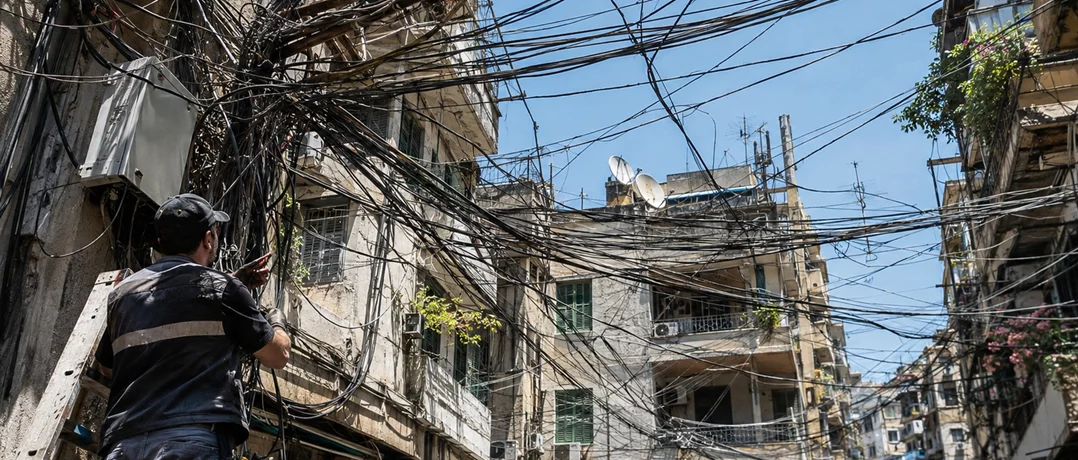
With more than nine in 10 people in Lebanon using the internet, unauthorized networks remain a major challenge for regulators. After years of growth in neighbourhood distribution networks operating outside the regulatory framework, the state has launched a new drive in 2026 to bring subscribers under licensed operators. The scale of the problem, however, remains unclear, as does the campaign’s ability to restore fair competition.
Internet access in Lebanon is provided by several players, including state-owned Ogero and the Ministry of Telecommunications, licensed internet service providers, and mobile operators Touch and Alfa, which offer data services over 3G and 4G networks.
Alongside these official providers, neighbourhood distributors supply internet connections to households and businesses, particularly in areas where existing infrastructure and services do not always meet local demand. Some of these networks operate without the required licences or permits, placing them outside the normal regulatory framework.
According to figures cited in earlier industry reports, unauthorized distributors account for about 60 per cent of the market. The figure should, however, be treated with caution. Available public data do not establish whether it refers to subscribers, connection volumes or the total number of providers. It therefore cannot, on its own, be considered an independently verified measure of the current scale of Lebanon’s illegal internet market.
The stakes are considerable. According to Data Reportal’s Digital 2026: Lebanon report, the country had approximately 5.38mn internet users at the end of 2025, equivalent to an internet penetration rate of 91.8 per cent. Around 483,000 people, or 8.2 per cent of the population, remained offline. Internet access has become essential to communications, education, employment and economic activity.
How does the system work?
Under the legal framework, licensed providers offer services to customers in accordance with applicable authorizations, using infrastructure and wholesale services permitted by regulation.
Problems arise, in particular, when intermediaries purchase internet connectivity from an authorized operator and then resell it in a neighbourhood or village without holding the necessary licences or permits themselves. Other unauthorized networks may also operate entirely outside the official framework.
Such arrangements can take hold in areas where consumers have few alternatives. They may leave subscribers dependent on a single local distributor, restrict consumer choice and make it harder for regulators to monitor service quality, pricing and compliance with financial obligations to the state.
The issue is therefore not simply the installation of cables or antennas without authorization. It also concerns the structure of the market: who owns and operates the networks, who is permitted to sell internet services, which rules apply to providers and how consumers can be guaranteed a genuine choice.
2026: regulators move to enforce the rules
The issue is no longer confined to discussions of possible reform. Concrete measures have been introduced in 2026.
On February 5 2026, Lebanon’s Telecommunications Regulatory Authority (TRA) adopted Decision No. 4/2026, aimed at ending the operation of unauthorized internet networks. The decision requires licensed providers to transfer affected subscribers to authorized networks, including through the infrastructure of the Ministry of Telecommunications and Ogero, or via licensed data service providers.
The framework also seeks to ensure continuity of service and prohibits additional charges being imposed on subscribers solely as a result of the migration.
The decision further requires weekly reports detailing the number of subscribers transferred, the locations and infrastructure of unauthorized networks, and fees owed to the Treasury. Licensed operators that fail to comply may face sanctions, including the suspension or withdrawal of their licences.
On September 23 2026, the TRA announced the operational launch of the process to regularize subscriptions and transfer users to authorized networks. The initiative is being carried out in co-ordination with licensed providers and judicial and security authorities.
The first phase targets subscribers connected to unauthorized networks in areas served by 10 Ogero exchanges: Achrafieh, Hamra, Badaro, Adlieh, Mina El Hosn, Ras Beirut, Baabda, Hazmieh, Tripoli – El Mina and Tripoli – El Bahsas
Affected subscribers have been urged to contact their existing provider or a licensed operator to begin the necessary procedures and avoid a possible interruption to their service.
The list does not mean that the problem is confined to these 10 areas. Decision No. 4/2026 also provides for measures in other locations where official fibre-optic networks are already deployed or are being rolled out.
What will it take to bring the market into the legal framework?
Closing unauthorized networks is only part of the solution. The authorities must enforce the rules while ensuring that subscribers retain access to reliable, affordable and uninterrupted internet services.
First, regulators need to identify the networks and their subscribers. Authorities require an accurate map of unauthorized installations, their coverage, subscriber numbers and regulatory status. The weekly reporting requirements under Decision No. 4/2026 provide an important monitoring mechanism.
Second, subscribers must be transferred to licensed providers. Migration should take place without unjustified service interruptions or additional costs imposed on consumers as a direct result of the transfer. This would help restore compliance without penalizing households that rely on these connections for everyday activities.
Third, competition must be strengthened. Regularization will be sustainable only if subscribers can choose between several providers, regardless of where they live or work. This requires adequate network coverage, fair access to infrastructure and effective oversight of pricing practices.
Fourth, sanctions must be enforced. Networks that continue to operate outside the legal framework should face proportionate measures, while licensed providers must fulfil their regulatory obligations. Without effective monitoring and consequences for non-compliance, the campaign risks falling short of its objectives.
Transparency will also be crucial. Publishing data on the number of subscribers transferred, the networks brought into compliance, additional revenue collected by the Treasury and any service interruptions would allow the public to assess the policy’s actual impact.
The challenge: turning enforcement into measurable results
The measures introduced in 2026 suggest that the authorities are moving beyond simply acknowledging the existence of unauthorized networks. Decision No. 4/2026 establishes a framework for migration and oversight, while the operational launch announced in September marks a further step towards enforcement.
Nevertheless, the public information reviewed does not establish with certainty the current share of the market served by unauthorized networks, the total number of subscribers already transferred or the additional revenue actually recovered by the state.
The campaign’s success will ultimately have to be measured against tangible outcomes: a reduction in the number of illegal networks, an increase in the number of subscribers served legally, affordable prices, improved service quality and a more competitive market.
In a country where more than 90 per cent of the population now uses the internet, the issue extends well beyond licensing. It concerns the governance of essential infrastructure, public revenue and consumer rights. The objective should not be to legitimize illegality without conditions, but to ensure that internet access operates under clear rules that are effectively monitored and consistently enforced.
