

In an exclusive interview with The Beiruter, former U.S. ambassador to Lebanon and veteran U.N. diplomat Jeffrey Feltman delivers a sobering analysis of the trilateral diplomatic Framework now shaping Lebanon’s precarious future.
Lebanon’s narrow opening

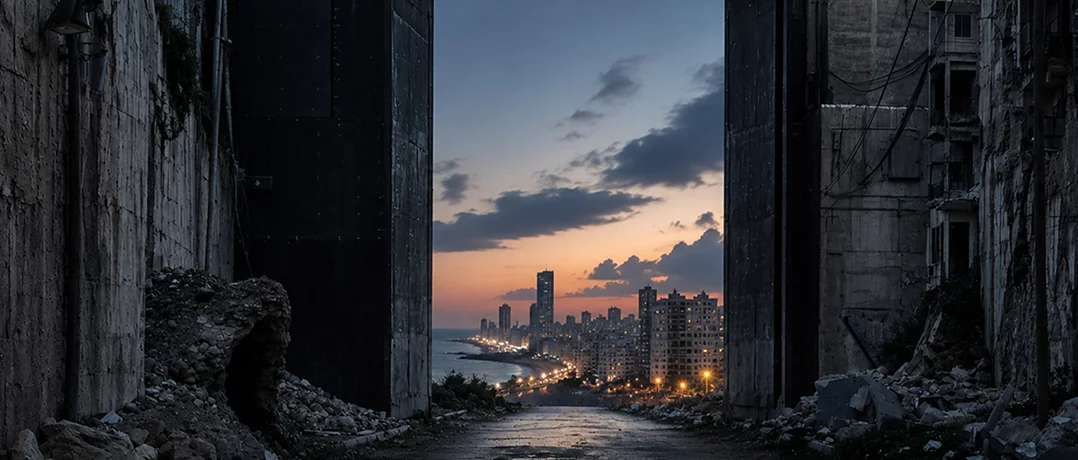
For much of the past half century, Lebanon has been acted upon more often than it has acted. Its territory has served as a theater for regional wars, a bargaining chip among stronger powers, and a convenient arena for foreign-backed militias to pursue ambitions the Lebanese state never authorized. In an interview with The Beiruter, Jeffrey Feltman offers a guarded but consequential argument: the pattern may finally be shifting. The trilateral agreement, he says, is important because “there’s been a fundamental shift” both inside Lebanon and in Washington’s attention. Lebanon, long “on the menu,” may for once be “at the table.”
That judgment matters because Feltman is not a casual observer. A former U.S. ambassador to Lebanon, assistant secretary of state for Near Eastern affairs, and United Nations under-secretary-general for political affairs, he has seen Lebanon from Washington, Beirut, and New York. He remembers the optimism of 2005, when Rafiq Hariri’s assassination and the March 14 uprising helped force Syria’s withdrawal. He also remembers what followed: Hezbollah’s expansion, the 2006 war, the capture of Lebanese institutions by armed coercion, and the long erosion of the state.
Feltman identifies two changes that give the trilateral track its unusual significance. First, a U.S. president is personally engaged on Lebanon in a way Feltman has not seen since George W. Bush worked with Jacques Chirac during the crisis that preceded Syria’s withdrawal. Second, Lebanon now has a president, Joseph Aoun, and a government led by Nawaf Salam willing to speak “honestly to the Lebanese people” about the risks of hosting an armed non-state actor. But Feltman’s optimism is deliberately limited. “President Trump has a notoriously short attention span,” he warns. Presidential backing matters but only if it lasts long enough for the Lebanese state to turn diplomatic opening into political fact.
Hezbollah: A weakened, but persistent threat
Feltman’s assessment is neither triumphalist nor sentimental. Hezbollah, he argues, has been badly weakened. “Three of the five pillars of support that Hezbollah had are gone”: Nasrallah’s personal authority, the Syrian land bridge once guaranteed by Assad, and the complicity of Lebanese governments that refused to confront Hezbollah’s state-within-a-state. Nasrallah’s successor, Naim Qassem, lacks the same stature. Syria is no longer an automatic logistical rear base. And Lebanon now has leaders willing, at least rhetorically and institutionally, to challenge Hezbollah’s presumption that it can decide questions of war and peace for the entire country.
But Hezbollah’s weakness is not Hezbollah’s defeat. The party remains capable of sabotage. It still has Iranian support, a hardened armed core, and a deeply rooted social presence among Lebanese Shia citizens who were neglected by the state and then told that Hezbollah alone could offer protection, jobs, services, dignity, and power. Feltman is blunt about the party’s destructive logic: Hezbollah’s weapons “create the very threat” they claim to prevent. Yet coercion is no shortcut. The Lebanese Armed Forces cannot simply be ordered to disarm Hezbollah by a deadline without risking institutional fracture and perhaps civil conflict.
The real opportunity is for the Lebanese state to occupy the space Hezbollah has exploited for decades. “The Lebanese government must be seen as providing compensation and reconstruction… not Hezbollah,” Feltman argues in substance. The lesson of 2006 is painful: Hezbollah moved faster than the state after the war and converted relief into renewed loyalty. Today, with Iran’s resources more constrained and the Lebanese government at least rhetorically committed to reform, Beirut has a narrow chance to show that sovereignty is more than a slogan.
This is the central tension in the interview: Hezbollah must be diminished, but the method matters. An Israeli occupation would not cure the Hezbollah problem; it could revive the conditions in which Hezbollah historically thrived. While Israeli security fears after October 7 are understandable, Feltman cautions that maximalist demands can become self-defeating. If Israel remains in Lebanese territory or treats the trilateral framework as cover for continued incursions, it will undercut the very state it claims to want empowered. Hezbollah, he notes, has long been most comfortable fighting occupation forces; Israeli hard-liners and Hezbollah, though enemies, can feed each other’s worst instincts.
The alternative Feltman sketches is slower and more plausible: shrink the space in which Hezbollah operates. That means cutting Iranian finance and supply channels, tightening border cooperation between Beirut and Damascus, restoring state authority over the airport and port, and policing financial networks. Above all, it means replacing Hezbollah’s social infrastructure with state capacity. If the state again arrives late, corrupt, or absent, Hezbollah will turn destruction into political renewal.
For Lebanon, reconstruction is not charity but a matter of sovereignty. Feltman argues that reforms, especially in electricity, compensation, government visibility, and anti-corruption, are essential tools to restore state authority and undercut Hezbollah’s appeal. Yet he warns that “there’s so many vested interests” in corruption that even modest reforms will face significant opposition, as corruption has thrived on, rather than merely coincided with, the state’s absence.
That is why Feltman’s argument is strongly anti-Hezbollah without being anti-Shia. He distinguishes between a community’s legitimate fears and a party’s destructive exploitation of those fears. Hezbollah’s genius was to fuse protection, patronage, identity, and Iranian strategy into a single political machine. Its failure is that this machine has repeatedly dragged Lebanon into wars decided elsewhere. The party claimed that its arms deterred danger; increasingly, those arms invite it. The Lebanese state’s task is not to humiliate Hezbollah’s constituency, but to prove that citizens do not need a proxy army to be safe, respected, and served.
The trilateral moment
The trilateral framework, in his reading, is not normalization in disguise, “at least not yet.” Feltman sees it primarily as a ceasefire architecture and security mechanism, one that could create pilot zones for Israeli withdrawal and Lebanese state deployment. Its success depends on verification.
Feltman delivers a scathing assessment of UNIFIL, calling some of its past reports “dishonest” for ignoring Hezbollah facilities. He is blunt: only robust “monitoring and verification” of the trilateral agreement can address the problem, not more conventional peacekeepers. Verification, he insists, must be two-sided: confirming both the removal of Hezbollah infrastructure and Israel’s withdrawal. He favors a mechanism with Security Council authority and public reporting to hold both sides publicly accountable.
Feltman contends that the shifting regional context now favors the Lebanese state, provided Beirut acts swiftly. He notes that Assad’s collapse has stripped Hezbollah of a permissive Syrian rear base. At the same time, Iran, in his words, “will not negotiate away Hezbollah,” remaining firmly committed to its Lebanese proxy. Feltman cautions that any sanctions relief or release of frozen funds could further strengthen Hezbollah. He observes that Syria’s interim government may be less threatening than the old Assad-Hezbollah axis, but distrust persists. Feltman adds that Turkey, the Gulf states, and Egypt are closely watching: none want Lebanon to become an Iranian satellite, but they are equally wary of Israeli hegemony replacing Iranian influence.
Shifting strategies
American attention is decisive. Feltman sees a rare moment in Washington, comparable in some respects to the Bush-Chirac focus on Lebanon in 2004 and 2005. External pressure alone did not end Syria’s occupation; nor did internal protest alone. It took both. Today, Lebanon needs the same convergence: U.S. engagement, a government willing to speak plainly, and a public that sees evidence of change. But “the window is only as wide as Washington’s attention span.” If American focus drifts, Israeli politics harden, or the Lebanese state fails to deliver, Hezbollah can recover.
Feltman’s interview is ultimately a warning against both fatalism and fantasy. Fatalism assumes Hezbollah is too entrenched to be challenged. Fantasy imagines disarmament can be imposed immediately by military pressure. “There is no exclusively military solution to Hezbollah,” his Brookings analysis stresses, and the interview reinforces the same point. The realistic path is to isolate Hezbollah, sever its external lifelines, deny it the benefits of Israeli overreach, and build a state that can eventually replace the party’s coercive welfare system. Hezbollah’s relevance has always depended on Lebanon’s weakness. If the state fills the vacuum, the militia’s claim to necessity begins to collapse.
For now, Lebanon’s opening is real but fragile. Hezbollah is battered, not broken. Its enemies have often strengthened it by misunderstanding how it survives. Feltman’s message is that slogans about sovereignty will win the contest ahead less than by proof of sovereignty itself: borders controlled, services delivered, reconstruction led by the state, corruption confronted, and arms returned-eventually, but unmistakably-to national authority. Hezbollah’s most dangerous weapon may not be its arsenal but the memory of a state that was absent. Lebanon’s challenge is to make that memory obsolete.
