

At USEK’s Agri-Food Hackathon, Lebanese students turn real industry challenges into innovative solutions, bridging education and entrepreneurship.
Lebanon’s next generation of entrepreneurs
Lebanon’s next generation of entrepreneurs
By Katharine Sorensen | March 17, 2026

Reading time: 10 min
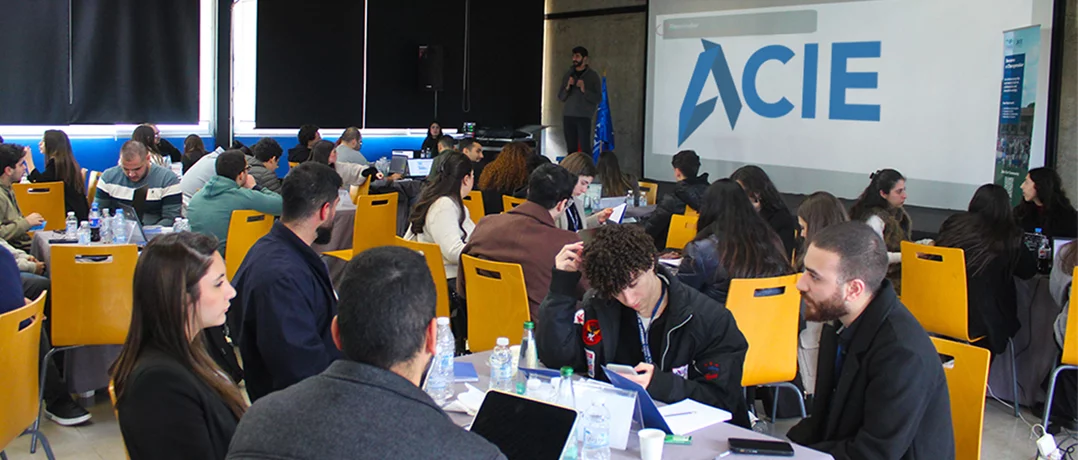
In a top-floor auditorium at the Holy Spirit University of Kaslik, two students step to the front of the room, glancing briefly at the presentation projected behind them.
“Water is one of the most precious resources in Lebanon,” the first begins. “And yet a significant portion of it is lost through inefficient irrigation.”
Seated several meters before them, a panel of judges, executives from some of Lebanon’s leading agri-food companies and industry experts, take notes as the students speak.
During the next three minutes, the students outline their proposal: a new irrigation system designed to reduce agricultural water waste through the use of agricultural hydrogel to improve soil water retention. A three-minute question session follows. How easily could the system be adopted by farmers already facing rising costs? What kind of infrastructure would be required to implement it at scale?
The pitch is one of sixteen delivered that afternoon as part of the Agri-Food Transformation Hackathon organized by the Asher Center for Innovation and Entrepreneurship (ACIE) in partnership with the Industrial Kingdom, where 86 students tackled real challenges from nine Lebanese companies: Adyar, Almaza, Berdawni, Debbane Agri, Del Libano, Zeit Boulos, Natura Spoon, Second House, and Mayrig.
What unfolded over those next three days was less a competition than a collaborative experiment linking students, mentors, and companies across Lebanon’s innovation ecosystem.
Bridging universities and industry
For organizers, the hackathon represents more than a student exercise. According to Dr. Nancy Saliba, the director of ACIE and one of the key driving forces behind the hackathon, the three-day event seeks to address a persistent challenge in higher education: how to translate academic knowledge into practical yet innovative solutions that companies can implement.
Lebanese businesses, she noted, are not only looking for graduates, but for problem-solvers and entrepreneurs capable of driving research and development and helping them innovate. “Students possess the necessary knowledge,” she said. “But the question is how to make them employable.”
Events like the Agri-Food Transformation Hackathon are designed to close that gap. By pairing student teams with company challenges, participants are exposed to the day-to-day complexities of problems businesses confront every day, while companies gain insight into the next generation of Lebanese talent.
The initiative is also part of a broader effort to strengthen Lebanon’s entrepreneurial ecosystem. Within the ecosystem, Saliba explained, universities supply much of the ecosystem’s energy, producing young innovators and entrepreneurs, while companies and investors provide the industry experience and resources needed to turn ideas into viable businesses.
Yet, according to Saliba, the key challenge lies in linking these actors into a coherent ecosystem. “The partners in the ecosystem exist,” she said. “But the connections between them are often weak.” Building those connections requires time, coordination, and the right institutional infrastructure. “You need tools, connections, and know-how,” she said. “Those are the building blocks.”
Central to that process is cultivating what Saliba calls an “entrepreneurial mindset,” one rooted in problem solving, design thinking, and creativity. During the event, students were therefore encouraged to approach the presented challenges from multiple angles, considering design, product development, and implementation simultaneously.
“We are not here just for theory,” she said. “We want the students to be creative and translate ideas into action.”
Learning beyond the classroom
For many students, the hackathon offered a rare opportunity to work directly on problems facing Lebanese companies and to test ideas against real-world constraints rarely encountered in the classroom. “It helps us build our CVs, but more importantly it teaches us how to think through a real problem,” one student said.
For many, the motivation was also personal. “It’s rewarding to feel like you can help,” one participant said. “Especially when it’s for companies here in Lebanon.”
Mentors played a central role in guiding that process. For John Rbeiz, a startup mentor who helped design and lead the hackathon, the goal was not only to solve a specific challenge, but to build skills that remain relevant regardless of the field. “If you don’t understand the problem, no matter the field, you can’t provide solutions,” he said. “The better you understand it, the more creative the solution will be.”
Throughout the afternoon, 16 additional mentors pushed teams to refine their ideas. “You have to ask: who is the customer? Who will use it?” Rbeiz said. Nearby, head of USEK’s Department of Agriculture and Food Engineering Samar Azzi challenged students to think through how their delivery platform would function in practice, while legal advisor Souheir Nadde urged another team to protect brand identity: “You have a name, you have a reputation. Keep it.”
By the end of the day, nearly every team had strengthened its proposal through a series of questions, critiques, and conversations with mentors.
The roots of Lebanon’s entrepreneurial culture
What emerged during the hackathon offers a glimpse into the environment that has shaped generations of Lebanese entrepreneurs. For Rbeiz, the energy visible at the event reflects something deeper about Lebanon’s entrepreneurial spirit. “It’s in our DNA as a society,” he said. In a country where the domestic market is small, competition is intense, and political and economic instability are recurring features of life, adaptability has become a survival skill.
“People are hustling all the time,” he said. “Because of the problems and instability, Lebanese learn to innovate and emerge stronger.”
That connectivity is reinforced by a cultural tendency toward mentorship and collaboration. “Lebanese love to help and give back,” Rbeiz said, describing the strong informal networks that link entrepreneurs at home with professionals abroad. Members of the diaspora frequently support new ventures through advice, introductions, and investment, creating an ecosystem that stretches well beyond the country’s borders.
“Lebanese are so well connected all over the world,” he said. “There are no digital boundaries anymore, and scalability is more feasible than ever.”
Building the country’s startup infrastructure
Despite the country’s economic collapse in recent years, Lebanon’s startup ecosystem has shown notable durability.Much of its early momentum came from Circular 331, a 2013 Banque du Liban policy that encouraged banks to invest in startups by guaranteeing up to 75 percent of their investments. The initiative helped catalyze dozens of venture funds, incubators, and accelerators, contributing to more than 160 startup investments by the late 2010s.
While the financial crisis disrupted parts of this system, many of its institutions continue to operate. Today, a growing network of incubators, accelerators, and university-based innovation hubs connects students with investors, mentors, and industry partners. Programs like USEK’s ACIE are part of this ecosystem, helping translate ideas developed in classrooms into ventures that can operate in the market.
“The ecosystem has layers,” Rbeiz said. “Programs like this help unleash ideas, but they also connect people with the experts who can help them move forward.”
Industry leaders on the next generation
As the presentations wrapped up on the second day of the hackathon, many of the industry leaders in attendance said the event was about more than evaluating student proposals. It was also an opportunity to see how the next generation of Lebanese talent approaches real business challenges.
As noted by CEO of Boulous Tony Maroun, collaborations with universities offer companies a way to connect directly with students working on research projects and theses in fields like food engineering. Initiatives like the hackathon, he suggested, help cultivate a pipeline of young professionals capable of contributing ideas that are both creative and practical.
For Lara Ghaziri, a digital marketing consultant working with Almaza, the decision to participate came quickly. “I said yes on the spot,” she recalled. Supporting initiatives like the hackathon, she said, is about helping shape the next generation of industry leaders. “They are the future. They are shaping the market and the industry.”
As she listened to the student presentations, Ghaziri said what struck her most was the optimism in the room. Despite Lebanon’s economic and political challenges, the students remained eager to build, innovate, and experiment. “They are motivated,” she said. “And they still believe in Lebanon — that Lebanon can be a leader in innovation and creativity.”
For the students, mentors, and companies gathered at USEK, the event served as a small but telling reflection of the vibrancy that continues to define Lebanon’s innovation ecosystem.
-
-

-
Katharine SorensenReporter
-
