



Long before today’s schools, these institutions were already teaching generations of Lebanese. From École des Trois Docteurs to Saint Joseph–Antoura and Makassed, this article explores the stories, struggles and legacies behind some of Lebanon’s oldest schools.
Lebanon’s oldest schools that shaped generations
Lebanon’s oldest schools that shaped generations
By Yara Saliba | September 27, 2026

Reading time: 7 min
In Lebanon, education has long been more than what happens between four classroom walls. Schools have been places where languages were introduced, ideas were exchanged, communities came together and generations were prepared for a changing country. Their histories often run alongside Lebanon’s own shaped by social change, war, political upheaval and the constant search for a better future.
Some institutions have survived for generations, changing buildings, curricula and even their roles without losing the thread that connects them to their beginnings. Among them are École des Trois Docteurs, Collège Saint Joseph Antoura and the schools of the Makassed Philanthropic Islamic Association of Beirut. Their stories are different, but together they show how deeply education has been woven into Lebanon’s history.
École des Trois Docteurs: Centuries of education in Beirut
The story of École des Trois Docteurs begins in 1751, when the institution was known as La Grande École in downtown Beirut, near the Cathedral of Saint George. A church, a school and a printing press stood alongside one another, forming an early center of learning and religious life. The school’s historical record traces its beginnings to a period when Beirut’s leading figures were investing in education and the spread of knowledge.
During an exclusive interview with The Beiruter, school principal Eva Maria Massoud explained that the date sometimes listed online as 1800 is misleading. The school was officially registered in 1835, when it moved from downtown Beirut to Gemmayzeh. Its history then continued through several relocations. In 1852, it moved to Souk El Gharb, before returning to Beirut in 1860.
Its reputation also grew beyond the classroom. The school’s historical records list prominent former students including writer Jurji Zaydan, poet Bishara al-Khoury known as Al Akhtal al Saghir, and Greek Orthodox Patriarchs Gregory IV Haddad and Theodosius Abu Rujayleh.
For Massoud, another defining feature was language. The school was known for teaching several languages at a time when many schools offered fewer. Its historical curriculum included Arabic, Greek, Turkish, English and French. Today, it offers both the Lebanese and French curricula, with students able to pursue either the Lebanese or French Baccalaureate.
But its history has also been one of disruption. During the Lebanese Civil War, the school moved temporarily to Mar Mitr and closed for a period. It later returned to its current location in 1998. Decades later, the August 2020 Beirut port explosion caused further damage. Massoud said the school received support from institutions including the French Embassy and Œuvres d’Orient during its recovery.
Yet survival, for Massoud, is not only about rebuilding walls. She points to an educational philosophy centered on the student as a whole academically, spiritually and socially as well as an emphasis on inclusion. Although the school is Greek Orthodox, students come from different religious backgrounds, while children with learning difficulties can be integrated into regular classrooms.
Saint Joseph–Antoura: A school inside Lebanon’s history
At Antoura, the school came after the mission. The site was first used by Jesuit missionaries in the 17th century. After the Jesuits left, the Lazarists took over the mission and, in 1834, established the school that the institution describes as the first modern Francophone school in the Middle East.
During an exclusive interview with The Beiruter, M. Antoine-Pierre Nakad, Father Superior of Saint Joseph–Antoura, explained that the 1834 school was also the first school there to open its doors to laypeople. Its first intake consisted of only seven students: two Lebanese and five foreigners, including Austrians and French.
In a separate interview with The Beiruter, archivist Charles Al-Hayek placed Antoura’s importance in an even wider context. He argued that French became established in Lebanon long before the French Mandate. French had already become a language of diplomacy, while the Lazarists’ network of schools helped spread it beyond intellectual circles and into wider society.
Antoura also educated figures connected to the making of modern Lebanon. Among its alumni were Albert Naccache and Maurice Gemayel, while the school’s history links figures such as Boulos Njeim and Khairallah Khairallah to the intellectual movement surrounding the creation of Greater Lebanon.
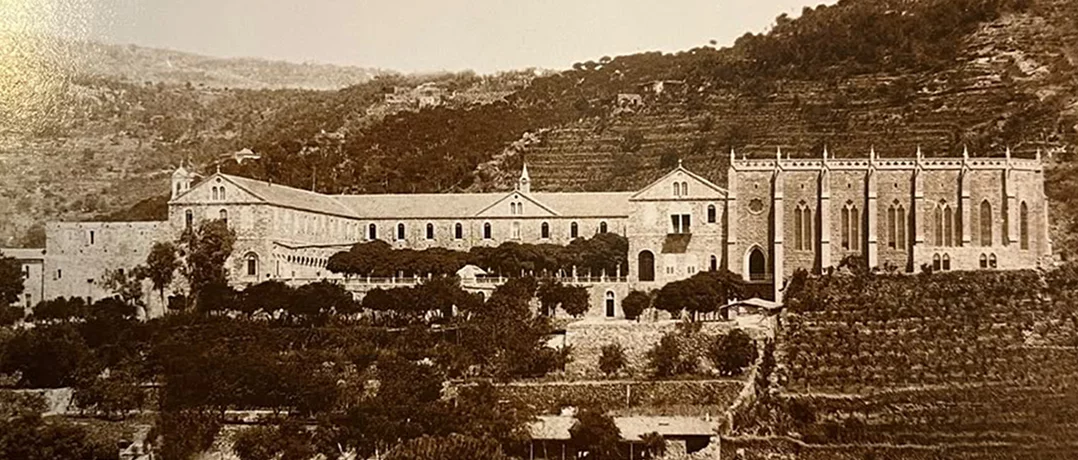
And then there is the campus itself. Much of what stands today belongs to a 19th-century building campaign, while parts of the site are centuries older. The U-shaped complex was built in stages between 1870 and 1904, and its tower became one of the school’s symbols. The campus also contains a neo-Gothic chapel completed in 1896, whose stained glass was brought from France.
Antoura’s archives preserve darker chapters too. During World War I, Ottoman authorities confiscated the school. According to Al-Hayek, Armenian children were brought there and subjected to forced Turkification and Islamization; many died from malnutrition and mistreatment. Father Nakad also described the Armenian children and the mausoleum on the school grounds dedicated to those who died.
The school survived the First World War, continued through the Second World War and then faced the Lebanese Civil War. By 1975, its campus was serving more than classrooms: its basements were used as shelters and its covered sports court became a place for storing and distributing aid. Nakad’s answer when asked what allowed the school to survive was simple: “C’est la foi”, faith.
Today, the school continues its long tradition of language education, while its archives are being preserved as a resource for researchers, ensuring that Antoura’s history survives not only in its buildings, but also in the documents left behind.
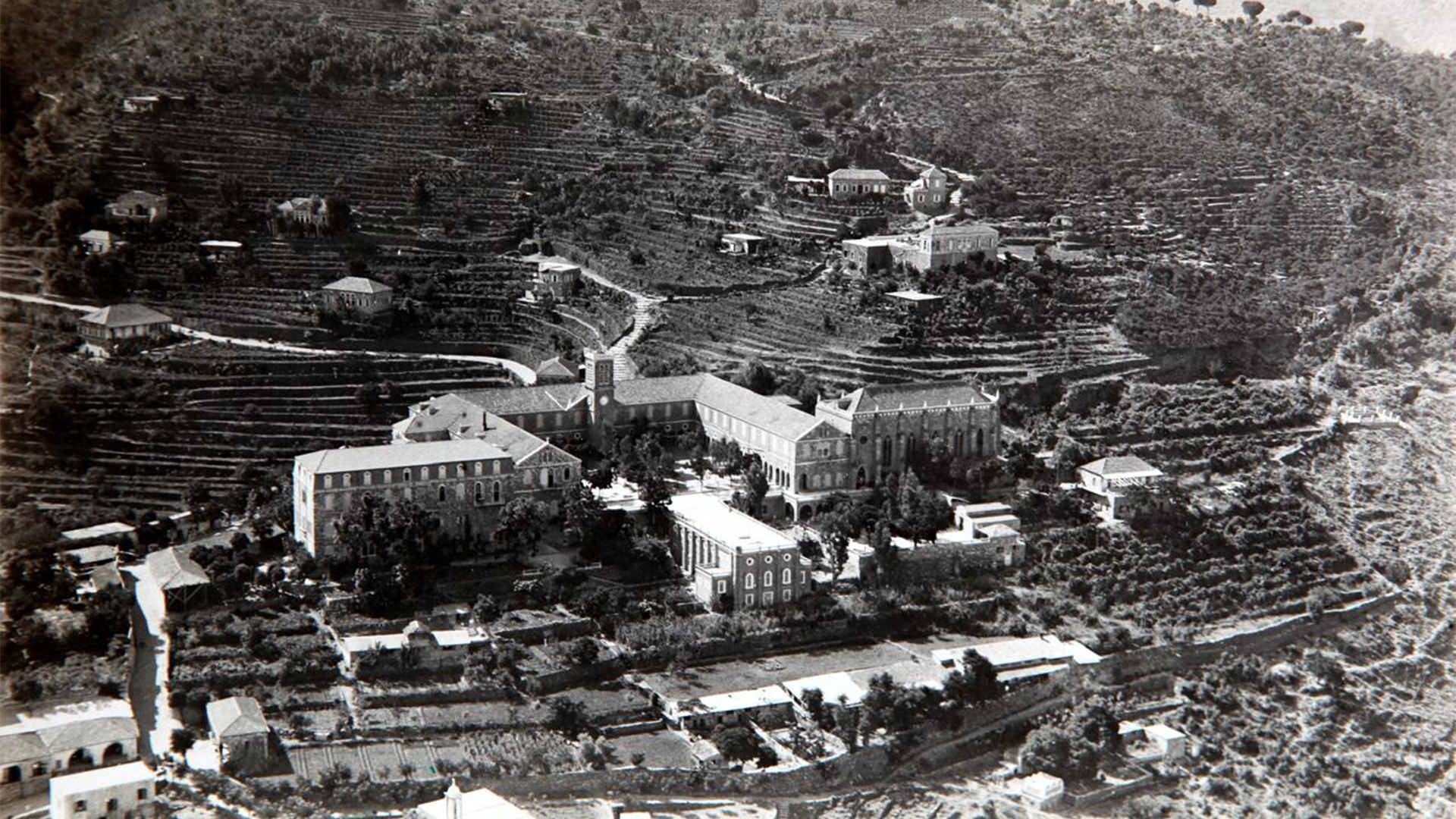 Source: Aintoura Archives.
Al-Makassed: When a girls’ school became a wider mission
The Makassed story begins with a different question: What did the community need most?
During an exclusive interview with The Beiruter, Dr. Ghina Al-Badawi, Director General of Educational Affairs at the Makassed Philanthropic Islamic Association of Beirut, explained that a group of people from Beirut came together to create a school for girls at a time when opportunities for girls, particularly within the Muslim community, were limited.
The founders gathered at the home of Sheikh Abdelkader Kabbani and collected donations to establish the school. Makassed’s official history dates the association’s foundation to 1878 and says it began its educational mission with a Girls College.
For Al-Badawi, however, the date is only part of the story. The founders’ mission, she explained, was to provide what was “most needed” by their community. At that moment, that meant educating girls. More than a century later, she says the same principle remains: Makassed asks what society needs now and responds accordingly, whether through technology, STEAM or artificial intelligence.
The first school was established in Bashoura, and its historic building still stands. Al-Badawi explained that it has been restored and now has a university-related role. The girls-only model eventually became difficult to sustain as families increasingly chose mixed schools. But Makassed did not simply disappear with the end of that model. It grew into a much broader network of schools, higher education, healthcare and social services. Makassed University of Beirut was officially established and offers three faculties: nursing, education and Islamic studies.
Makassed has since grown from its first school into a well-known community association with around 15 schools across Lebanon, alongside its wider educational and social work. What began as an effort to educate girls eventually became a much broader institution serving generations of Lebanese.
The legacy that lives on
The histories of these three institutions are not identical, and that is precisely what makes them revealing. École des Trois Docteurs followed Beirut through relocations, war and rebuilding. Antoura grew from a centuries-old mission into a school whose alumni, campus and activities became part of Lebanon’s wider history. Makassed began by answering a specific social need girls’ education and grew into a much broader community institution.
Their buildings have changed. Their classrooms have changed. Their students have changed. Yet their stories share one idea: education was never separate from the society around them.
In a country whose history has rarely stood still, these schools have done the same adapting, reopening and carrying their stories forward.
-
-
-
Yara SalibaJunior Writer/Translator
-
