



With Google Transit now live, Lebanon takes a significant step away from decades of informal transport, making bus routes visible, trackable, and easier to use nationwide.
Lebanon’s public buses go live on Google Maps
Lebanon’s public buses go live on Google Maps
By The Beiruter | January 13, 2026

Reading time: 3 min
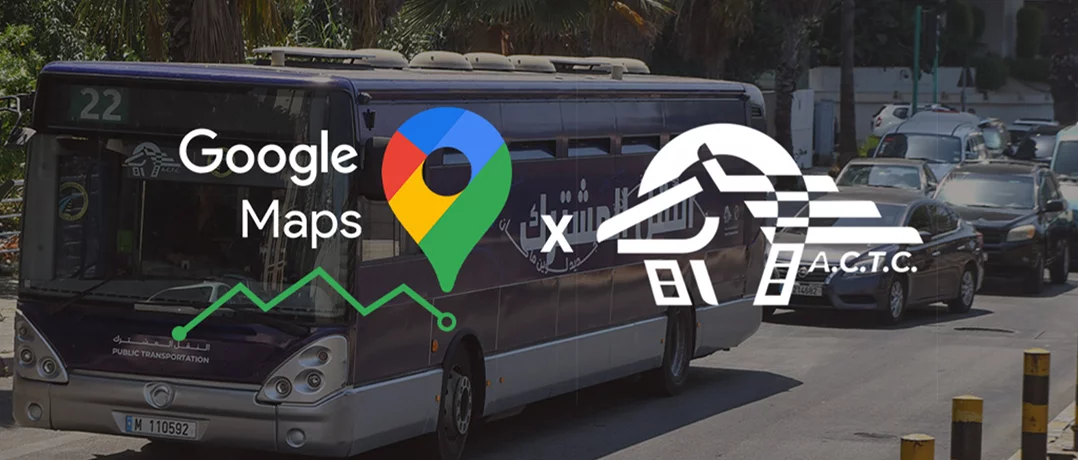
Lebanon’s long-struggling public transportation system has taken a significant digital leap, with the country’s national bus network now fully integrated into Google Maps, a change that promises to make commuting more predictable, accessible, and visible to the public.
Roughly a year and a half after the launch of its revitalized bus fleet, Ahdab Commuting and Trading Company (ACTC), the private operator of Lebanon’s state-owned buses, announced that Google Transit is officially active nationwide. The rollout, implemented through a partnership between ACTC and Lebanon’s Railways and Public Transportation Authority (RPTA) under the Ministry of Public Works and Transport, marks one of the most consequential upgrades to public mobility in decades.
For the first time, riders can now open Google Maps, enter their origin and destination, select public transport, and receive route suggestions that include walking directions to bus stops, transfer points, and projected arrival times. While ACTC’s own mobile application launched in September 2025 already offered real-time bus tracking, embedding the system within Google Maps dramatically expands its reach by placing public transport inside a platform already used daily by millions of Lebanese.
A Shift in how riders experience the city
To gauge the impact of the update, The Beiruter spoke with active ACTC riders. One commuter described her astonishment at discovering that Google Maps now offered multiple public transport routes to her workplace. Another rider in her mid-twenties said she was “shocked” and “surprised,” calling the feature “an improvement for the lives of people who cannot afford to own a car.” A third characterized the update as a sign of “Lebanon rebuilding itself” and a step toward restoring confidence in basic public services.
Several riders also noted the broader social implications. For young women in particular, the ability to see routes, stops, and arrival times digitally reduces uncertainty one of the main deterrents to using public transportation helping expand mobility and independence in a country where safety concerns often shape travel decisions.
Inside the technology behind the system
ACTC Managing Director Aoni Ahdab said the Google Maps integration was the result of deliberate investment in digital infrastructure that began when the company won the state tender in the summer of 2024.
According to Ahdab, advanced technology formed a core part of ACTC’s contract scope. The buses are equipped with 24-hour onboard cameras and AI-based driver-monitoring systems designed to analyze driving behavior. All activity is supervised through a centralized control room that tracks fleet movements and monitors routes in real time.
After launching the ACTC app in September, now used by 65,000 riders, according to Ahdab, the next strategic step was integration with Google Maps, which dominates urban mobility platforms worldwide. ACTC has been working on the project for seven to eight months, in parallel with the app’s development.
“As the official operator of state-owned buses, we reached out to Google and supplied them with the necessary data and technical information,” Ahdab said. He added that ACTC’s in-house technical team worked directly with Google engineers. A beta version of the service was delivered about two months ago, followed by successive testing phases before public release.
What comes next
ACTC’s digital push does not stop with Google Maps. Within the next one to two months, the company plans to introduce in-app online payments, a loyalty points program, student discounts, and daily, weekly, and monthly travel passes. Ahdab also said ACTC aims to coordinate with the state to expand routes and integrate the 30 buses donated by Qatar into the national fleet.
More Than a Map Update
Beyond convenience, the move signals a deeper shift in how public transport is being reimagined in Lebanon. By making routes legible, schedules predictable, and service digitally visible, the system begins to move away from decades of informal, unreliable transit toward something closer to a modern urban network.
In a country long defined by private cars, shared taxis, and improvised bus stops, Lebanon’s buses are now, quite literally, on the map.
-
-

-
The Beiruter
-
