



Brigadier General Khalil Helou, in an exclusive interview with The Beiruter, analyzes Israel’s targeting of southern bridges, its strategic objectives, as well as the military, political, and humanitarian implications for Lebanon.
Lebanon’s southern bridges at the center of conflict
Lebanon’s southern bridges at the center of conflict
By The Beiruter | March 19, 2026

Reading time: 7 min
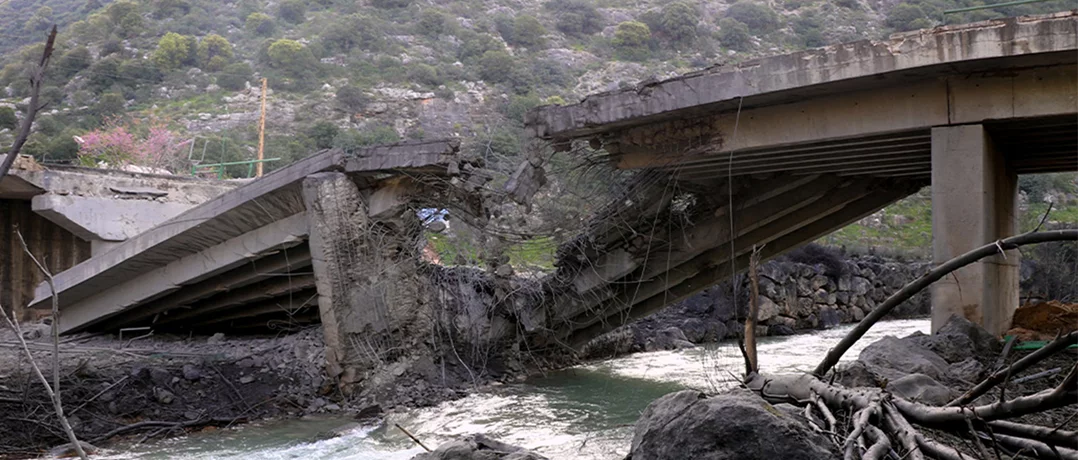
In a dangerous escalation in the current armed conflict between Hezbollah and Israel, the latter began targeted strikes on critical infrastructure, most notable bridges and routes in the south, drawing attention to Tel Aviv’s operational strategy and its broader implications for the Lebanese state and civilians.
In an exclusive interview with The Beiruter, geopolitical analyst, lecturing professor of geopolitics at Saint Joseph University of Beirut (USJ), chair of the Board of Trustees of The Convention-Lebanon, and retired Lebanese Armed Forces (LAF) Brigadier General Khalil Helou provided an in-depth perspective on the current conflict, detailing the rationale behind the attacks on bridges, the strategic implications for Hezbollah and Lebanon, and the humanitarian and political consequences of these operations.
Key bridges under attack and their strategic significance
According to General Helou, Israel’s recent strikes have concentrated on a select number of critical bridges and access points, signaling both military and psychological objectives.
Among the most significant is the Qasmiyeh Bridge, which has been deliberately closed to military passage to prevent further escalation and collateral damage; redirecting citizens to the Burj Rahhal Bridge instead. Given the bridge’s importance for the Lebanese Army’s defensive positioning and its close proximity to one of the United Nations Interim Force in Lebanon (UNIFIL) headquarters, Helou believes that its closure was coordinated between the United Nations (UN) peacekeepers and the LAF.
Other bridges and roads have also been targeted, including the Khardali (Marjeyoun), Deir Mimas (Marjeyoun), Zrariyeh (Tayr Felsay), and Qantara (Wadi al-Hujeir). The Khardali area, Helou particularly highlights, is vital for movement and logistics, given that it represents a strategic link connecting Nabatieh to Marjeyoun and the eastern sector. Controlling or disabling these routes gives Israel a significant tactical advantage in monitoring and restricting potential militant mobility.
Israeli military and political objectives behind the bridge strikes
The strategic rationale behind these operations extends beyond battlefield control. General Helou explained that Israel’s targeting of bridges serves several intertwined objectives.
Limiting Hezbollah’s mobility: By controlling or disabling key transport routes, Israel aims to impede and restrict Hezbollah’s potential military movements and supplies (including personnel, weapons, and resources) that could support the group’s operations.
Inducing civilian displacement: Striking infrastructure applies pressure on southern Lebanese communities, preventing already displaced people from returning as well as encouraging those who remained to evacuate. An emptied area allows Israel to monitor movement more effectively and classify any activity as potentially linked to Hezbollah, thus “justifying,” based on Israeli thinking, further military action.
Exerting pressure on the Lebanese State: These operations place enormous logistical and financial demands on the government, testing its ability to provide food, shelter, and security for its citizens (especially displaced people). This not only strains governmental resources and tests the country’s institutional capacity, but also amplifies the political pressure on Lebanese authorities to enforce ceasefire agreements and maintain territorial control.
Therefore, Helou notes that these operations are not purely tactical and military, but also represent a calculated integration of psychological, political, and humanitarian leverage. The attacks influence civilian behavior, weaken Hezbollah’s military and logistical movements, challenge state authority, and create conditions favorable to Israel’s broader strategic aims.
Implications for civilian populations and minority communities
A major concern highlighted by General Helou is the humanitarian impact of bridge strikes and associated military actions. While Israel primarily targets areas linked to Hezbollah, civilian populations inevitably face disruption, particularly in towns and villages near key infrastructure.
Christian villages in southern Lebanon, which historically do not support Hezbollah, are particularly vulnerable. While residents often resist displacement, ongoing strikes have forced temporary evacuations in areas like Marjeyoun. Simultaneously, Helou highlights that international diplomatic interventions, including communications with the Vatican, aim to ensure their protection and the ability to remain in their hometowns.
Moreover, Helou points out that Israel’s strategy leverages population movement as part of its operational calculus. By creating conditions that encourage evacuation, Israel can assert greater control over territories while framing any remaining movements as potentially hostile or linked to Hezbollah, increasing operational flexibility. However, Helou stressed that the Lebanese government as well as military and security forces are actively engaged in mitigating these impacts through coordinated efforts to safeguard displaced and at-risk populations; though challenges remain.
Differences in strategic context and operations: 2006 vs. 2024
During the 2006 July War, Israel launched indiscriminate, widespread attacks on bridges and infrastructure, striking major highways (such as the Beirut-Damascus and Beirut-Khaldeh routes) and bridges (such as the Mudeirej and Baabda bridges) throughout the north and south. These operations, General Helou explains, aimed to curtail Hezbollah’s military logistics, prevent the transport of heavy missiles (often concealed in shipping containers) and intimidate the civilian population.
In this context, Helou recalls an incident when he still served in the LAF. He said, "I remember the first rocket I saw in 2006 was hidden in a container in Beit Chai, near Baabda. It was hit while still in the container, exploding at the Kfarshima barracks and causing a large fire."
He added that “within a few hours, the barracks in Jumhour were hit, killing about 30 soldiers and officers.” Helou further noted,
At the time, Israel considered Lebanon was collaborating with Hezbollah. There were even threats to strike the Ministry of Defense, which was ultimately prevented by American intervention.
A critical difference between the current conflict and the 2006 war is the absence of Syria as a logistical and strategic rear base. At the time, Hezbollah relied heavily on Syrian territory to store and transport its arsenal, including long-range missiles, which made Lebanese bridges and roads vital transit points. As a result, civilian infrastructure thus suffered extensive damage, and population displacement was widespread.
In contrast, the current strikes are highly selective. Today, with reduced Syrian involvement and tighter Israeli surveillance of Iranian supply lines via Damascus and Aleppo, Hezbollah’s capacity to rebuild its arsenal is significantly constrained. This shift dramatically changes the tactical environment. Israel’s current strikes focus on bridges essential for mobility, as well as on restricting militant movement and exerting notable pressure on both the Lebanese State and local populations in the south.
Broader strategic lessons and recommendations
Reflecting on past and present conflicts, General Helou stresses the importance of state sovereignty and proactive measures. While Hezbollah continues to exert significant influence, the Lebanese government has a central role in protecting civilians, asserting sovereignty and control over infrastructure, and preventing militarization of civilian areas.
Helou argues that adherence to United Nations (UN) ceasefire agreements (such as Resolution 1701 and the recent 2024 cessation of hostilities agreement) and strict enforcement of territorial control could reduce Israel’s justification for targeted strikes. The key lesson is that effective governance, combined with precise security measures, is essential for both mitigating conflict and safeguarding civilian populations. He affirmed,
Had the Lebanese state fully enforced the ceasefire, much of this could have been prevented. Hezbollah should have deferred to the authority of the Lebanese state.
More importantly, Helou stresses on the need to rely on diplomacy to achieve the intended goal and secure Lebanon’s security, safety, and interests, relying on historical precedents.
"Looking back, in 1996, during the period of displacement, residents returned based on negotiated agreements. Similarly, in 2006, civilians fled the south but eventually returned under the framework of UN Resolution 1701."
Helou asserted, "Hezbollah’s actions, while capable of causing disruption within Israel, did not prevent Israeli forces from operating within Lebanese territory. Every military organization studies its past engagements: when direct military actions fail to achieve desired outcomes, safeguarding the civilian population requires alternative strategies and approaches."
In conclusion, the targeting of bridges in southern Lebanon highlights the complex interplay of military, political, and humanitarian considerations in the ongoing conflict. These structures are more than physical connectors; they are a focal point of modern asymmetric warfare as well as symbolic and operational assets that shape mobility, influence civilian behavior, and test the Lebanese state’s capacity to protect its people.
-
-

-
The Beiruter
-
