

Lebanon’s water paradox is leaving households to pay multiple times for a basic necessity, as aging infrastructure, losses and weak management turn a water-rich country into a place where securing reliable supply has become a costly burden.
Lebanon’s three water bills

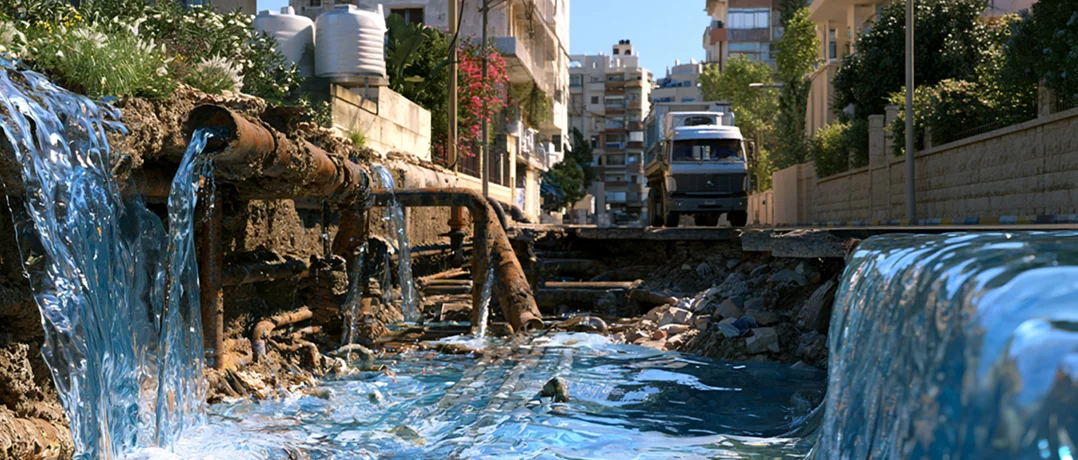
In a country long described as one of the Middle East’s most water rich, there is a costly paradox: Lebanese households may end up paying not one, but three separate bills for the same basic necessity. They pay the public water establishment, then a private tanker when the network supply falls short, and finally for drinking water because what reaches the household is not necessarily what the family relies on to drink.
Water has therefore become more than a natural resource in Lebanon. It is a recurring and increasingly significant household expense.
The scale of the challenge is acknowledged at the highest levels of the sector. Energy and Water Minister Joe Saddi recently said in an interview that Lebanon’s water problem is even more difficult than its electricity problem because addressing it requires costly infrastructure that takes time to build. With the ministry’s available resources, he said, work is underway on improvements and reforms.
The contradiction is particularly striking in a country that, compared with much of the region, receives substantial rainfall and snowfall and sits on significant groundwater reserves.
So how did Lebanon go from a “country of water” to a place where households can pay three times to secure it? And what is the real cost of water for a Lebanese family?
A “Country of water,” by the numbers
Hydrogeologist Dr. Samir Zaatiti tells The Beiruter that a French geological mission that worked in Lebanon between 1928 and 1955 ultimately described Lebanon as a “country of water in the Middle East.”
The description is particularly significant given Lebanon’s location in a region characterized by widespread water scarcity.
Zaatiti also recalls the work of the late engineer Ibrahim Abdel Aal, one of the pioneers of Lebanon’s water and electricity sector and a leading figure behind the Litani project, who viewed Lebanon’s mountains as natural water reservoirs feeding rivers and springs across the country.
Citing a historical United Nations Development Programme study on Lebanon’s groundwater published in 1970, Zaatiti estimates annual precipitation from rainfall and snow at around 10 billion cubic meters.
According to figures he cites, surface water from rivers and springs amounts to approximately 1.3 billion cubic meters annually, while renewable groundwater resources reach around 3 billion cubic meters per year.
Lebanon’s geography is central to this relative abundance. Zaatiti explains that the country’s position on the eastern edge of the Mediterranean, combined with its two mountain ranges, forces moisture laden Mediterranean air upward, producing rainfall at lower elevations and snow across the higher mountains.
Lebanon’s highly fractured carbonate and karst formations also allow significant quantities of water to infiltrate underground. Zaatiti estimates that 30% to 40% of precipitation falling over these formations can infiltrate the rock, feeding underground aquifers and springs.
“We are a country rich in water,” Zaatiti tells The Beiruter.
The problem, in his view, is what happens to that wealth afterward.
How much water does Lebanon actually need?
Another weakness, according to Zaatiti, lies in the age of much of the scientific knowledge underpinning Lebanon’s understanding of its water resources.
Following the French geological mission and the UN groundwater study of the twentieth century, he argues that comprehensive research has not progressed at the pace required to provide a sufficiently detailed and continuously updated picture of Lebanon’s resources.
How much water does Lebanon need every year for drinking? How much for agriculture? How much for industry and services?
Those are not merely technical questions. They are economic ones.
More recent official planning does provide estimates of future demand. Lebanon’s National Water Sector Strategy 2024 to 2035, published by the Ministry of Energy and Water, projects total annual water demand at approximately 1.734 billion cubic meters by 2035.
Of that, around 706 million cubic meters are projected for domestic demand, 927 million cubic meters for agriculture, and 101 million cubic meters for non-domestic uses.
The challenge, therefore, is not simply finding new sources of water. It is also making better use of what Lebanon already has.
Where does the water go?
Between a raindrop falling on a Lebanese mountain and water reaching a household tank, there is a long journey.
Zaatiti points to studies conducted by German water specialists in the Jeita area as an example of losses that can occur before water reaches consumers.
According to his account of those studies, significant quantities can be lost while water is transferred from Jeita toward the Dbayeh infrastructure. He estimates that around 30% may be lost during one stage of transmission as water leaks into surrounding soil, rocks and underground cavities.
He also points to capacity constraints in aging infrastructure, estimating the capacity of the Dbayeh tunnel at around 3.1 cubic meters per second, meaning that available water cannot always be fully captured and transported.
Then comes the distribution network.
Zaatiti estimates losses there at around 40%, contrasting Lebanon with cities such as Paris, where he says leakage is significantly lower and leaks are continuously identified and repaired.
The broader problem is also documented by international institutions. World Bank and UNICEF assessments have placed physical and commercial losses, known as non revenue water, at around 40% nationally.
Part of Lebanon’s water problem, in other words, begins long before a household turns on the tap.
A problem of supply and demand
Economist Louis Hobeika frames Lebanon’s water crisis in straightforward economic terms: supply and demand.
Demand is substantial, while supply is constrained by a combination of water losses, pollution and insufficient investment and attention, he tells The Beiruter. Regional water establishments, he adds, have also struggled with limited financial resources and staffing.
For Hobeika, however, providing water should not be treated as an impossible technical challenge.
“Providing water is not a complicated matter,” he tells The Beiruter.
As households search for alternatives to insufficient public supply, a parallel private market emerges, most visibly in the form of water tankers.
And that is where the story of Lebanon’s three water bills begins.
Bill No. 1: The public water establishment
Before paying for a tanker or a bottle of drinking water, households already face an official water bill.
Information obtained by The Beiruter on the 2026 tariffs shows that the annual cost alone can approach or exceed $200.
At the North Lebanon Water Establishment, the annual 2026 subscription stands at LBP 20.08 million for metered subscriptions and LBP 19.42 million for gauge based subscriptions.
At an exchange rate of approximately LBP 89,500 to the dollar, that is equivalent to around $224 and $217 a year, respectively.
At the South Lebanon Water Establishment, the annual 2026 subscription stands at approximately LBP 16.75 million, equivalent to about $187. The establishment has also allowed subscribers to pay the fee in four quarterly installments.
In Beirut and Mount Lebanon, 2026 bills have been put into collection, with fees varying according to subscription and property classifications. Payment facilities have also been introduced, including the possibility of spreading current dues across as many as 12 monthly installments.
But paying the public water bill does not necessarily mean the household’s spending on water ends there.
Bill No. 2: When the tanker arrives
When public network supplies are insufficient, water becomes a need that cannot simply be postponed.
That is when the tanker arrives.
Information gathered by The Beiruter indicates that a water tanker delivery in Lebanon costs around $50 on average, although the final price can vary depending on the size of the tanker, the quantity delivered, the geographical area, the distance from the water source, and transportation and fuel costs.
For a family requiring one tanker delivery per month, that adds approximately $600 a year. For a household requiring two deliveries per month, the annual cost rises to around $1,200.
Tanker water alone can therefore cost several times the household’s annual public water subscription simply to compensate for shortages in public supply.
And the family has still not paid for the water it actually drinks.
Bill No. 3: The drinking water
Consider a household of four people.
For the purpose of illustrating the cost, assume that each person drinks two liters of water per day. That means the household would consume approximately 240 liters of drinking water per month.
Current retail prices gathered by The Beiruter put a two liter bottle of drinking water at around LBP 50,000. To obtain 240 liters, the family would need the equivalent of 120 such bottles per month, costing around LBP 6 million.
At an exchange rate of approximately LBP 89,500 to the dollar, that amounts to roughly $67 a month, or approximately $804 a year.
That is for drinking water alone.
Bottle size can make the cost even higher. According to prices gathered by The Beiruter, a half liter bottle currently sells for around LBP 25,000. At that price, one liter costs approximately LBP 50,000, twice the price per liter of a two liter bottle at LBP 50,000.
How households buy their drinking water can therefore significantly change the final bill.
Adding up the three bills
This is where the scale of the burden becomes clearer.
Take a hypothetical family of four in South Lebanon. The household starts with an annual public water subscription of approximately $187 in 2026. Based on the drinking water scenario outlined above, it would spend another $804 a year.
If the family also needs one tanker delivery per month, at an average cost of around $50 per delivery according to information gathered by The Beiruter, another $600 is added to its annual expenses. Altogether, the household would spend approximately $1,591 a year on water.
If public supply is more limited and the family needs two tanker deliveries per month, tanker costs would rise to around $1,200 a year, pushing its total annual water spending to approximately $2,191.
The figure can be slightly higher depending on the public water establishment. Using the North Lebanon Water Establishment’s metered annual subscription of approximately $224, a family requiring two tanker deliveries per month and spending the same amount on drinking water would face an annual water bill of roughly $2,228.
These figures are not an official national average. Actual household expenditure varies according to location, family size, consumption, the reliability of public supply, the frequency of tanker deliveries and the type of drinking water purchased.
They do, however, illustrate how a family of four could spend more than $2,000 a year securing water when dependence on private alternatives is high.
Who pays for the losses?
For Zaatiti, addressing the problem begins with a fundamental change in the way Lebanon manages its water wealth.
He argues for greater reliance on renewable groundwater, better management of existing resources, modernization of infrastructure and a serious reduction in leakage and losses.
“Poor management of water wealth is at the heart of the problem,” he tells The Beiruter.
Hobeika puts the household at the center of the economic consequences.
“The citizen is the victim,” he tells The Beiruter, arguing that the state must put basic household needs higher on its list of priorities, particularly as Lebanon’s social and economic pressures continue.
Water rich country, costly service
Zaatiti recalls an exchange that, in his view, captures Lebanon’s water paradox.
During a television appearance with a Jordanian expert specializing in groundwater and wells, he cited estimates that Lebanon receives around 10 billion cubic meters of rainfall and snowfall annually. According to Zaatiti, the Jordanian expert responded that if Jordan received even half that amount, it could solve many of its water problems.
Water scarcity has pushed Jordan toward wastewater treatment and reuse, seeking to extract as much value as possible from every available cubic meter. Lebanon starts from a very different geographical position.
But having water is not the same as delivering it.
Between rainfall and the household tap stands an entire system of springs, wells, pumping and treatment stations, tunnels, reservoirs, distribution networks and public institutions. When that system cannot provide sufficient and reliable supply, households are left to fill the gap themselves.
And that is where Lebanon’s water paradox becomes an economic one.
In a country endowed with a resource that much of the region struggles to secure, households are still paying multiple times for one basic necessity.
The real cost of Lebanon’s water crisis, then, is not only measured in the water lost before it reaches the tap. It is also measured in the money families spend replacing what the system fails to deliver.
Lebanon does not need to find water. It needs to stop making its people pay for failing to deliver it.
-
-

-
Jessica HabchyJournalist
Focusing on economy and social affairs.
-
