

Lebanon’s 2026 tourism season recovered after a difficult start, but airport traffic, regional demand and spending remained below previous highs, revealing a sector still dependent on stability and confidence.
Lebanon’s tourism comeback: By the numbers
Lebanon’s tourism comeback: By the numbers
By Christiane Tager | September 14, 2026

Reading time: 9 min
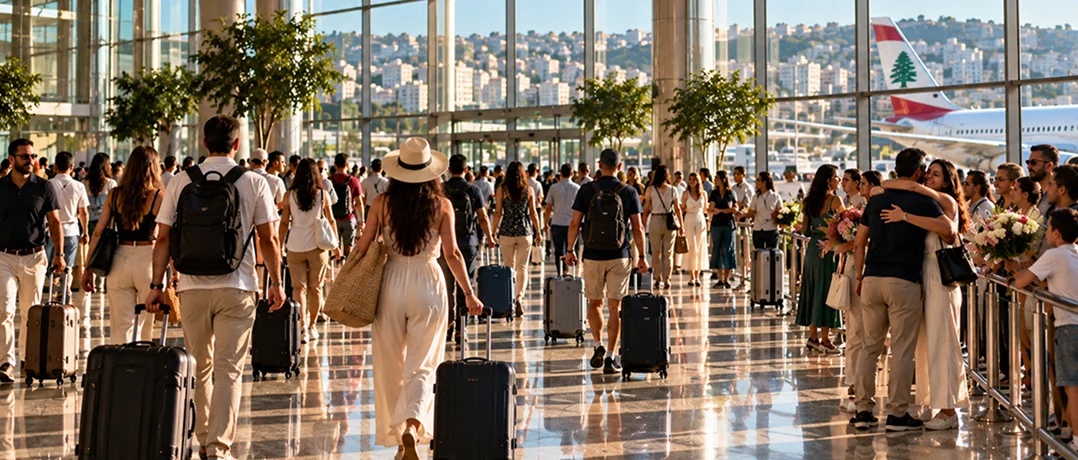
After a disastrous start to the summer, Lebanon’s tourism sector staged a partial comeback from late June onwards. Airport traffic picked up, mountain hotels reached occupancy rates of up to 80% and coastal bookings exceeded 70% in August. But the country remained well below the levels of 2025 and even further from the strong 2023 season.
Lebanon’s 2026 tourism season began with what industry representatives describe as a near-disaster.
The escalation of the security situation in March led to cancelled bookings, delayed arrivals and a sharp drop in tourism activity during the spring. But from the end of June, the picture began to change.
By July, visitors were returning. August brought a further improvement, particularly in the mountains and along parts of the coast.
The recovery, however, was never strong enough to bring the country back to last year’s levels.
Ramzi Salman, president of the Syndicate of Guesthouse Owners, describes the season as a succession of “lows, then highs”. According to him, July reached roughly two-thirds of the level recorded in July 2025, while August was also performing at around two-thirds of last year’s level.
“The beginning was catastrophic,” Salman said. “Then, towards the end of June, things started to recover.”
His assessment captures the defining feature of Lebanon’s 2026 tourism season: demand did not disappear, but it became extremely sensitive to security conditions.
Nearly 27,000 passengers a day at Beirut airport in August
The clearest indicator is passenger traffic through Beirut’s Rafic Hariri International Airport.
In August 2026, the airport handled 835,576 passengers, its strongest monthly performance of the year. That represented an increase from 722,043 passengers in July.
But compared with August 2025, the picture was considerably weaker.
August 2025 saw 929,815 passengers, meaning that August 2026 was approximately 10% lower year on year.
On average, that translates into around 26,950 passengers passing through the airport every day in August, including arrivals and departures.
More importantly for tourism, Beirut airport recorded 369,972 arrivals in August, equivalent to almost 11,935 arrivals per day.
The difference with 2023 is even more revealing.
August 2023, one of Lebanon’s strongest post-pandemic tourism seasons, recorded 915,085 passengers through the airport, including 380,610 arrivals. August 2026 therefore remained about 8.7% below the total passenger traffic recorded three years earlier.
July tells a similar story. Passenger traffic reached around 722,000 in July 2026, about 9% below July 2025, while July 2023 saw approximately 924,000 passengers.
The message is clear: Lebanon recovered a significant part of its summer traffic, but it did not return to the exceptional levels seen before the latest crisis.
The season was not equally bad everywhere
The geographical divide is one of the most important characteristics of the 2026 season.
According to Jean Beyrouti, secretary-general of the Federation of Tourism Syndicates, occupancy at tourism establishments in mountain areas reached up to 80% in August, while coastal bookings exceeded 70%.
Guesthouses also began receiving weddings that had previously been cancelled, another sign that confidence was returning as the summer progressed.
Ramzi Salman sees an even sharper regional divide.
He says areas such as Batroun and Kesrouan were not substantially affected, while southern Lebanon suffered a much heavier blow.
This created a tourism map with very different realities: some northern and central destinations were able to capture demand from visitors looking for safer locations, while southern areas faced far greater disruption.
Guesthouses: from “catastrophic” to a partial recovery
The guesthouse sector illustrates the volatility of the season particularly well.
Salman says the beginning of the summer was extremely difficult, with activity only starting to recover towards the end of June.
By July, guesthouses were operating at roughly two-thirds of the previous year’s level, according to his estimate.
August was also stronger, but still around two-thirds of the level reached in 2025.
The result was a season that generated business, but not enough to compensate for the losses accumulated earlier in the year.
And there is still a major concern among operators: another security shock could quickly reverse the recovery.
“Of course, we are still worried about another halt in activity,” Salman said.
That uncertainty is particularly damaging for small accommodation businesses, which have less financial capacity than large international hotels to absorb weeks of cancellations.
Hotels: strong pockets of demand, but no national boom
The hotel market followed a similar pattern.
At the end of July, hotel occupancy in Beirut was estimated at around 40%, while some mountain destinations were already reaching 60% during weekends.
By mid-August, however, the picture had improved significantly, with occupancy in some mountain tourism establishments reaching 80% and coastal bookings exceeding 70%.
This suggests that the summer did not produce a uniform national hotel occupancy rate.
Instead, demand became concentrated in destinations perceived as safer and more attractive to summer visitors.
That distinction matters.
A hotel in a mountain resort could experience a strong August weekend while another property in Beirut or the south remained significantly below capacity.
The 2026 tourism market was therefore less a national recovery than a selective recovery.
Restaurants and nightlife: activity returned, but spending remained under pressure
Restaurants, bars and nightclubs also benefited from the summer rebound, but the recovery was uneven.
One of the biggest challenges was not simply the number of visitors, but how much they were prepared to spend.
Lebanese expatriates returning for the summer faced sharply higher prices across restaurants, beaches, accommodation and transport. Some returning Lebanese were complaining that Beirut had become more expensive than Paris, with one couple reporting a $150 restaurant bill before drinks.
That creates an important distinction between tourist traffic and tourism revenue.
A busy restaurant does not necessarily mean a highly profitable restaurant if customers are reducing the number of meals, choosing cheaper options or shortening their stay.
The nightlife sector also remained highly dependent on confidence and security conditions. The Ministry of Tourism issued a circular in July reminding bars and nightclubs that people under 18 were not permitted to enter, but the broader industry continued to operate against a backdrop of uncertainty.
Airbnb and short-term rentals: a different story
The short-term rental market is harder to measure because Lebanon does not publish a comprehensive official national Airbnb occupancy figure.
Private market data nevertheless suggests that the picture varies considerably by location.
In Beirut, AirROI estimated average short-term-rental occupancy at 33.7% over the 12 months to July 2026, with an average nightly rate of around $96.
In the Aley district, AirDNA reported average occupancy of 55%, with occupancy up 83.2% year on year as of September 2026.
Chouf, meanwhile, recorded average short-term-rental occupancy of around 38%, with occupancy up 45.1% year on year.
These figures should not be directly compared with hotel occupancy because the methodologies and time periods differ. But they reinforce the same broader trend: demand shifted geographically rather than disappearing completely.
Who came to Lebanon this summer?
The exact nationality breakdown for the full summer of 2026 has not yet been published by the Ministry of Tourism.
The latest complete annual data provides a useful benchmark.
In 2025, Europeans represented 45.8% of tourist arrivals, followed by visitors from Arab countries at 22.1% and the Americas at 19%. Africa accounted for 4.6%, Oceania 4.3% and Asia 4.2%.
The 2026 season, however, faced a weaker flow from several traditional regional markets.
Industry representatives reported that tourism from Iraq, Egypt and Jordan was lower than in previous years, while Lebanon did not fully benefit from the lifting of the UAE travel restriction, partly because of economic conditions in the Gulf.
This suggests that Lebanon’s tourism base in 2026 remained heavily dependent on Lebanese expatriates and international visitors willing to travel despite the security uncertainty**, rather than a broad-based recovery across all traditional markets.
2023 remains the benchmark
The comparison with 2023 is particularly important. That year, Lebanon recorded 1.67 million tourist arrivals, the highest annual figure since 2019 at the time. Europeans accounted for 40.8%, Arab visitors 25.8% and visitors from the Americas 20.4%.
In 2023, Lebanon had a much stronger summer momentum. In 2026, businesses were recovering from a major disruption earlier in the year.
2025: the year Lebanon almost returned to pre-crisis tourism levels
The comparison with 2025 is equally important. Lebanon welcomed 1.64 million tourists in 2025, up 44.6% from 2024 and only around 2% below 2023. The third quarter, which includes the peak summer season, recorded 612,101 arrivals.
July 2025 alone brought 252,079 tourist arrivals, while August recorded 209,525.
Against that backdrop, 2026 represents a significant setback.
The country entered the year with a tourism sector that had been rebuilding rapidly. The March escalation interrupted that momentum just as the industry was preparing for another strong summer.
A season saved but not a normal season
The 2026 summer therefore cannot simply be described as a failure.
By August, mountains were reaching occupancy rates of up to 80%, coastal bookings were above 70%, Beirut airport was handling almost 27,000 passengers a day and guesthouses were once again hosting weddings that had previously been cancelled.
But neither can it be described as a normal recovery.
The airport remained below both 2025 and 2023 levels. Guesthouse activity, according to Ramzi Salman, reached only around two-thirds of last year’s performance. Traditional regional markets were weaker, while the economic pressure on visitors limited spending.
And the regional divide remained stark.
Batroun, Kesrouan and several mountain destinations managed to benefit from the recovery. Southern Lebanon remained severely affected.
Tourism’s biggest problem is no longer demand, it is confidence
The most striking lesson from Lebanon’s summer 2026 may be that the appetite for Lebanon is still there. Visitors returned as soon as conditions improved. Bookings recovered. Hotels filled up in some destinations. Guesthouses reopened their calendars. Restaurants and entertainment venues regained customers.
But the recovery remains fragile.
The World Bank estimates that the renewed conflict will cost Lebanon around $3.57 billion in tourism and domestic consumption revenues in 2026 compared with what the economy could have generated without the conflict. That number puts the summer experience into perspective.
Lebanon did not lose its tourism appeal in 2026. It lost time, confidence and spending.
The challenge now is to turn the partial rebound of July and August into a sustainable recovery one in which visitors stay longer, spend more and, most importantly, feel confident enough to book their trip months in advance.
For Lebanon’s tourism industry, the summer of 2026 was not the season that disappeared. It was the season that came back but only after a very costly delay.
