



Fifty-one years after the spark of Lebanon’s civil war, the country faces a familiar and dangerous reality, where unresolved dual authority and armed actors outside the state continue to threaten a return to conflict.
Lebanon’s unfinished war and the risk of another
Lebanon’s unfinished war and the risk of another
By Josiane Hajj Moussa | April 13, 2026

Reading time: 7 min
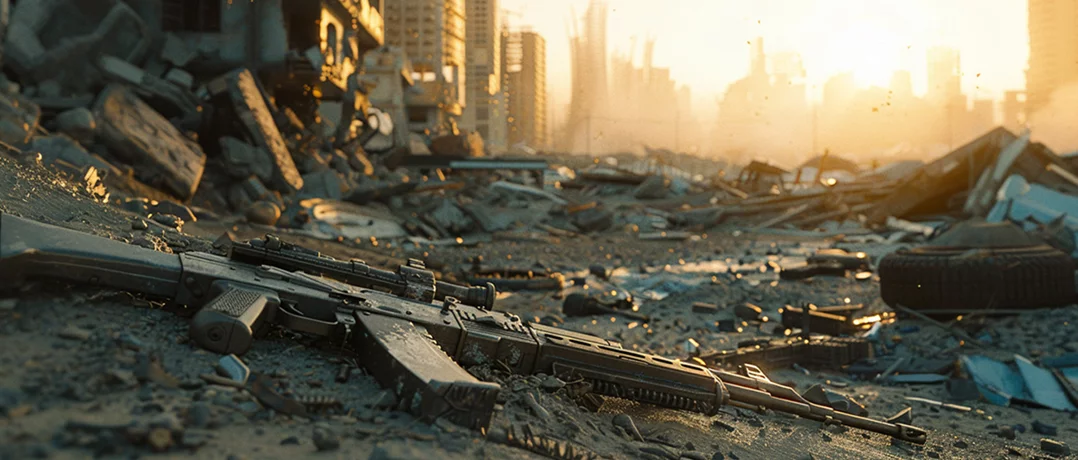
On April 13, 1975, gunmen opened fire in Ain el-Rummaneh, setting off what would become a fifteen-year civil war.
But the violence did not emerge in isolation. It exposed a deeper structural reality: the existence within Lebanon of armed actors operating outside the authority of the state.
More than five decades later, that same condition persists. As Lebanon faces renewed internal and regional pressures, the question is no longer historical. It is immediate: could it happen again?
A system designed to break
Lebanon’s political system contained the seeds of its own instability. The 1943 National Pact, an unwritten agreement dividing power among sects, institutionalized identity as the basis of governance: a Maronite president, a Sunni prime minister, a Shia speaker. It was a compromise shaped by its moment, with limited capacity to adapt.
As demographics shifted, the system remained rigid, and pressure accumulated.
The first rupture came in 1948, when more than 110,000 Palestinian refugees entered Lebanon following the Arab-Israeli war. The second came in 1970, when the Palestine Liberation Organization (PLO), expelled from Jordan, relocated its armed infrastructure to Lebanese territory.
By 1969, the Cairo Agreement formalized what the Lebanese state could not control: Palestinian camps became autonomous zones under PLO authority. Lebanon had, in effect, ceded sovereignty over parts of its own territory.
The state did not collapse overnight. It eroded quietly, structurally, irreversibly.
April 13, 1975: The incident that ignited everything
On the morning of April 13, gunmen opened fire outside the Church of Notre Dame de la Délivrance in Ain el-Rummaneh, killing four people, including bodyguards of Kataeb leader Pierre Gemayel. The attackers were widely attributed to Palestinian factions.
Within hours, tensions escalated. That afternoon, a bus carrying Palestinian passed through the same neighborhood. Fighters aligned with the Kataeb Party and emerging Lebanese Forces opened fire, killing 27 of the 33 passengers.
The attack on the bus marked a decisive escalation, turning an isolated incident into a nationwide confrontation.
Within 72 hours, more than 300 people were dead. The Lebanese Army, fragmented along sectarian lines, remained in its barracks—unwilling to intervene, unable to unify.
What began as a localized clash became the opening phase of a fifteen-year war.
The logic of war: Fragmentation and foreign intervention
The Lebanese war was not a single conflict but a series of overlapping wars: Lebanese against Lebanese, Lebanese against Palestinians, Syria against Lebanon, Israel against Palestinian factions, and regional powers using Lebanese territory as a proxy battlefield.
By 1976, massacres in Karantina and Damour established a brutal pattern of retaliatory sectarian violence. Syria intervened not to stabilize Lebanon, but to manage the outcome, ensuring that no single faction could dominate in a way that threatened its strategic interests.
In 1982, Israel invaded Lebanon, expelled the PLO, and reshaped the battlefield. That same year, Bashir Gemayel was elected president, only to be assassinated weeks later. The Sabra and Shatila massacre followed, cementing international outrage and deepening Lebanon’s internal fractures.
Out of this evolving conflict, a new actor emerged: Hezbollah. Backed by Iran, it introduced a more disciplined, ideological, and asymmetric model of warfare—one that would outlast the war itself.
By 1990, the Taif Agreement formally ended the conflict and mandated the disarmament of militias. One exception remained.
That exception would shape Lebanon’s political and security landscape for decades to come.
The war that did not end
Lebanon’s war did not conclude in 1990. It was reconfigured.
The Taif Agreement redistributed political power and formalized Syrian dominance, but it failed to resolve the core issue: the existence of an armed force operating outside state authority. Hezbollah retained its weapons under the justification of “resistance.”
What emerged was not a resolution, but a deferral. Each major crisis that followed can be traced back to that same unresolved condition.
May 7, 2008: A warning ignored
On May 7, 2008, Lebanon received a preview of its future.
After the government attempted to dismantle Hezbollah’s private telecommunications network, the group’s leader, Hassan Nasrallah, declared the decision a “declaration of war.”
Within hours, Hezbollah fighters took control of West Beirut. Media outlets were seized, political opponents overrun, and key infrastructure captured. Nearly 90 people were killed in days of fighting. The Lebanese Army remained on the sidelines, unable to intervene or impose control.
The crisis ended with the Doha Agreement, which introduced a model of consensual democracy that effectively paralyzed the Lebanese system. By granting veto power within government, it shifted decision-making away from state sovereignty toward a balance of internal and external actors, notably Iran-backed Hezbollah under a Qatari-brokered framework. In this structure, governance weakened, and true state authority no longer fully existed.
2023–2026: A state dragged into war
On October 8, 2023, Hezbollah opened a front against Israel following Hamas’s attack a day earlier. The Lebanese state neither authorized nor controlled the decision.
The escalation that followed reshaped Lebanon’s strategic landscape. Israeli strikes devastated infrastructure, targeted senior Hezbollah leadership, and culminated in the killing of Hassan Nasrallah in September 2024.
A fragile ceasefire followed, but it did not hold. By early 2026, renewed hostilities, driven by regional escalation and Hezbollah’s continued military activity, once again drew Lebanon into conflict. Thousands were killed or wounded. Entire regions were depopulated. Economic losses deepened an already collapsed state.
The pattern was consistent: war initiated outside state authority, with consequences borne by the state.
Why 2026 is not 1975
The parallels are strikingbut the differences are equally important.
Lebanon in 2026 is not Lebanon in 1975.
First, Hezbollah is no longer at its peak. The 2024 war severely degraded its leadership and infrastructure. Its deterrence capacity has been weakened, even if not eliminated.
Second, Lebanon’s collective memory acts as a constraint. The civil war is not an abstraction; it is lived experience. Entire generations carry its scars.
Third, all political parties willed to place themselves fully under state authority. This means a clear commitment to the primacy of state power, where no group operates outside its institutions and the monopoly of force rests solely with the state.
Fourth, the political landscape has shifted. The election of President Joseph Aoun and the government of Prime Minister Nawaf Salam marked a rare moment of alignment around the principle of state sovereignty explicitly including the monopoly over arms.
International dynamics have also changed. The United States, France, and Saudi Arabia have tied reconstruction support to structural reforms, including disarmament.
Unlike in 1975, internal constraints and external pressure now point in the same direction.
Why the Risk Still Exists
And yet, the risk persists.
Lebanon today still contains the core ingredient that triggered its civil war: an armed actor operating outside the state, with independent decision-making power and external backing.
The state remains weak. More than 80 percent of the population lives in poverty. The Lebanese Army, underfunded and overstretched, faces structural constraints similar to those of 1975—including the risk of internal fragmentation.
The political system itself remains unchanged. Sectarian governance continues to prioritize balance over effectiveness, compromise over sovereignty.
The conditions are not identical. But they are dangerously familiar.
If it happens again: A different war
A renewed civil conflict in Lebanon would not resemble the war of 1975–1990. It would likely be shorter, more asymmetric, and more destructive.
Urban warfare would dominate, particularly in Beirut and mixed regions. Non-state actors would operate with advanced capabilities, including drones and precision weapons. External actors, Israel, Iran, and possibly others, would be directly involved from the outset.
The Lebanese Army would face its defining test: either assert authority or fracture under pressure.
Unlike the previous war, such a conflict would unfold amid economic collapse, leaving far less capacity for endurance or recovery.
The unresolved question
Lebanon’s crisis is not rooted in diversity. It is rooted in dual authority.
In 1975, the challenge came from the PLO. Today, it comes from Hezbollah. The structure remains the same: a state that does not fully control decisions of war and peace.
The question facing Lebanon in 2026 is not whether it remembers its past, but whether it is willing, and able, to break from it.
Can the state impose a single authority over arms?
Can political actors prioritize sovereignty over sectarian calculation?
Can external actors support stability without reinforcing fragmentation?
The answers remain uncertain.
One fact, however, is no longer in question: Lebanon cannot sustain another war.
Fifty-one years after the bus in Ain el-Rummaneh, the country stands at a familiar edge—not because it failed to remember, but because it has yet to decide.
History is not repeating itself.
Lebanon is being asked, whether it has learned.
-
-

-
Josiane Hajj MoussaReporter
-
