

For nearly 170 years, L’Œuvre d’Orient has worked through local institutions in Lebanon, sustaining schools, hospitals, and communities across moments of crisis and calm.
L’Œuvre d’Orient in Lebanon and the commitment to remain
L’Œuvre d’Orient in Lebanon and the commitment to remain
By The Beiruter | April 20, 2026

Reading time: 7 min
In a country where many humanitarian and social organizations arrive in moments of crisis and leave when conditions shift, L'Œuvre d’Orient operates on a different premise.
Its work is measured less in moments of urgency than in the relationships it maintains over time, often long after the immediate crises fade from view.
“We are just not here for the war,” said Vincent Gelot, the organization’s head in Lebanon. “We are here to support in times of peace as well.”
Founded in 1856 by French academics, L’Œuvre d’Orient was initially created to support French-language schools in Lebanon. At the time, the idea of a non-state association addressing social needs was still emerging in France, making it one of the earliest examples of organized cross-border support. From the outset, its work was tied to institutions rooted in Eastern Christian communities, raising awareness and preserving their heritage, even as those institutions served a far broader segment of society.
Nearly 170 years later, that model has expanded but not fundamentally changed. The organization now operates in 23 countries, supporting more than 1,250 projects annually through a structure that combines a Paris headquarters, led by Director General Monseigneur Hugues de Woillemont, with local teams and volunteers.
In Lebanon, a small team of five full-time staff and fifteen volunteers works closely with a wide network of partner institutions across the country, supporting schools, hospitals, and social organizations that serve a broad cross-section of the population
Working through local networks
Across the regions where it operates, L’Œuvre d’Orient works through schools, hospitals, and local organizations that are already embedded in their communities. Its role is less about building new structures than supporting those already in place.
“L’Œuvre d’Orient has a long history of close relationships with our partners on the ground,” Gelot said. “We know the projects, we know the people, and we remain involved in their work.”
That involvement is sustained over time. Relationships are often built over years, sometimes decades, Gelot explained, allowing the organization to maintain a detailed understanding of how these institutions function and what they need.
Internally, this approach is described as a “friendship association” connecting donors in France with local institutions and communities. In practice, this model allows the organization to remain present in places where fewer actors operate, including areas where international attention is limited. It also enables support to continue when external funding priorities shift, or when attention moves elsewhere.
Lebanon’s central role
Lebanon occupies a central place in L’Œuvre d’Orient’s work. “There is a long, special relationship between France and Lebanon,” Gelot said, pointing to ties between the two countries rooted in language, education, and decades of exchange.
That relationship is reflected in the scale of the organization’s engagement. Almost half of its funding is directed toward Lebanon and neighboring Syria, with approximately €10 million allocated to Lebanon each year.
Across the country, the funding supports a wide network of more than 200 organizations, including Christian schools, hospitals, specialized care centers, and groups serving vulnerable populations, among them people with disabilities. Taken together, these institutions reach roughly 150,000 vulnerable people each year.
“In Lebanon, we are really close to our beneficiaries, not only because we are giving them money, but because we are involved in each project and we know everyone,” said Etienne, one of the five full-time employees.
Education, coexistence, and strain
In classrooms across Lebanon, L’Œuvre d’Orient’s role becomes most visible, often in places where few other options remain. Through the schools it supports, students from across the country continue to access education, particularly in rural areas where these institutions are among the few still functioning.
Although many of these schools are affiliated with Christian organizations, their reach extends far beyond a single community. In parts of the south, Beirut’s southern suburb, and Tripoli, they serve predominantly non-Christian populations. Families choose them less for religious affiliation than for their reliability, accessibility, and perceived quality, while the schools themselves bring together students from different religious and social backgrounds in shared classrooms.
“We support these schools not because they have Christian students, but because they have a valuable mission in Lebanese society,” Gelot said.
At a regional level, a joint program between the organization and the French state supports around 300,000 students in francophone schools across the Middle East, including in Lebanon, Syria, Iraq, Jordan, Egypt, and the Holy Land. The program is funded equally by the French government and the organization, reflecting the continued importance of education as a point of connection between France and the region.
In Lebanon, Gelot explained, that role has come under increasing pressure since the onset of the economic crisis in 2019. Currency devaluation has sharply reduced the value of funding, while operational costs have risen and household incomes have declined. Schools have struggled to cover basic expenses, including salaries, even as demand for affordable education has increased.
“Many schools are at risk of not being able to continue,” Gelot said.
If they stop operating, the consequences would be significant.
The history at stake
Alongside its operational work, the organization places significant emphasis on advocacy, particularly around the presence of Eastern Christian communities in the region.
Over the past fifteen years, that presence has declined sharply in several countries. In Syria, for example, an estimated 80 percent of the Christian population has left, driven by conflict, economic pressure, and prolonged instability.
For Gelot, the argument is not limited to identity. It is also a question of continuity and the presence of communities that have shaped the region over centuries and remain part of its social and cultural fabric. Their disappearance would mark not only a demographic shift, he argues, but a break in that historical legacy.
“If they disappear, our histories disappear, and we disappear the future,” Gelot said, describing it as not only a disaster for those communities, but also a loss for the Middle East and an impact on the Western world, where part of its cultural, civilizational, and spiritual roots lies.
“Supporting the presence of Christians in the East is not a matter of religion or politics,” Gelot said. “It is a matter of humanity.”
Responding to the war
When hostilities between Israel and Hezbollah escalated, L’Œuvre d’Orient moved through the same networks it relies on in calmer times. In the south, convoys began making their way to towns along the front line, from Marjeyoun and Qlayaa to Debel, Ain Ebel, Tyre, and Nabatieh, often coordinated with local dioceses that remained in place. In one recent convoy where The Beiruter was present, around 30 tonnes of humanitarian aid were distributed.
The response was carried out alongside a wider ecosystem of Catholic organizations, including Caritas and Solidarité, and in coordination with the Apostolic Nuncio. Contacts with the Lebanese military and UNIFIL helped facilitate access where conditions allowed.
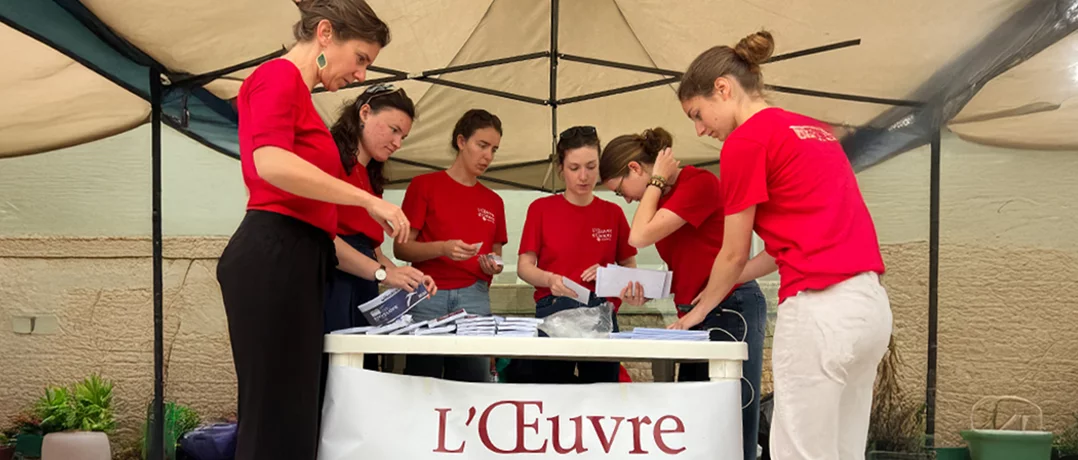
Support extended beyond large-scale deliveries to meet the needs of the displaced. At Bkerke, following a Sunday mass at the Maronite Patriarchate, a group of seven volunteers stood behind a table, placing $50 vouchers into envelopes for displaced households before serving ready-to-eat meals prepared in coordination with another local NGO.
For Gelot, much of this response was shaped by experience. In previous escalations, it could take weeks to organize a first convoy. This time, it happened within days.
“We were able to respond much faster,” he said.
We were responding with more experience, but also with fewer means, and with people who were more tired.
That shift reflects a broader change in the context. Funding has tightened across NGOs and governments, even as needs have grown more acute. Displacement has been more sustained, and in parts of the south, entire communities now face the possibility of long-term absence.
“The only positive thing we had was the experience we gained before,” Gelot said. “But everything else has become more difficult.”
A presence that endures
For volunteers, the model emphasizes immersion rather than rotation. Placements typically last between six months and two years, allowing individuals to work directly within institutions and alongside the communities they serve.
At Bkerke, where volunteers had gathered earlier to distribute aid following Sunday mass, that approach was visible in practice.
“You are present and live with the community. Your entire mission is to serve their needs,” said Agathe, one of the volunteers, slipping vouchers into an envelope.
To her left, Louise spoke of a similar experience, defined by long periods of independent work that deepen her connection to the country, its culture, and the communities she supports.
Over time, those experiences form a shared identity within the organization. Etienne described L’Œuvre d’Orient simply as a “big family,” with a sense of closeness that persists even as members are spread across different countries.
Like the communities it serves, the organization is built on long-standing ties that endure.
It is, in the end, a commitment to remain.
-
-

-
The Beiruter
-
