Discover the story of Machghara, a historic Western Bekaa town where abundant springs, a thriving tannery industry, religious coexistence, war, and cultural heritage have shaped more than a thousand years of resilience.


Discover the story of Machghara, a historic Western Bekaa town where abundant springs, a thriving tannery industry, religious coexistence, war, and cultural heritage have shaped more than a thousand years of resilience.

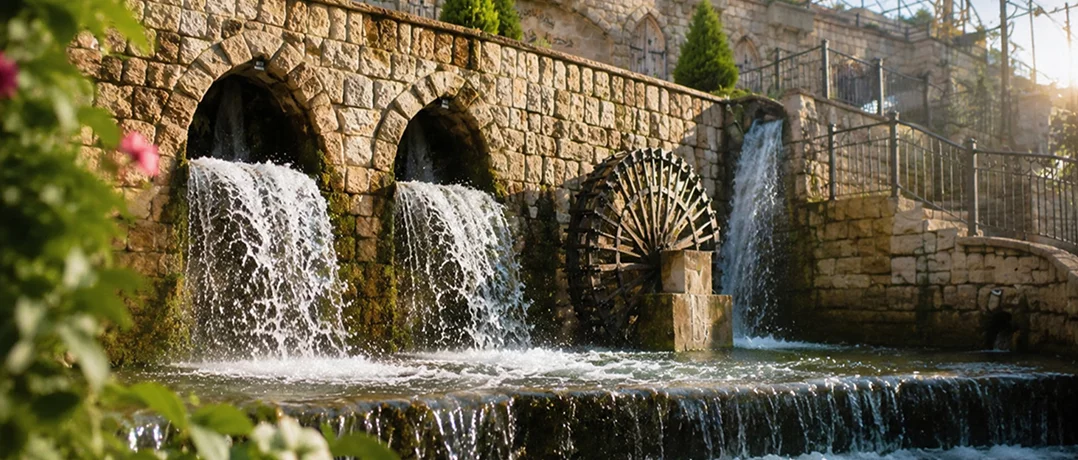
In Western Bekaa, a Lebanese town of springs, tanneries, and shared prayer bears witness to a century of upheaval, and to the stubborn art of beginning again. Perched roughly 1,050 meters above sea level on the eastern flank of Mount Lebanon, overlooking Lake Qaraoun and the Litani River basin, the town owes its very name to the water that pours through it.
The word traces back to the ancient Phoenician root meaning "to gush," a fitting origin for a village built around some thirty natural springs that thread through its stone alleys like a second circulatory system. For more than a thousand years, that water has shaped who came to Machghara, what they built there, and how the town endured what came next.
Long before Machghara appeared on any modern map, it was a place people passed through rather than toward, a settlement more than eleven centuries old, once known as Mougra, sitting astride routes that Ottoman caravans used to cross the Bekaa Valley. Its springs made it a natural waystation, a place to water animals, rest, and trade, and its position on the mountain's eastern slope, along the geological line of the Yammouneh fault, gave it both its abundant water and its vulnerability to the region's seismic and political tremors alike. The town is also remembered as a seasonal retreat associated with the seventeenth-century Druze emir Fakhr al-Din II, whose ambitions once stretched across much of Mount Lebanon.
By the twentieth century, Machghara had transformed itself into an industrial anomaly within a largely agrarian valley. Its free-flowing streams, so useful for washing hides, fed roughly forty tanneries, each once employing dozens of workers who turned leather into bags, shoes, and carpets. The clatter of tannery engines mixed with the murmur of running water became the town's signature soundscape, and the trade brought Machghara a prosperity and self-sufficiency uncommon for a mountain village of its size.
That industrial identity did not survive the century intact, but it left behind a physical memory, old stone walls, disused machinery, and alleyways still shaped by the rhythms of a vanished trade.
Machghara's demographic character, a town shared by Greek Orthodox and Greek Catholic Christians alongside a Shiite Muslim majority, has long been both a source of local identity and a vulnerability in a country where sectarian geography often determines fate.
The Lebanese civil war struck the town hard. In June 1986, Machghara became a flashpoint when Hezbollah seized control after a week of fighting, prompting the Syrian army to enter the town to enforce a brokered truce. That episode was only one chapter in a longer ordeal that also included Israeli occupation of the south and the broader instability of the war years. The human cost was severe: tanneries shut down almost overnight, families scattered to Beirut, to the Gulf, and above all to the United States, and a once self-sustaining economy lost its industrial backbone within a generation.
Machghara's postwar calm did not last as long as its residents might have hoped. In the final months of the civil war, on 3 December 1989, the town became the scene of fierce fighting between Hezbollah and the rival Amal Movement, with Hezbollah fighters overrunning most Amal positions by the afternoon and securing control of the village and much of the surrounding western Bekaa, while Amal held on to only a narrow foothold near the town's northern entrance.
In the decades since, Hezbollah has become deeply woven into the social and political fabric of the Bekaa Valley more broadly, running schools, clinics, and welfare programs that have made it a dominant force across Shiite-majority towns, even as some residents of the valley have grown more openly critical of the group's grip on local life and its cost to the region's development.
That long entanglement has made Machghara a recurring target whenever conflict flares between Hezbollah and Israel. During the 2006 Lebanon war, an Israeli strike on the town killed several civilians alongside a Hezbollah fighter. The pattern repeated itself in the war that erupted in March 2026. Israeli forces struck buildings in Machghara that they identified as Hezbollah infrastructure, part of a wider campaign of near-daily attacks across the Bekaa Valley tied to international pressure on the Lebanese state to disarm the group. In March 2026, a separate Israeli drone strike on a family home in the town killed several relatives of a Hezbollah-linked individual, a strike that drew international attention.
Culturally, Machghara's proudest modern export is arguably its music. The town was the birthplace of Zaki Nassif, one of Lebanon's most celebrated composers, whose family home, a two-story property with sections dating to the mid- and late nineteenth century, has been converted into a museum and music school, a gift to the community that now draws visitors and young musicians alike.
Machghara's story is, in miniature, Lebanon's story, a place of ancient abundance, disrupted by war and sectarian fracture, sustained by diaspora loyalty, and repeatedly rebuilt by people unwilling to let a difficult history be the final word. Its springs still gush as they did when the Phoenicians may have first named them, indifferent to the centuries of caravans, tanners, fighters, and returning sons and daughters who have walked beside them. In that persistence lies Machghara's claim on the country's attention, as a village that has repeatedly found a way to keep flowing.

