

Pope Leo XIV’s encyclical Magnifica Humanitas calls for ethical AI governance, defending human dignity, peace, and technology serving humanity.
Magnifica Humanitas: Humanity before AI

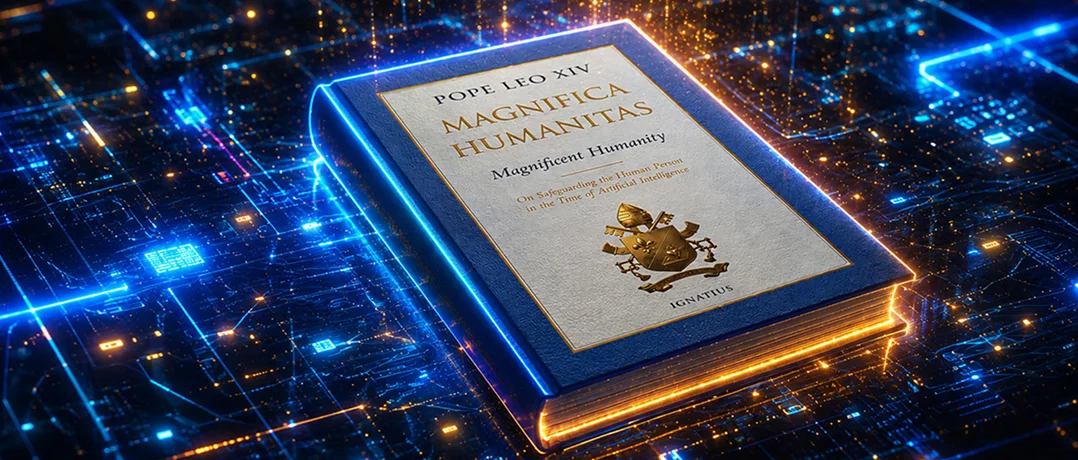
In an age increasingly shaped by artificial intelligence (AI), Pope Leo XIV has positioned the Catholic Church at the center of one of the defining ethical debates of the 21st century. Through his first social encyclical, Magnifica Humanitas (“Magnificent Humanity”), the Pope presents a powerful reflection on the promises and dangers of emerging technologies, urging the global community to ensure that AI remains firmly at the service of humanity rather than becoming a tool of domination, exclusion, and warfare.
The document represents far more than a theological meditation on technology. It is a comprehensive moral and social appeal that seeks to redefine the relationship between human dignity and technological progress. Drawing direct parallels with Pope Leo XIII’s landmark 1891 encyclical Rerum Novarum, which addressed the injustices of the Industrial Revolution, Pope Leo XIV argues that the world now faces another transformative moment requiring ethical discernment, collective responsibility, and renewed attention to the common good.
A new technological revolution
Pope Leo XIV describes the rise of artificial intelligence as an “epochal turning point” comparable to the Industrial Revolution. Just as industrialization transformed economies and societies in the 19th century, AI is now reshaping nearly every aspect of human life. From healthcare systems and employment decisions to military operations and political communication, algorithms are becoming deeply embedded in structures that determine human coexistence.
However, the Pope warns that technological advancement cannot be viewed as morally neutral. Every technological system reflects human choices, values, and priorities. Artificial intelligence, he argues, carries within it the risk of reinforcing inequalities, concentrating power, and reducing human beings to data points or instruments of productivity.
One of the encyclical’s central concerns is the growing use of AI in warfare. Pope Leo strongly condemns autonomous weapons systems and the increasing reliance on predictive technologies in military conflicts. According to the Pope, delegating life-and-death decisions to algorithms threatens to further dehumanize war while lowering the moral barriers to violence.
His declaration that “artificial intelligence needs to be disarmed” became the defining message of the encyclical. Although he acknowledged the forcefulness of the phrase, the Pope insisted that the gravity of the present moment requires language capable of awakening global consciences.
The human person at the center
At the heart of Magnifica Humanitas lies the Church’s longstanding defense of human dignity. Pope Leo XIV repeatedly highlighted that no machine can replace the spiritual, emotional, and moral dimensions of the human person. Human beings possess freedom, conscience, interiority, and the capacity for love and worship; qualities that transcend technological replication.
The Pope criticizes modern tendencies to evaluate individuals solely through measurable performance, efficiency, or productivity. He warns that AI systems capable of denying access to healthcare, employment, or security based on biased or incomplete data risk creating new forms of exclusion and discrimination.
In this context, the encyclical strongly opposes both “transhumanism” and “posthumanism.” Pope Leo argues that humanity must resist ideologies that seek to blur the distinction between humans and machines or reduce human identity to technological enhancement. Instead, he insists that authentic progress must protect the unique value of every person, particularly the poor, vulnerable, and marginalized.
The Pope also links AI-related exploitation to historical injustices, including slavery and colonialism. In one of the document’s most striking passages, he offers a profound apology for the Catholic Church’s historical failures regarding slavery, while warning against the emergence of what he calls “new digital slaveries.” He suggests that societies risk normalizing exploitation once again through unethical labor practices, surveillance systems, and monopolistic control of data and technology.
Moral responsibility and global cooperation
Rather than rejecting AI outright, Pope Leo XIV calls for ethical governance and responsible innovation. He acknowledges the tremendous opportunities AI can offer in medicine, education, scientific research, and communication. Nevertheless, he stresses that technological power must always be accompanied by moral responsibility and public accountability.
The encyclical advocates robust legal frameworks, independent oversight, and international cooperation to regulate AI development. The Pope argues that decisions concerning AI cannot remain in the hands of a privileged few corporations, governments, or technological elites. Instead, all sectors of society (including educators, scientists, political leaders, religious communities, and ordinary citizens) must participate in shaping the ethical future of technology.
Pope Leo also warns against what he describes as “digital colonialism,” whereby powerful nations or corporations impose technological systems upon weaker societies while extracting economic and social control. For the Pope, genuine technological progress must benefit the entire human family rather than deepen global inequalities.
The encyclical further reflects the Pope’s broader commitment to peace. He criticizes the logic of perpetual conflict and questions the relevance of the traditional “just war” theory (bellum iustum) in an era of autonomous weapons and algorithmic warfare. According to Pope Leo, humanity already possesses more humane tools for resolving disputes, including dialogue, diplomacy, forgiveness, and international cooperation.
Building a “civilization of love”
Despite its warnings, Magnifica Humanitas is ultimately a hopeful document. Pope Leo XIV does not portray technology as humanity’s enemy but rather as a “construction site” that can either strengthen or weaken civilization depending on the values guiding its development.
Drawing from his missionary experience in Peru following devastating floods in 2017, the Pope reflects on the meaning of rebuilding societies. Reconstruction, he explains, is not merely about restoring physical infrastructure but about repairing relationships, rebuilding trust, and renewing hope. This vision becomes a metaphor for the ethical rebuilding required in the digital age.
The Pope invokes the biblical figure of Nehemiah rebuilding the walls of Jerusalem as a model for constructing a more humane technological future. He calls upon believers and non-believers alike to become “artisans of hope” dedicated to creating what previous popes described as a “civilization of love.”
At a time when technological power continues to expand at unprecedented speed, Pope Leo XIV’s message serves as both a warning and an appeal: that progress without ethics risks undermining the very humanity it claims to advance.
-
-

-
The Beiruter
-
