



Marie-Rose Osta won the Golden Bear for Best Short Film in Berlin for Someday, a Child (Yawman ma Walad), marking a major moment for contemporary Lebanese cinema.
Marie-Rose Osta wins Berlin’s Golden Bear

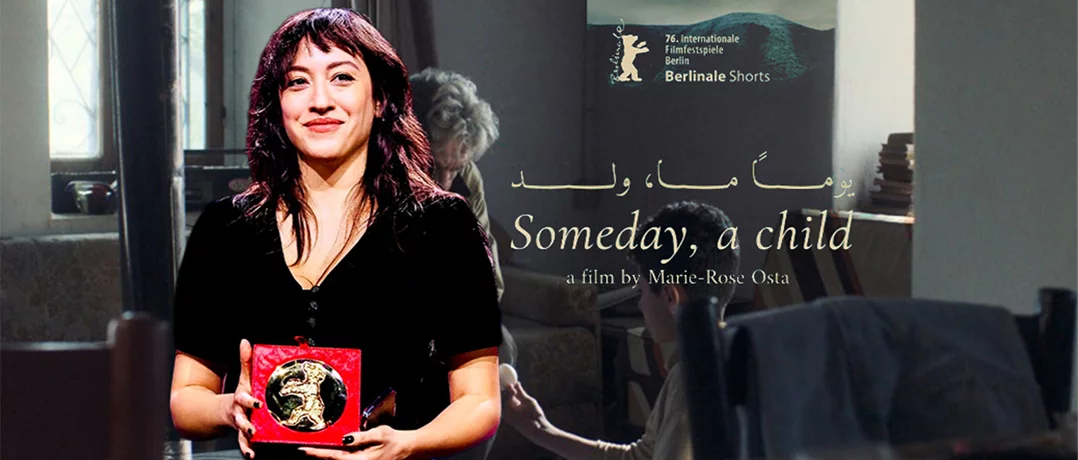
Lebanese filmmaker Marie-Rose Osta has brought one of world cinema’s highest honors back to Beirut. At the 2026 Berlin International Film Festival, Osta won the Golden Bear for Best Short Film for her latest work, Someday, a Child (Yawman ma Walad), a haunting, politically charged film that merges magical realism with the lived reality of war.
A child with powers and a country at war
Someday, a Child tells the story of a boy gifted, or burdened, with special powers that prevent Israeli fighter jets from waking him from his sleep. His uncle helps him suppress those powers, teaching him how to appear “normal,” until the force inside him spirals beyond control.
On the surface, the premise feels fantastical. But Osta’s storytelling is anything but escapist. The film moves in the space between dream and documentary, between childhood imagination and political trauma. The “powers” become a metaphor for resistance, survival, and the cost of growing up too quickly.
Osta captures what might be called the first political consciousness of a child, the moment innocence fractures and awareness enters. In her hands, magical realism becomes a language for unspeakable realities.
A filmmaker shaped by independence
Marie-Rose Osta is no stranger to international recognition. A Lebanese scriptwriter and director with a strong passion for independent filmmaking, she has built a body of short films, each distinct in tone and texture. Her 2021 short, Then Came Dark, premiered at the 43rd Cairo International Film Festival, where it won the Special Jury Award, and was later presented at the 40th São Paulo Biennial. She is currently developing her debut feature film while producing a new short, both forming part of a diptych centered on childhood.
Berlin and a speech that cut through the room
Standing on stage in Berlin, Osta used her moment for confrontation. “No child should need superpowers to survive a genocide empowered by veto powers and the collapse of international law,” she said in her acceptance speech. “If this award means anything at all, let it mean that Lebanese and Palestinian children are not negotiable.” In a festival known for its political consciousness, her words landed heavily, transforming a cinematic victory into a moral statement.
A new Lebanese cinematic voice
Lebanese cinema has long carried stories of war, memory, and fragmentation. Osta belongs to a generation reshaping how those stories are told, less through direct confrontation, more through layered allegory and intimate psychological landscapes.
Winning the Golden Bear places her among the most internationally recognized Lebanese filmmakers of her generation. More importantly, it positions her voice within a global conversation about art, accountability, and the politics of representation. With a debut feature film currently in development and a growing international presence, Marie-Rose Osta is no longer just an emerging filmmaker. She is becoming one of the defining cinematic voices of a generation raised between bombardment and imagination, and unwilling to let either be forgotten.
-
-

-
The Beiruter
-
