



New maritime traffic data and maps reveal where global trade converges, who controls the passages it depends on, and the distances ships must travel when the shortest routes are no longer available.
Maritime trade and the limits of shortcuts
Maritime trade and the limits of shortcuts
By Katharine Sorensen | September 24, 2026

Reading time: 8 min
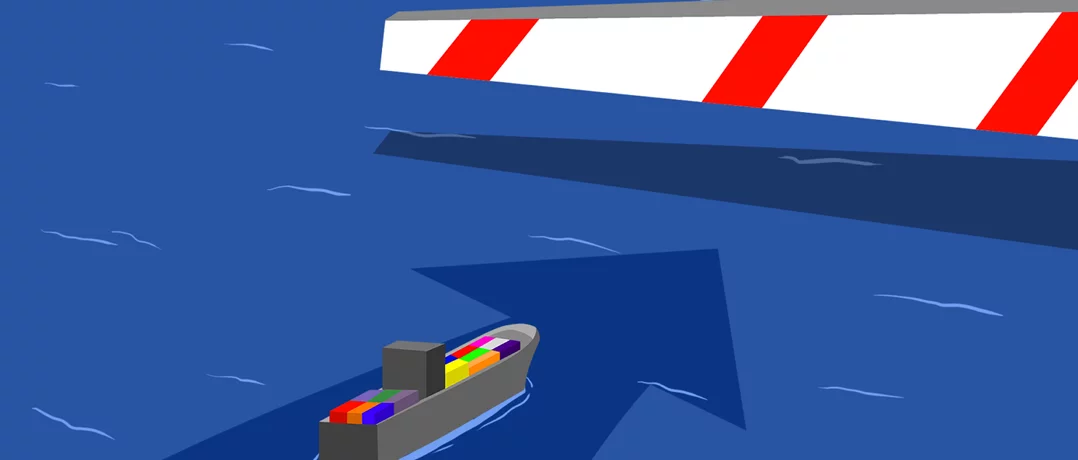
When container ship Dubai Tower left Ningbo-Zhoushan in eastern China on August 15, carrying roughly 1,500 containers of manufactured goods, it did something unusual for a container ship bound for Europe. It turned north. Instead of joining the stream of vessels heading toward the Strait of Malacca, the Red Sea and the Suez Canal, the Dubai Tower sailed through the Bering Strait and entered the Arctic. From there, it followed Russia's northern coast toward Europe. Twenty-five days later, it reached Teesport in Britain. The voyage was part of a wider increase in vessel activity across Arctic waters. Pole Star Global, a maritime intelligence company, recorded 144 vessel visits to the Northwest Passage in August 2026, up from 127 in August 2025. Traffic remains highly seasonal, falling to only a handful of visits during the winter months, but summer activity has risen and is expected to increase as northern waters become more accessible. For a trading system confronting disruption in the Middle East, a more navigable Arctic could give Asia-Europe shipping an alternative to routes through several critical passages. Sea Legend, the Chinese carrier operating the Dubai Tower, markets the Arctic journey at roughly 20 days, compared with around 40 through Suez. But the Dubai Tower remains an exception. Most global shipping still funnels through a remarkably small number of passages. Pole Star has identified nine at the center of the system: the Straits of Malacca, Taiwan, Hormuz and Gibraltar, Bab el-Mandeb, the Bosporus Strait, the English Channel, and the Suez and Panama canals. “The broader story here is just how important these nine chokepoints are globally,” Saleem Kan, chief data and analytics officer at Pole Star Global, told The Beiruter. Close one gate, and the world's ships begin searching for another. Globalization dispersed production across continents, built ports handling tens of thousands of containers at once, and connected supply chains across enormous distances. Yet much of that system still converges on waterways whose locations were determined by geography long before modern trade existed. The vulnerabilities created by that concentration, however, are not uniform. Chokepoints face pressures ranging from conflict and geopolitical tension to congestion (English Channel), climate (Panama Canal), or dependence on a heavily used corridor (Strait of Malacca). Conflict in the Middle East has put those differences to the test. From January through August, observed daily transits through the Strait of Hormuz were 64.9% lower in 2026 than in 2024, while Bosporus traffic was 176.5% higher. Panama rose 28.2%, Suez 14% and Malacca 9.9%. As fighting involving Iran continued to disrupt Hormuz, petroleum flows through the strait fell from 21.6 million barrels per day in late 2025 to 4.9 million in the second quarter of 2026, while flows through Bab el-Mandeb rose from 5.4 million to 8.1 million, according to the U.S. Energy Information Administration. By August, Houthi attacks were also constraining Saudi exports through the Red Sea, pushing more oil north through the Suez Canal. Disruption at one passage had seemingly redirected traffic toward routes facing risks of their own. Few countries have tried more deliberately to reduce such dependencies than China. Beijing has developed pipelines, diversified its energy suppliers and reduced some oil demand through electrification, partly to lessen its reliance on supplies passing through the Strait of Malacca. “China has spent the past two decades trying to overcome the ‘Malacca dilemma,’ and it has managed to do so with some success,” Collin Koh, a senior fellow at the S. Rajaratnam School of International Studies in Singapore, told The Beiruter. Pipelines, alternative ports and new shipping routes can therefore redistribute dependence, but they rarely eliminate it. Instead, they shift where that dependence falls. If geography determines where a chokepoint lies, it does not necessarily determine who controls passage through it. Under the United Nations Convention on the Law of the Sea, straits used for international navigation generally carry a right of “transit passage,” limiting the ability of coastal states to treat the waters like an ordinary extension of their territory. Ships must proceed without delay and comply with navigation and pollution rules, while states bordering the strait retain authority over matters including safety and traffic separation. But the world's major chokepoints sit under very different regimes. Panama owns and operates its canal through the Panama Canal Authority, although a 1977 treaty commits it to permanent neutrality and peaceful transit for vessels of all nations on equal terms. Egypt operates the Suez Canal. Passage through the Turkish Straits is governed by the 1936 Montreux Convention, while Malacca and Hormuz fall under international rules governing transit through straits. The distinction between legal authority and practical power is crucial. Compare Malacca and Hormuz. Iran shares the strait with Oman and does not possess an unrestricted legal right to halt international transit. But its position along the northern shore, combined with its military capabilities, gives Tehran the practical ability to threaten shipping through the passage. “Iran does not need to close the strait to threaten the ships moving through it,” Khan said. On September 21, a tanker transiting into the Strait of Hormuz was struck by an unidentified projectile, injuring two crew members. The vessel remained under its own power and continued toward its next port, according to the UK Maritime Trade Operations. The International Maritime Organization identified it as the LR Stephanie and listed it among 82 confirmed incidents in the Strait of Hormuz and the wider Middle East as of that date. This year's fall in observed traffic showed how military risk, rising insurance costs and operators' willingness to sail can matter as much as the formal rules governing passage. Malacca, on the other hand, presents a different security environment. Koh said the principal threat has been piracy rather than armed groups such as the Houthis threatening passage, while the waterway is shared among Indonesia, Malaysia and Singapore. ““There are longstanding intraregional problems, including overlapping claims and differences over how the waterway should be governed. But none of these has stopped practical cooperation,” Koh said Control, then, is rarely absolute. A state may possess the territory without an unrestricted right to stop passage, operate the infrastructure without controlling the security environment beyond it, or lack formal authority over shipping while retaining the military power to make transit prohibitively dangerous. Not every chokepoint has the same alternatives. Suez can be bypassed around Africa, while ships avoiding Malacca can take longer routes through the Indonesian archipelago. Panama saves vessels from rounding South America, but drought can restrict access. Hormuz is different. Pipelines can carry some Gulf oil to terminals elsewhere, but there is no maritime bypass. The fewer the substitutes, the greater the consequences when passage is disrupted Rerouting also depends on the cargo and its origin. Sneakers shipped from China to Europe, for instance, can still reach their destination if Suez becomes unavailable. The vessel can sail around the Cape of Good Hope, adding two to three weeks, Khan said. Oil and liquefied natural gas produced in the Gulf face a different problem. If Hormuz becomes inaccessible, a tanker cannot simply choose a longer maritime route because every route to the open ocean first passes through the strait. “Some commodities have far more flexibility than others,” Khan said. Where rerouting is possible, however, it comes at a price. Since the shortest viable route is generally the cheapest, every additional day at sea adds fuel and crew costs, while tying up vessels that could otherwise be carrying cargo. Those additional distances were already visible in global shipping data before the disruptions of 2026. In 2024, the volume of goods transported by sea grew just 2.2%, but ships were carrying that cargo considerably farther, with the amount of transport required rising 5.9%, according to UN Trade and Development. As those costs accumulate, the limits of adaptation may ultimately lie not with shipping, but with the economies it serves. “The question facing global trade is not so much whether the world’s maritime system can withstand simultaneous disruptions,” Koh said. The Dubai Tower reached Teesport in 25 days, more than two weeks faster than the conventional route through Suez. Its voyage did something more than avoid an established passage; it treated the geography of Asia-Europe trade itself as negotiable, using a route that until recently sat largely outside the commercial system. For now, such voyages account for only a fraction of global shipping. But its emergence points to what prolonged disruption could do to global shipping. Routes built around Suez, Malacca and other passages are not immutable. If the cost or risk of using them remains high enough for long enough, carriers have an incentive to test alternatives once considered too expensive, difficult or seasonal. Monthly vessel visits to the Northwest Passage, September 2024 to September 2026. Visits peaked at 144 in August 2026. Source: Pole Star Global.
Around ninety percent of everything we consume and use globally comes to us on a ship by sea.
The geography globalization could not engineer away
 Average daily vessel transits through nine major maritime chokepoints from January through August, 2024–26, alongside the dominant source of stress identified at each passage. Source: Pole Star Global.
 Average daily vessel transits through nine major maritime chokepoints, January through August 2026, with changes measured against the same period in 2024. Source: Pole Star Global.
But ultimately, China still relies on free passage through the Indian Ocean, whether we are talking about energy resources coming from the Middle East or trade flowing toward Europe.
Who controls the gate?
Any oil tanker in the Gulf right now is essentially a sitting duck.
For any of the coastal states in the Malacca Strait to have leverage over the waterway, it has to be collective rather than unilateral.
The cost of another way
Not every commodity can be rerouted easily. It depends on the type of commodity.
It is whether the world economy can continue to withstand them, as inflation rises, consumers bear higher costs, and more vulnerable developing economies feel the consequences.
-
-

-
Katharine SorensenReporterSpecializing in global affairs, technology and economics, with a focus on on-the-ground investigative reporting.
-
