



Ahead of its expected launch in early 2027, The Beiruter gained access to MITAI’s ambitious new AI-powered platform, testing its ability to guide citizens through nearly 3,000 government procedures, recommend administrative reforms and identify potential conflicts in legislation.
Meet Sabil, Lebanon's digital reform platform
Meet Sabil, Lebanon's digital reform platform
By Katharine Sorensen | November 19, 2026

Reading time: 7 min

“How can I help you today with your procedures?” the screen reads in English, with the same question repeated beneath it in Arabic. It looks like a typical artificial intelligence chatbot, except the suggested questions are distinctly bureaucratic in focus and center on paperwork, permits, and public approvals. Users can change the platform’s primary language to French or Arabic by selecting the respective option in the upper-right corner of the screen, while a microphone icon signals that questions can also be asked aloud. A quick scroll down the homepage reveals hundreds of “procedures” grouped together by ministry. There's the Ministry of Agriculture, the Ministry of Culture, the Ministry of Education and Higher Education, the list continues. Emergency numbers for the Lebanese Red Cross, Internal Security Forces, Directorate General of Civil Defense, and the Lebanese Army are listed at the bottom. Behind the curious platform is Lebanon's Ministry of Technology and Artificial Intelligence (MITAI), which is developing an AI-powered tool to help citizens navigate the country's complicated at best—bewildering at worst—administrative procedures. Named Sabil, from the Arabic word سَبِيل, meaning “way” or “path,” the platform brings information on thousands of government procedures into a single, searchable interface. It is set to become accessible to the public in early 2027, although citizens can sign up on an early access waitlist through the ministry’s website. “The aim is to give citizens direct access to information that has often been difficult to obtain,” Jean-Pierre Fakhry, who leads Sabil’s development, told The Beiruter. In October 2026, MITAI held a three-day demonstration at the Grand Serail, inviting representatives of government ministries to test the platform, provide feedback, and verify the accuracy of its administrative information ahead of the public launch. “Any digital product doesn't need to be perfect when you launch it,” Minister of State for Technology and Artificial Intelligence Kamal Shehadi said, speaking to The Beiruter. Following a live demonstration at the ministry, MITAI granted The Beiruter access to Sabil for a week to better understand its capabilities. The question at hand was an intriguing one: could a chatbot really make sense of Lebanon's bureaucracy, let alone help simplify it? Sabil's citizen-facing interface draws on a database of 2,999 administrative procedures across 61 public institutions, consolidating information previously scattered across government offices. “As a citizen, you can access the platform and ask any question about any government procedure,” Fakhry said. Rather than requiring users to identify the responsible institution, the platform allows them to describe what they need in ordinary language. Its AI assistant then searches the relevant procedures and identifies required documents, fees, offices to visit, and the sequence of administrative steps. The interaction is designed to be conversational rather than confined to a predetermined list of questions. Users can ask follow-up questions and upload photographs of documents to receive more specific guidance. Alongside written exchanges in Arabic, French and English, Sabil supports spoken questions and responses, including in Lebanese Arabic, while accommodating Arabizi, the informal practice of writing Arabic using Latin characters and numbers. The catalogue also allows users to browse procedures by institution rather than relying exclusively on the chatbot. Individual entries identify the administrative steps involved and, where available, provide estimates of processing times and costs. Procedures range from passport renewals and industrial licenses to the accreditation of election observers and complaints against tourism establishments. For citizens, the immediate benefit would be greater certainty before approaching a public institution. By removing some of the guesswork from administrative transactions, Sabil could reduce unnecessary visits, spare applicants the familiar frustration of arriving with the wrong paperwork and lessen dependence on intermediaries who charge for navigating bureaucratic requirements. Yet Sabil does not currently allow citizens to complete every transaction online. Its immediate function is to explain existing procedures and direct users to online services where available. The information itself remains subject to verification by the institutions responsible for administering those procedures. Lest one think Sabil is merely a guide through Lebanon's bureaucratic maze, its second interface turns the scrutiny on the bureaucracy itself, identifying administrative requirements that could be simplified or eliminated altogether. During a demonstration for The Beiruter, Fakhry opened a Ministry of Culture procedure for submitting a cultural project. The process involved approximately ten steps, each accompanied by its legal references and administrative requirements. Sabil's AI analysis identified several opportunities for simplification, including eliminating a step that did not require a change in legislation, introducing digital submissions, and dispensing with the manual transfer of documents between offices. According to the platform's estimates, implementing the proposed changes could reduce processing times from 17–41 days to just 5–12 days, while eliminating three administrative steps could save applicants between LBP 105,000 and LBP 205,000. These figures represent AI-generated projections rather than improvements already achieved by the ministry. Across the 2,999 procedures catalogued by MITAI, Sabil has mapped 20,441 individual steps. Of these, 9,908 have no identified legal basis, according to the ministry, meaning they may arise from administrative practice rather than requirements established by legislation. That does not necessarily make them unlawful or dispensable. It does, however, suggest that some of Lebanon's bureaucratic complexity could be addressed through administrative decisions without waiting for Parliament to amend existing laws. “This is how we're using AI to show ministries how they can make their procedures more efficient,” Fakhry explained. Whether those recommendations translate into changes will depend on the institutions themselves. Each ministry has a designated point of contact responsible for reviewing its procedures, confirming their accuracy or submitting corrections, with ministries prioritizing five to ten procedures intended to cover approximately 60% of citizen demand. The process is particularly important because some administrative requirements have changed through internal circulars and instructions that are not necessarily published in Lebanon's Official Gazette. “Those in government who want to work together to advance digitization are welcome to join our efforts,” Shehadi said. As of November, 16 of the 23 participating ministries and public institutions had begun reviewing their procedures, with 188 confirmed and 38 of 40 submitted corrections incorporated into the platform, according to MITAI and The Beiruter's review of the platform. The figures indicate that the validation process is underway, although most of the catalogue has yet to receive formal confirmation from the institutions responsible for its contents. Drafting new legislation is complicated enough without discovering that it contradicts laws already on the books. A third Sabil tool, still under development, allows government employees to upload draft legislation and use AI to identify potential contradictions, overlaps and gaps in existing laws and regulations. During the demonstration, Fakhry presented an analysis of a draft law concerning beneficial ownership and taxpayers' obligations. The analysis identified eight potential conflicts with existing legislation, nine areas requiring amendment or implementation, and four implementing decrees. It also flagged 12 directly affected administrative procedures and 79 procedures citing the laws in question. The findings are preliminary, requiring legal review rather than constituting authoritative interpretations of Lebanese law. Nevertheless, the tool could substantially reduce the time officials spend examining how proposed legislation interacts with existing requirements. “Because we have all this legal data, someone working in a ministry can upload a draft law and identify potential contradictions, overlaps and gaps,” Fakhry explained. Such applications form part of a larger effort to reconsider how Lebanon’s government delivers public services, with AI potentially serving as an instrument of administrative reform rather than simply another technology adopted by the state. “The starting point should be identifying the critical services a digital government needs to provide,” Shehadi said. At this stage, Sabil remains an experiment in making government procedures more accessible, understandable and, potentially, less cumbersome. Its longer-term ambitions depend on ministries translating digital recommendations into practical changes. The technology may be new, but the obstacles it seeks to address are decidedly familiar. And digitizing bureaucracy, it turns out, requires navigating a formidable amount of it.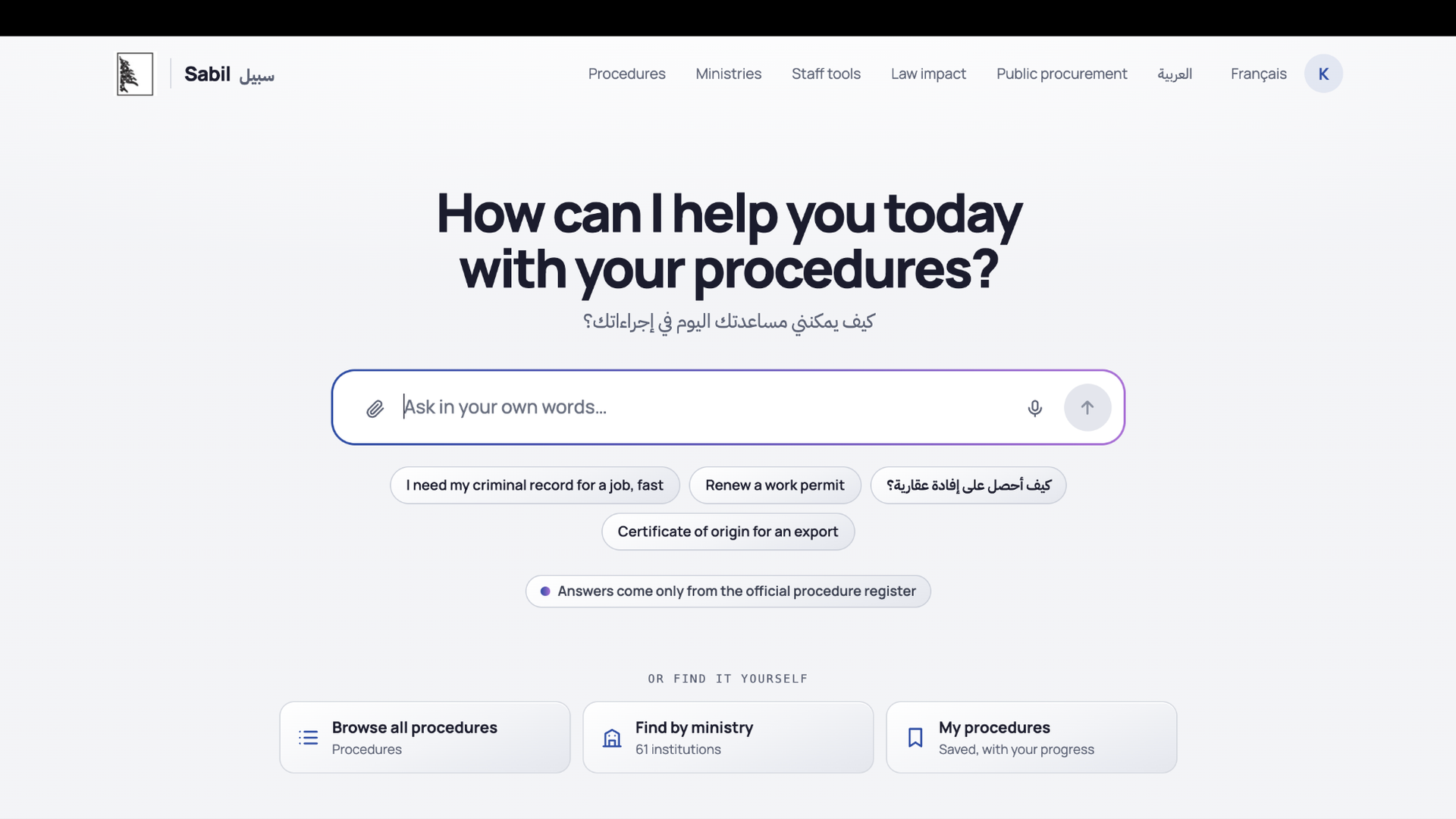 Sabil's homepage offers citizens access to nearly 3,000 government procedures through an AI-powered interface
We’re trying to tackle ‘samsara’ (سَمْسَرَة), the reliance on intermediaries, and we see this as step zero.
When you pilot it, you start discovering areas for improvement and can act on them. That should be part of our DNA, never considering something perfect and stopping there.
A citizen’s guide to the bureaucracy
Our ultimate goal is for citizens to complete any government procedure through Sabil without having to visit a ministry or public institution. That's our north star.
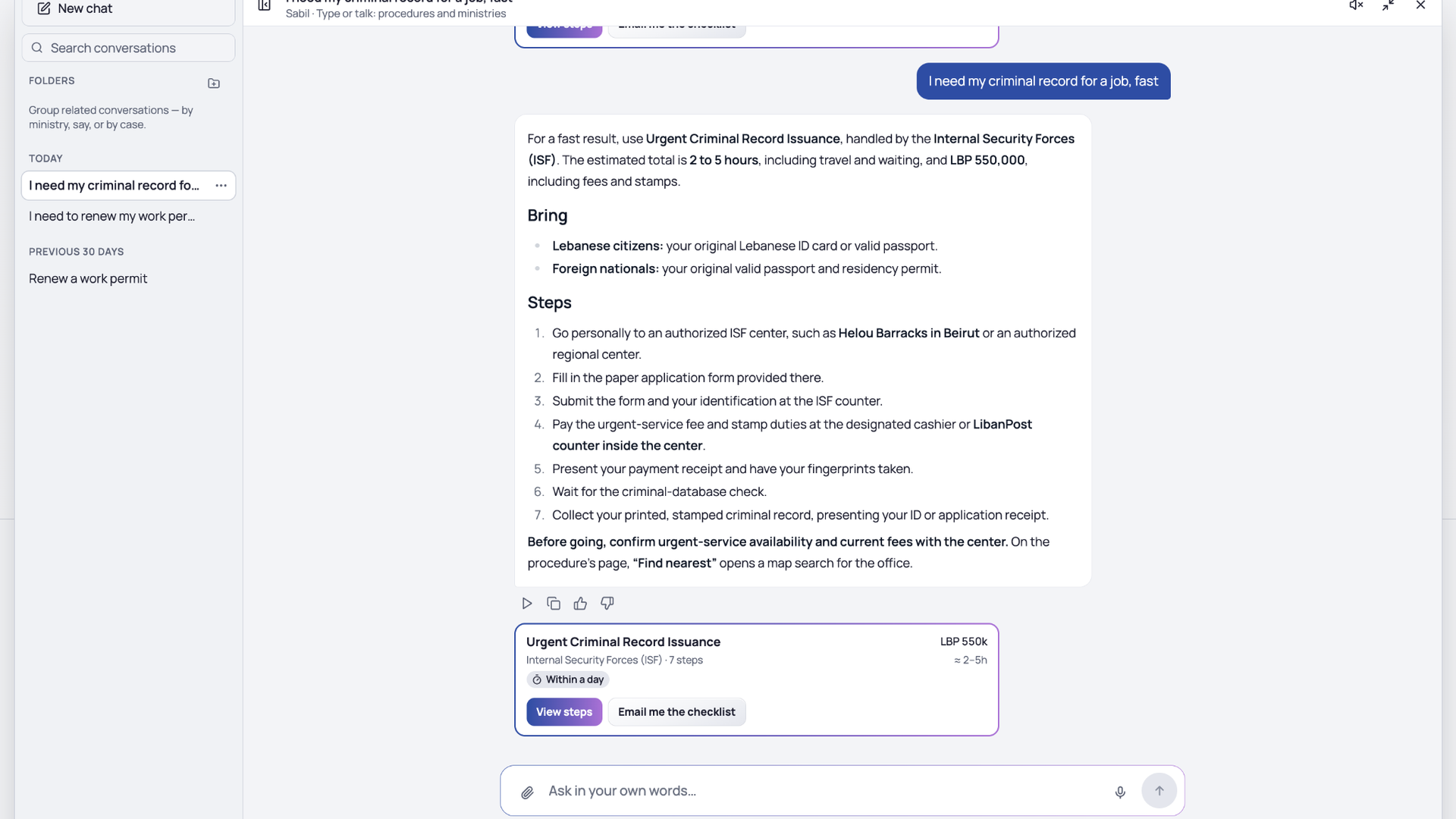
Sabil's AI assistant responds to a request for an urgent criminal record, outlining the documents, fees and seven administrative steps involved.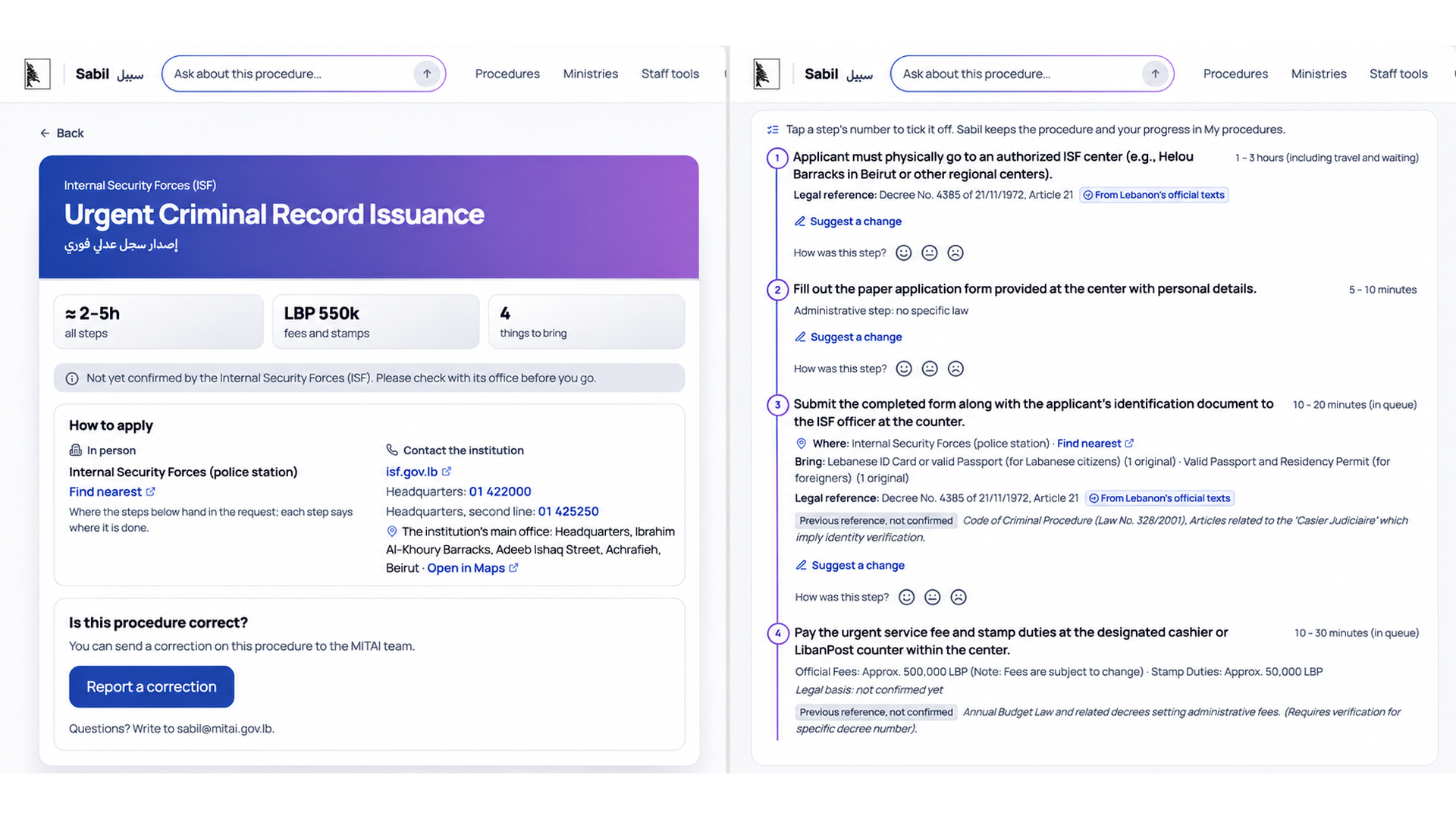 Sabil's detailed procedure guide provides estimated processing times, fees, office information and individual administrative steps, accompanied by legal references.
A government audit of its own procedures
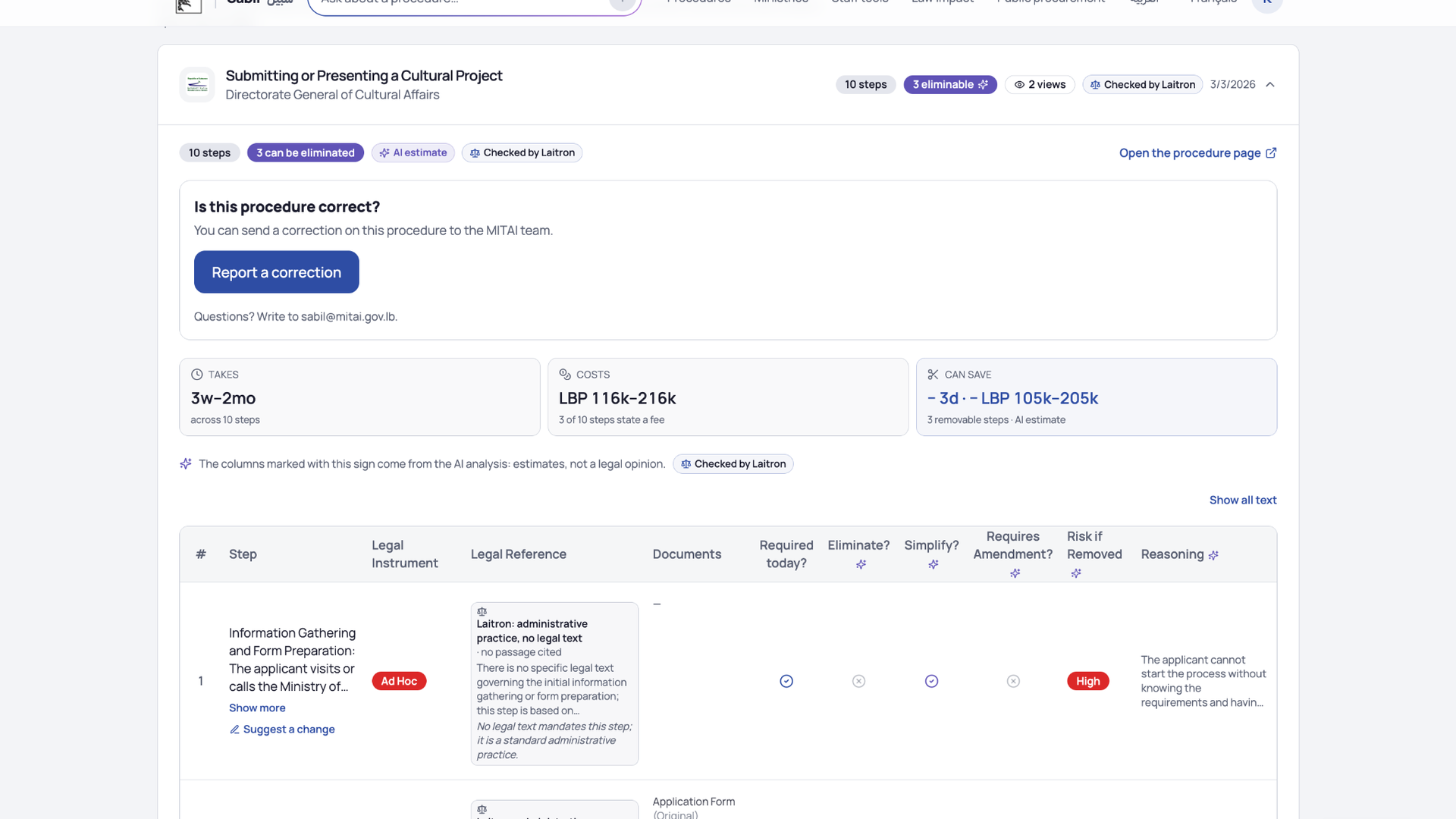 Sabil's AI analysis of a Ministry of Culture procedure identifies three potentially removable administrative steps and estimates savings of LBP 105,000–205,000. The recommendations and projected savings are AI-generated.
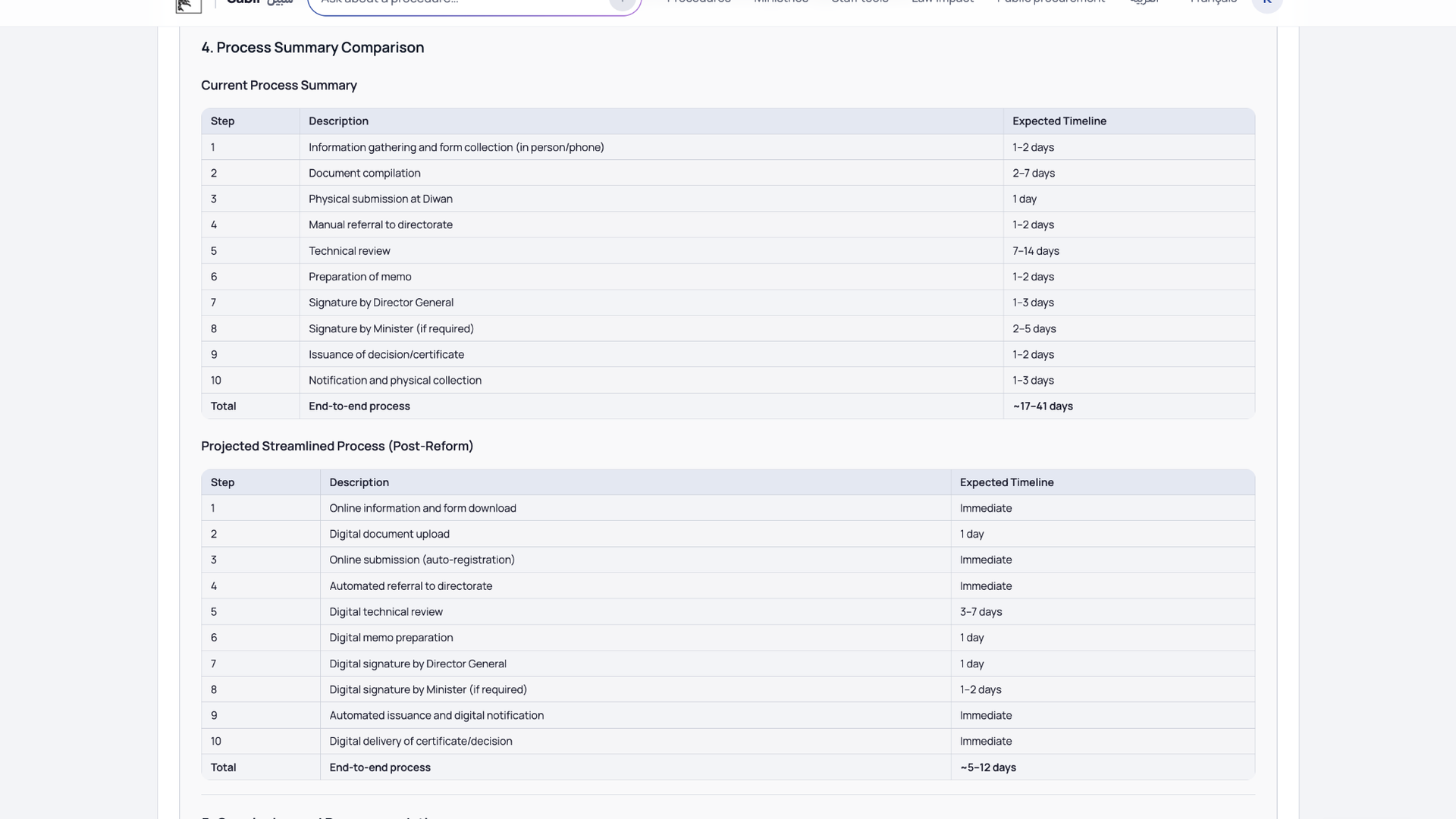 A comparison generated by Sabil outlines how digitizing a Ministry of Culture procedure could reduce estimated processing times from 17–41 days to 5–12 days. The proposed changes have not been implemented.
But these are AI-generated recommendations based on the data we have. We're not telling ministries they have to follow them. They know their own procedures better than we do.
The analogy of a ‘coalition of the willing’ is particularly apt.
Putting legislation to the test
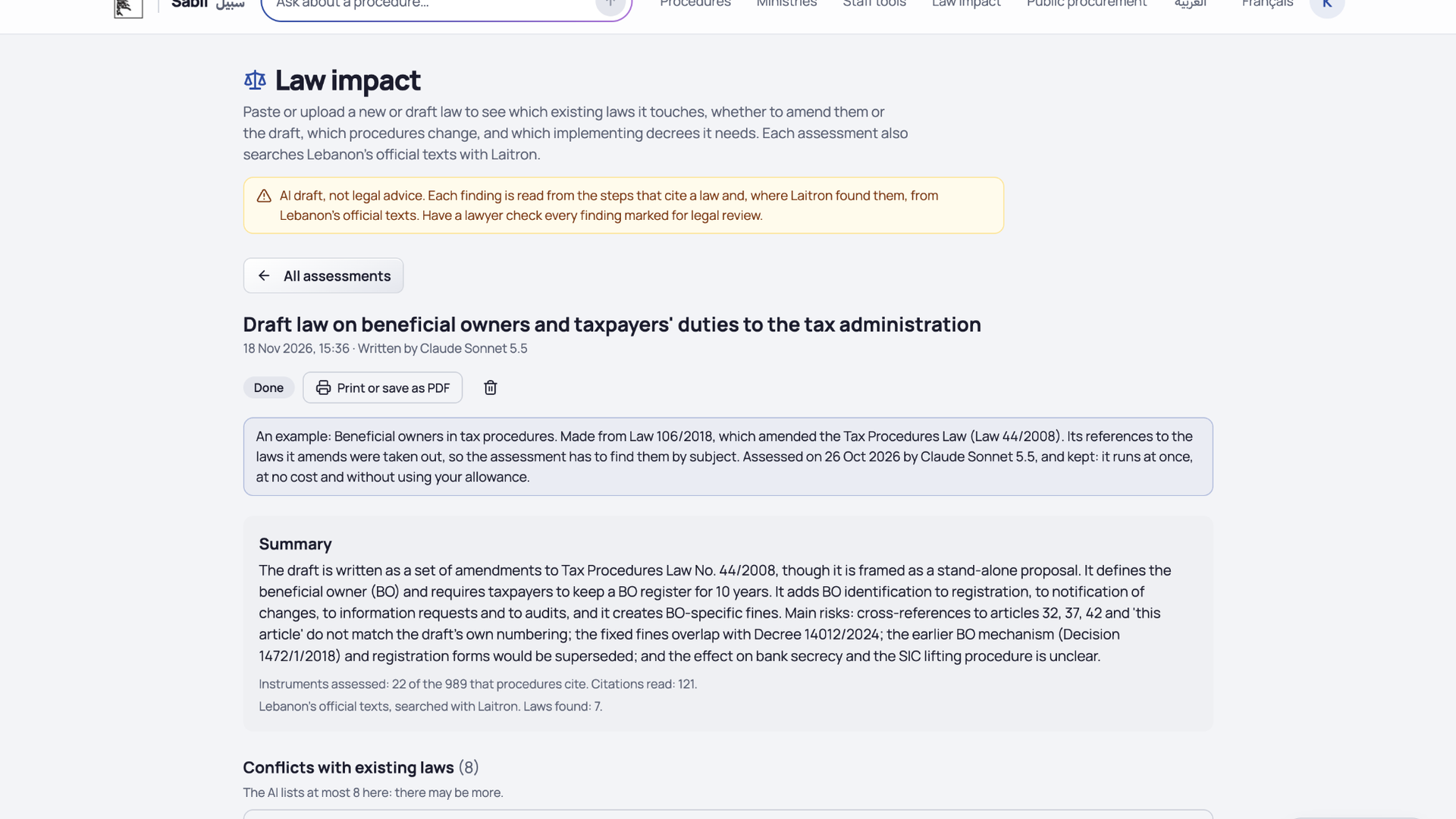 Sabil's legislative impact tool analyzes a draft law concerning beneficial ownership and taxpayer obligations, identifying potential conflicts with existing legislation. Its findings are AI-generated and require legal review.
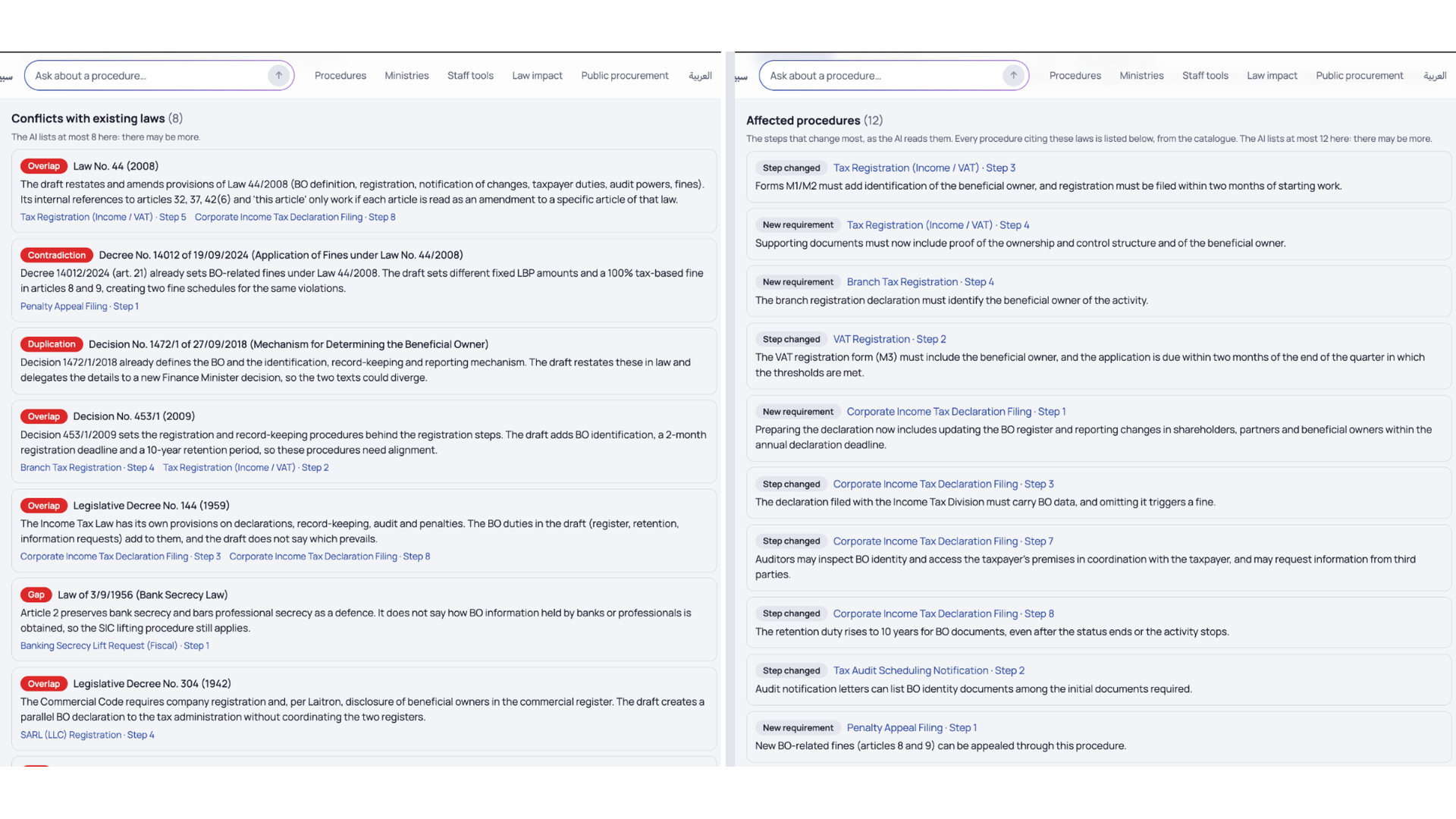 Sabil's legislative impact tool identifies potential conflicts with existing laws (left) and administrative procedures that could be affected by proposed legislation (right). The findings are AI-generated and subject to legal review.
AI can deliver better healthcare, better social benefits, and a better quality of life generally, not to mention a more efficient government.
-
-

-
Katharine SorensenReporterSpecializing in global affairs, technology and economics, with a focus on on-the-ground investigative reporting.
-
