



Justice Minister Adel Nassar details efforts to restore judicial independence, reopen stalled investigations, strengthen international cooperation, and rebuild Lebanon’s justice system amid deep structural constraints.
Minister Adel Nassar on restoring justice and the rule of law
Minister Adel Nassar on restoring justice and the rule of law
By The Beiruter | January 03, 2026

Reading time: 10 min
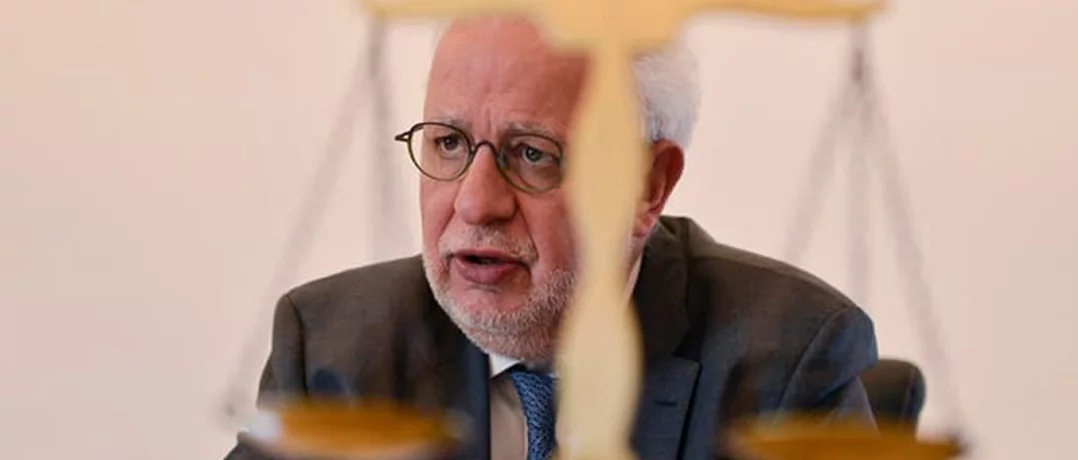
An Exclusive Interview to The Beiruter with the Lebanese Minister of Justice Adel Nassar
In an exclusive interview with The Beiruter, Lebanese Minister of Justice Adel Nassar outlined the priorities, challenges and outcomes of his tenure, placing particular emphasis on judicial independence, stalled investigations, international cooperation and institutional reform.
Throughout the discussion, Nassar framed his work not as a series of exceptional accomplishments, but rather as the fulfillment of long-overdue national duties; tasks delayed for years by political obstruction, institutional paralysis, and chronic underfunding of the justice sector.
From here, we will present the interview’s principal points, structured around the key thematic issues addressed by the minister.
Three core priorities and achievements: reactivating a paralyzed justice system
From the outset of his mandate, Minister Nassar explained that he defined three primary objectives for the Ministry of Justice; areas that had been either fully inactive or deliberately obstructed for years.
Resuming stalled investigations, particularly the 2020 Beirut port blast:
After a two-year suspension, investigations into the 4 August 2020 Beirut port explosion were resumed under the authority of Investigating Judge Tarek al-Bitar. Interestingly, an unprecedented step was taken when the Lebanese judiciary traveled abroad to conduct crucial interrogations; marking the first time such a procedure occurred.
Nassar considered this development an achievement in itself, stating that “even if the detainee did not cooperate, this does not negate the fact that this is considered an achievement, instead of foreign parties solely coming to Lebanon to conduct such interrogations.”
Other long-stalled investigations were also reactivated, including the case of assassinated intellectual and activist Lokman Slim, who was killed on 4 February 2021.
Filling judicial vacancies in accordance with the law:
Judicial appointments were made to key institutions, including the Higher Judicial Council, the Judicial Inspection Body and the Financial Prosecutor’s Office. Nassar stressed that these appointments marked a clear departure from past practices of political interference and quota-sharing, emphasizing that selections were made strictly on the basis of legal procedures and judicial independence.
“Of course,” he noted, “you all know that there was a specific position where pressure was applied, but I did not change my stance. I relied on the opinion of the Judicial Council and senior judges, and I stuck to that opinion.”
Completing and enacting the Judicial Independence Law:
The Council of Ministers submitted a draft Judicial Independence Law to Parliament’s Administration and Justice Committee, which proceeded to examine and consolidate the relevant texts. While Nassar stated that he would have preferred the law to be adopted as originally submitted by the government, he acknowledged that, ultimately, the law was passed.
According to Nassar, all three priorities were pursued simultaneously, with full political backing from Lebanese President General Joseph Aoun, Prime Minister Nawaf Salam and the Council of Ministers as a whole. Nevertheless, he refrained from describing them as “achievements,” instead referring to them as essential national obligations of the ministry.
Focusing on the judiciary: Its culture, institutions and sufferings
Nassar emphasized that progress within the judiciary resulted from collective institutional effort rather than individual leadership. He highlighted the work of the President and members of the Higher Judicial Council, noting that they worked continuously and relentlessly (including weekends) for over two months to complete judicial formations. To him, “they provided an example of professional work, free from political influence.”
Revitalizing the Judicial Institute:
Reforms extended to the Judicial Institute, where an agreement was reached with the French Judicial Institute to provide training for judges, including newly appointed ones. French trainers were sent to Lebanon, facilities were rehabilitated and equipment (including computers) was provided.
“We will also continue ongoing training for all judges,” Nassar said, describing the reactivation of the institute as “essential to guarantee the quality and integrity of judicial work.”
He linked these efforts to a broader shift in judicial culture, noting that stalled and dormant files resumed movement, long-term detainees without trial were released and political interference was increasingly kept “outside the doors of the courts.”
Court efficiency and prison overcrowding:
Nassar also addressed the reopening of the Roumieh courtroom, carried out in cooperation with the Lebanese Ministry of Interior and Municipalities. This led to a dramatic increase in court sessions (from approximately 30% to 88%). Judges and lawyers responded fully, helping reduce case backlogs and improve efficiency.
Moreover, the ministry is also working to activate the Committee for Sentence Reductions, which contributes to alleviating prison overcrowding. Parallel efforts are underway regarding pretrial detention. “It must be borne in mind that pretrial detention, as the term itself indicates, precedes trial and does not constitute a judgment or verdict,” Nassar stated. “The issuance of a release decision by an investigating judge does not imply the innocence of the accused; it merely indicates that the individual is not subject to detention at this stage, as guilt or sentencing is determined only by the final verdict following trial.”
Judges’ deteriorating conditions and international cooperation:
Nassar drew attention to the deteriorating working conditions of judges and courthouses. “Improving the conditions of courts and judges is absolutely necessary,” he said, warning that their conditions “are miserable, and the state must realize that it cannot treat the judiciary like any other sector. If the judiciary is not functional, the state and rule of law would cease to exist.”
On the international level, Lebanon initiated cooperation with the European Union Agency for Criminal Justice Cooperation (Eurojust) to strengthen investigative capacity, particularly in financial and terrorism-related cases. French financial and anti-terrorism prosecutors also visited Lebanon to facilitate coordination and expertise-sharing.
FATF compliance, Circular No. 1355 and financial investigations
Nassar explained that the ministry implemented all required procedures to comply with Financial Action Task Force (FATF) standards. These included establishing a fund related to proceeds from combating terrorism and corruption, as well as new procedures involving public prosecutors and notaries to combat smuggling and illicit financial flows.
In this context, the ministry issued Circular No. 1355 on 2 October 2025, instructing notaries (when organizing powers of attorney and transactions) to verify that all parties are not listed on national or international sanctions lists. If such listings exist, notaries must refrain from organizing the transaction and notify both the Ministry of Justice and the Special Investigation Commission.
These measures, Nassar said, aim to help Lebanon exit the FATF gray list within the scope of the Ministry of Justice’s responsibilities, while improving the application of the law and protecting the notarial profession from legal accountability.
As for compliance, “there is engagement with notaries,” he said, adding that “communication with them has never been cut off, but has rather persisted.”
Nassar thus stressed that such policies were not adopted merely because they were externally demanded. “If a request made by a state or group coincides with Lebanon’s national interest, I will not refrain from pursuing it merely because it has been requested; the decisive and overriding criterion remains Lebanon’s interest,” Nassar asserted.
Furthermore, the ministry drafted a bill to clarify the legal definition of “promotion” of drugs, which had resulted in excessively harsh sentences for individuals not actually involved in trafficking. The draft law was sent to Parliament and is based on a more humane legal interpretation.
Regarding financial investigations, Nassar stressed the paramount importance of seeing such investigations through to completion and ensuring accountability. Nonetheless, he cautioned against unrealistic expectations regarding the timeline. While investigations have begun, “their timing cannot match media timing,” he said, noting that some judges handle up to 1,500 cases each. Nonetheless, he stressed that files are being opened gradually and investigations are ongoing.
Press freedom and legal safeguards
Nassar stressed that no journalists were detained during his tenure. “Since assuming office, not a single journalist has been detained,” he said, rejecting claims to the contrary as inaccurate.
He clarified, however, that summoning journalists is a legally distinct procedure. When journalists or media professionals are summoned, appearing before the Public Prosecutor, he explained, often serves the journalist’s legal interest, as the prosecutor may either close the file entirely (terminating the case in the summoned party’s favor) or refer it to the Publications Court. For this reason, and in accordance with the law, attendance before the Public Prosecutor upon summons is advisable, as an early dismissal may therefore prevent further proceedings.
Therefore, the ministry was keen to safeguard public rights, including press freedom and the rights of journalists.
Lebanese–Syrian judicial cooperation and the prisoners file
A significant portion of the interview focused on judicial cooperation with Syria, particularly the prisoners file.
Nassar described Lebanon’s approach as “fully positive,” while stressing adherence to constitutional, legal, and institutional frameworks. He claimed that “I do not have the authority to do anything outside my jurisdiction,” while simultaneously stressing the importance of achieving the necessary results.
Nassar explained that a draft agreement covering convicted persons and those being pursued was prepared and reviewed; considered another accomplishment added to the ministry’s records. Nevertheless, certain crimes (such as the killing of civilians or military personnel and rape) were explicitly and vehemently excluded.
However, a misunderstanding arose regarding parliamentary ratification: transferring convicted persons does not require Parliament, whereas cases involving those being pursued do. The Syrian side initially assumed both categories were correlated, while Lebanon clearly distinguished between them. “This was a simple misunderstanding,” Nassar said, stressing that intentions on both sides remained positive and that the agreement is reciprocal and grounded in respect for both countries’ sovereignty.
Humanitarian considerations and prison overcrowding also necessitate resolution, although Nassar firmly rejected any characterization of the process as amnesty.
Meanwhile, the Lebanese judicial delegation, headed by Minister Nassar, presented 3 independent requests:
- Disclosure of all information regarding political assassinations in Lebanon attributed to the former Syrian regime (including the tenures of both former Syrian Presidents Hafez al-Assad and Bashar al-Assad).
- Disclosure of all information regarding Lebanese missing persons in Syria.
- Assistance in recovering fugitives from justice residing in Syria.
On the missing people issue, Nassar acknowledged Syrian claims that prisons had been emptied but said confirmation remains difficult, especially given the recent and drastic change that has occurred in Damascus; thus urging good faith while maintaining political opposition to violations by the former Syrian regime. While no concrete results have been achieved to date, he noted that the Syrian side expressed willingness to cooperate.
From here, Nassar asserted that “this is a discussion that takes place prior to reaching a final agreement.” He added, “Everyone puts forward their ideas, and ultimately, an agreement is reached; however, no options or doors have been closed off.” Nassar consistently underscored the importance of preserving Lebanese sovereignty, stating that “no one dictates anything to anyone.”
Judicial cooperation, he noted, also extends to France and other countries. Requests to hand over former regime officers are handled without leniency, claiming that “when requests come, the judiciary must perform its role and duties, and it is doing so;” although practical and security-related constraints may delay enforcement by the Lebanese security apparatus.
Opposition to the Cabinet’s “Financial Gap Draft Law”
Addressing the recently approved “Financial Gap Draft Law” by the Council of Ministers, Nassar explained his objections, citing unclear figures, insufficient depositor protections and the absence of mandatory forensic audits of the state, the central bank and commercial banks. Regarding the latter, he reiterated his support for a clear legal provision mandating such audits, describing them as “an essential component.”
Nevertheless, Nassar rejected the campaigns targeting the ministers over the vote, stressing that constitutional systems anticipate disagreement within government and that such differences do not undermine ministerial solidarity. Despite diverging perspectives and approaches, Nassar affirmed that “no one in the government had bad intentions towards the depositors.” He thus maintained that the discussions were constructive rather than hostile, while noting that he would have preferred more time to deliberate on such a “sensitive issue.”
Structural obstacles and capital punishment
Funding emerged as the ministry’s principal challenge. Nassar called for increased budgetary allocations for the justice sector as a whole, including the ministry, judges and courthouses. Therefore, due to financial constraints, several reform projects (particularly those aimed at improving judges’ living and working conditions) could not be implemented.
Nassar also reiterated his firm opposition to the death penalty (or capital punishment), arguing that it neither deters crime nor aligns with the state’s moral authority. “The state, including its judiciary, should no longer make a decision to take a life,” he stated, advocating instead for a focus on rehabilitation, institutional reform and support as well as the fair application of the law.
In conclusion, throughout the interview, Justice Minister Adel Nassar portrayed his tenure as a concerted effort to restore institutional credibility, judicial independence and the rule of law in Lebanon after years of stagnation. While acknowledging deep structural and financial constraints, he framed progress as the product of collective political support, professional judicial work and strict adherence to constitutional and legal frameworks.
Whether addressing high-profile investigations, international obligations or sensitive questions of sovereignty and capital punishment, Nassar consistently returned to one guiding principle: “Without a healthy judiciary, there is no state.”
-
-

-
The Beiruter
-
