

Lebanon’s Interior Ministry has launched its first strategic plan, shifting from crisis management to structured reform.
Ministry of Interior’s first ever strategic plan
Ministry of Interior’s first ever strategic plan
By The Beiruter | February 21, 2026

Reading time: 4 min
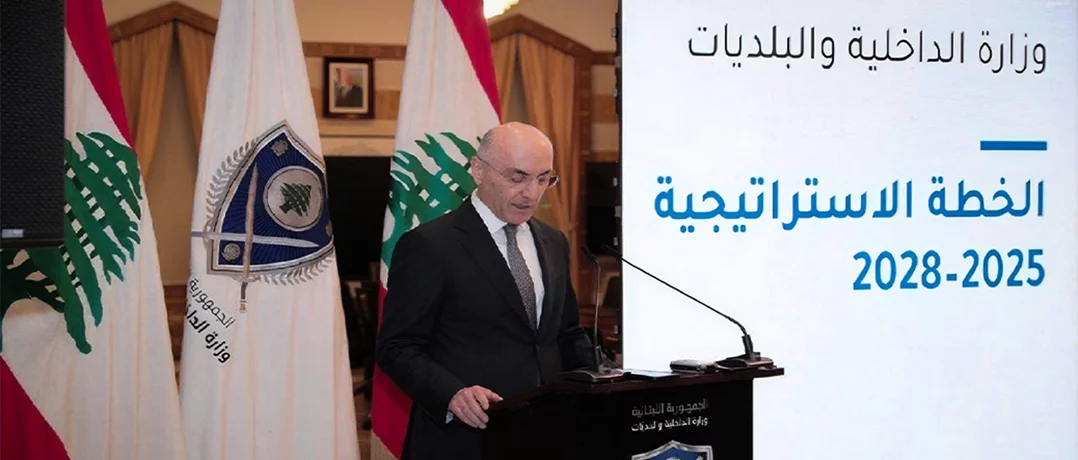
In a move described as unprecedented in the institutional history of Lebanon’s interior administration, Minister of Interior and Municipalities Ahmad al-Hajjar officially unveiled the Ministry’s Strategic Plan for 2025-2028. Announced at the Ministry’s headquarters in the presence of governors, director generals, security and administrative officials, and staff members, the plan represents the first comprehensive long-term strategy ever adopted by the Ministry.
Carrying the slogan, “A Ministry for All: Enhancing Security, Consolidating Democracy, and Anchoring Local Governance,” the initiative signals a deliberate shift from reactive crisis management toward structured institutional reform. It also seeks to provide continuity in a country where governance has often been shaped by political volatility and administrative fragmentation.
A vision beyond daily crisis management
In his address, Minister Hajjar stressed that the groundwork for the strategy began on his first day in office, 11 February 2025. Rather than waiting for circumstances to stabilize, he opted to simultaneously plan and implement, stressing that “planning is the road to success, and execution is the road of difficulty.”
The Minister acknowledged the daily pressures facing the ministry, from political and security challenges to the demands of upcoming elections, yet insisted that such burdens cannot justify the absence of long-term vision. According to the published document, Lebanon’s accumulated crises over decades necessitate not only immediate interventions but also a coherent institutional roadmap capable of rebuilding state authority and restoring public trust.
Central to this philosophy is the principle of continuity in public service. Hajjar underlined that upon transferring responsibilities to any future minister, a detailed record of completed and ongoing projects will be handed over, ensuring institutional memory and preventing reform efforts from dissolving with political transitions. In Lebanon’s often disrupted administrative landscape, this commitment to continuity is itself a structural reform.
Core objectives: Security, sovereignty, and democratic integrity
The strategy outlines an integrated framework centered on safeguarding security and stability, reinforcing state authority across all Lebanese territory, and upholding the rule of law. It articulates the ministry’s responsibility not only in managing internal security but also in ensuring that democratic processes remain credible and transparent.
A major pillar of the plan is the organization of parliamentary elections within their constitutional deadlines (scheduled for May 2026). The ministry pledges to adhere strictly to the law and to guarantee transparency and public access to information. Hajjar reaffirmed that the ministry considers the Lebanese people the ultimate source of authority, and therefore views electoral integrity as a non-negotiable commitment.
Beyond elections, the plan seeks to strengthen democratic practices more broadly. This includes oversight of political parties and associations, ensuring legal compliance while preserving pluralism; a delicate balance in Lebanon’s diverse political environment.
Comprehensive institutional scope
As outlined during the presentation, including a detailed explanation by Major Dargam Tarbey, the strategy encompasses the full operational spectrum of the ministry. Its scope extends across:
- Security and public order
- Civil status and personal documentation
- Municipal governance and decentralization
- Political parties and associations
- Traffic regulation and road safety
- Refugees and displaced persons
- Border crossings and territorial control
- Emergency and crisis response
- Prisons and detention centers
- Combating narcotics and organized crime
By integrating these diverse portfolios under one strategic framework, the ministry aims to overcome institutional silos and promote coordinated governance. The document stresses that each directorate will develop its own operational plan aligned with the overarching strategic objectives, creating coherence across the institution.
Transparency, accountability, and digital transformation
The plan is anchored in 3 fundamental principles: transparency and accountability, institutional efficiency and effectiveness, and digital transformation.
Transparency is framed not merely as a slogan but as an operational standard. The ministry commits to making information accessible to citizens without excess or omission, strengthening public oversight and reinforcing trust. Accountability mechanisms are to be integrated into administrative workflows, reducing discretionary practices that have historically undermined confidence in public institutions.
Equally important is the push toward digital transformation. The strategy identifies modernization of administrative services as a key tool to improve efficiency, reduce bureaucratic hurdles, and enhance service delivery. In a country where citizens often face lengthy and opaque procedures for basic administrative tasks, digitization could significantly improve both speed and fairness.
Empowering local governance
Municipal empowerment forms another central component of the plan. By strengthening local authorities and enhancing governance at the municipal level, the ministry seeks to respond more directly to citizens’ needs. The strategy frames local administration as an extension of democratic practice, bringing decision-making closer to communities while preserving national oversight.
Improved governance at the local level is also tied to crisis management capabilities, particularly in emergency response and social services. With Lebanon frequently exposed to economic shocks, displacement pressures, and infrastructure strain, enhancing municipal resilience becomes a matter of national stability.
Building the State through structured reform
Throughout his speech, Minister Hajjar returned to one overarching objective: rebuilding the state and its institutions so that Lebanon may regain stability across all sectors. The strategic plan, therefore, is not presented as a narrow administrative document but as part of a broader state-building effort.
By formalizing a 4-year roadmap, establishing measurable priorities, and embedding transparency and digital reform into its core, the Ministry of Interior and Municipalities positions itself at the forefront of institutional modernization. The stress on continuity, democratic integrity, and operational coordination marks a departure from ad hoc governance toward structured reform.
From vision to implementation
The launch of the 2025-2028 Strategic Plan marks a significant milestone for Lebanon’s Ministry of Interior and Municipalities. It reflects an institutional acknowledgment that sustainable governance requires planning as much as it requires crisis response.
Yet the true measure of success will lie not in the document itself, but in its implementation. If the Ministry succeeds in translating this roadmap into tangible reforms (strengthening security, ensuring transparent elections, empowering municipalities, and modernizing services) it may set a precedent for broader public sector transformation.
In a country seeking stability after years of compounded crises, the initiative signals a deliberate step toward institutional maturity; one that aspires to place the Lebanese citizen at the center of public policy and restore confidence in the state.
-
-

-
The Beiruter
-
