

After an initial surge of strikes, the U.S.–Israel air campaign against Iran is revealing how cost, inventory, and operational limits shape the ability to sustain modern warfare.
Modern warfare's limits in the air campaign against Iran
Modern warfare's limits in the air campaign against Iran
By The Beiruter | March 26, 2026

Reading time: 4 min
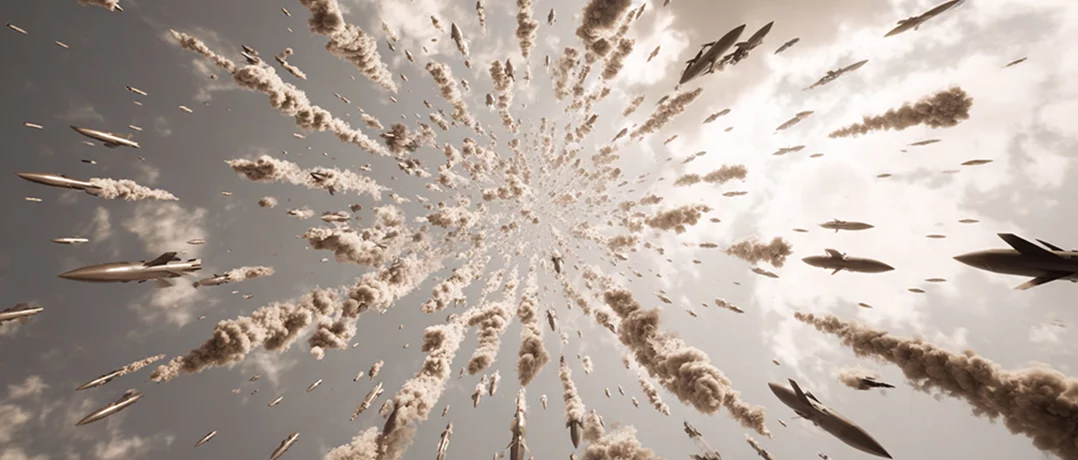
Nearly four weeks into the Israel–Iran war, strike data, munitions usage, and military briefings are beginning to illuminate the constraints governing the U.S.–Israel air campaign. Analysis by the American policy research organization the Center for Strategic and International Studies (CSIS) found that U.S. and Israeli forces jointly struck more than 1,700 targets within the first 24 hours of operations, marking one of the most concentrated opening phases of a modern air campaign.
That initial surge has since given way to a lower but steadier operational tempo, as the United States and Israel balance air dominance against the practical limits of aircraft maintenance cycles, crew endurance, and munition stocks. The emerging pattern suggests that modern warfare is defined not only by the ability to strike rapidly, but by the capacity to sustain operations over time.
A front-loaded air campaign
The opening phase of the war was marked by exceptional intensity. According to CSIS, U.S. and Israeli forces concentrated their strikes on Iranian missile launchers, air defense systems, and command infrastructure, aiming to degrade core capabilities within the campaign’s critical early window.
Analysis from the defense think tank the Royal United Services Institute (RUSI) underscores the scale of the surge, estimating that more than 5,000 munitions were expended within the first 96 hours, with the total exceeding 11,000 within the first 16 days.
Statements from U.S. officials reinforce this assessment. In remarks released March 10 by the Department of Defense, Secretary of Defense Pete Hegseth said early operations were designed to degrade Iran’s missile capabilities and broader military infrastructure, including its ability to project power. In the same briefing, he described the campaign as “winning decisively with brutal efficiency” and achieving “total air dominance,” underscoring both the intensity and effectiveness of the initial wave of strikes.
The slowdown in tempo
By the second and third weeks of the campaign, the pace of strikes declined. CSIS data shows that after Day 10, the strike rate stabilized at roughly 300 to 500 targets per day a substantial reduction from the opening surge. For comparison, Russian missile and drone launches in Ukraine have routinely reached 700 per day.
The study offers several explanations. Aircraft required maintenance, crews needed rest, and the initial target list was gradually exhausted. Just as critically, developing new targets takes time: targets must be identified, validated, and translated into strike plans before they can be engaged.
Operational conditions also evolved. According to CSIS, as coalition forces degraded large portions of Iran’s air defense network, U.S. aircraft were able to operate over much of Iranian territory with fewer constraints. This shift allowed the campaign to move away from scarce long-range “standoff” munitions such as Tomahawk cruise missiles and Joint Air-to-Surface Standoff Missiles (JASSMs), which CSIS estimates at approximately $3.5 million per shot toward more readily available systems such as the Joint Direct Attack Munition (JDAM), which costs under $100,000 per munition.
The economics of precision warfare
This transition in munitions use highlights a deeper constraint: cost and inventory. Modern air campaigns depend on advanced precision systems that are both highly effective and expensive. A separate CSIS cost analysis estimates that the war reached $11.3 billion in expenditures within the first six days approximately $1.9 billion per day during the opening phase.
Analysis from the Center for a New American Security (CNAS), a Washington-based defense policy think tank, further underscores these limitations. CNAS finds that key categories of U.S. munitions, including Tomahawk cruise missiles and long-range precision strike systems, are limited in inventory, while air defense interceptors are both costly and difficult to replenish quickly.
These constraints are increasingly reflected in how the campaign is conducted. In remarks on March 19, Secretary Hegseth noted that the United States had relied heavily on more “exquisite munitions” at the outset but “no longer need[s] to,” emphasizing that current operations are drawing from a deeper pool of available weapons.
Sustaining the fight
Nearly four weeks into the conflict, the data points to a consistent conclusion: air power remains a decisive tool in shaping the early trajectory of war, but its effectiveness is bounded by cost, inventory, and the ability to sustain operations over time.
What distinguishes this conflict is not the existence of these constraints, but how quickly they have become visible. In modern warfare, endurance has emerged as a form of power in its own right.
-
-

-
The Beiruter
-
