

Portrait of Mohamad Chatah’s vision for a sovereign Lebanese state, seen through his son Ronnie’s reflections on reform, diplomacy, and loss.
Mohammad Chatah: A life given to Lebanon’s sovereignty
Mohammad Chatah: A life given to Lebanon’s sovereignty
By Josiane Hajj Moussa | December 26, 2025

Reading time: 4 min
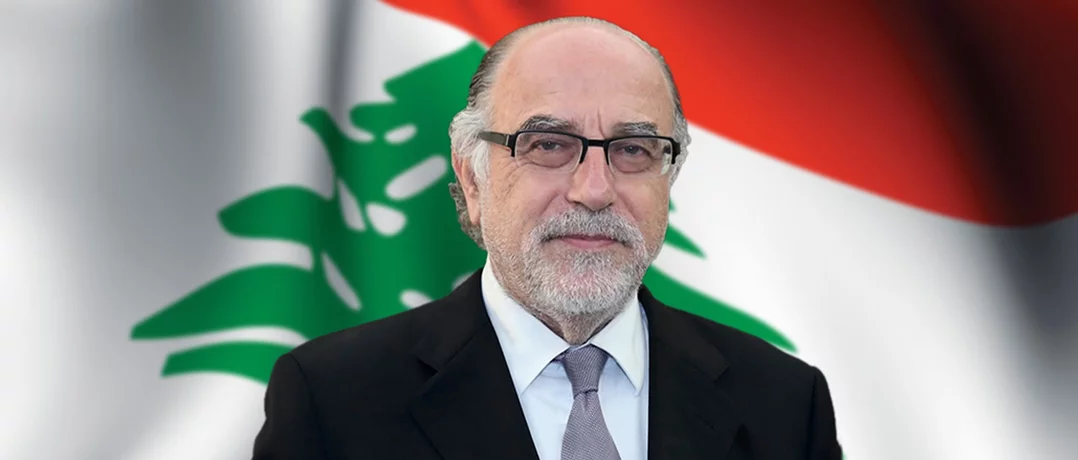
Mohamad Chatah belonged to that rare generation of Lebanese statesmen whose calm intellect and quiet integrity made him a moral compass in turbulent times. An economist of international standing and a diplomat of remarkable grace, he devoted his life to strengthening the institutions of the Lebanese state, restoring confidence in its economy, and defending the fragile yet essential principle that sovereignty must rest in the hands of a civilian government, not guns. From the halls of the International Monetary Fund (IMF) to the corridors of Beirut’s Grand Serail, Chatah served without theatrics or ego, believing deeply in dialogue, moderation, and the quiet power of reason.
He was among the most influential policy thinkers of his generation an economist-diplomat who helped form Lebanon’s financial governance, rebuild its credibility abroad, and articulate a vision of a modern, sovereign state anchored in law and institutions. After a distinguished international career, he served as Ambassador to Washington, Minister of Finance, and senior adviser to Prime Minister Saad Hariri, becoming a key architect of post-war economic strategy and international engagement. Calm, principled, and unwavering in his belief that security and diplomacy must remain the exclusive domain of the state, Chatah worked tirelessly to promote reform and resist the rise of non-state armed power.
His assassination in 2013 did not silence his message; it immortalized it as a reminder of the price paid by those who insist that Lebanon can and must remain open, lawful, and free.
Against this backdrop, his son Ronnie Chatah reflects on the political philosophy and national convictions that guided his father’s public life. He explains that his father understood sovereignty not as rhetoric, but as the exclusive authority of the state over security, foreign policy, and diplomacy. While serving as Lebanon’s ambassador to the United States in the 1990s, he saw Lebanon’s voice as one under occupation and pressure, and believed his role was to challenge that suffocation by defending what he considered Lebanon’s sovereign position; one that had largely collapsed since the 1970s.
He believed Lebanon began to fall apart during that period primarily because of the political and military influence of non-state militias. The form of sovereignty he imagined was one that restored Lebanon to what it had been in the 1960s, the Lebanon of his youth, a country capable of defending its national interests while also avoiding regional war. The year 1967 stood out to him as a defining example, when Lebanon did not participate in the Arab-Israeli War that summer.
His father’s vision, Ronnie says, was to unify Lebanon’s diverse voices under one independent national umbrella. It was never about aligning with America, France, Iran, or any other power. It was about being pro-Lebanon. His mission, as he saw it, was to represent the spectrum of Lebanese opinion without surrendering a single inch of Lebanese territory. In this regard, Ronnie believes he excelled, particularly during the years when Israel still occupied South Lebanon. He was firm and unwavering that Israel had to leave. Over time, he also became more outspoken toward Syria and Iran but never out of partisanship. It was always grounded in the defense of Lebanon’s national interest.
Ronnie also notes that his father believed deeply in structural political reform. The Lebanon he grew up in lacked the kind of sectarian reform that became necessary after independence. It was only later in his career that he saw the path forward the creation of a Senate, as envisioned in the Taif Agreement, which was never implemented.
For him, this Senate was essential because merit-based, non-sectarian politics needed to exist in Lebanon. That meant a merit-based parliament alongside a Senate that preserved the country’s communal mosaic. This was not only about diversity it was also about easing the fears and insecurities of Lebanon’s communities. He believed Lebanon’s Christians felt politically and demographically insecure after Taif, and that the Senate was intended to address that imbalance. Yet the idea never gained traction, including among his own allies. Still, he continued to support it and made implementing the Senate a priority until 2013.
He also believed extremism should never prevail, and that Lebanon should never fragment into cantons or separate regions. Yet, as long as an armed group like Hezbollah exists, he believed the threat of national divorce remains real. To him, Hezbollah was not simply an Iranian-backed militia but rather represented the end of the Lebanese state. He worked relentlessly to end Lebanon’s acceptance of Hezbollah in its current form and, ultimately, he was killed for that.
Ronnie underscores that diplomacy mattered deeply to his father, because Lebanon’s voice was rarely heard. Through intensive engagement, he helped secure the lifting of the U.S. travel ban on Lebanon in 1997. He also contributed to the creation of UN Security Council Resolution 1701, which he considered meaningful, precisely because all Lebanese parties including Hezbollah supported it. That, he believed, was Lebanon speaking with one diplomatic voice.
When asked whether his father’s assassination was meant as a political message, Ronnie says Lebanon’s current leadership is capable of doing more today than it could twenty years ago, yet continues to fall short. While he does not hold them responsible for Lebanon’s prior collapse, he notes that they are not taking risks or challenging the status quo the way his father’s generation did between 2005 and 2008 - a period during which many Lebanese leaders paid the same price his father did in 2013. Today’s leadership, he says, has become a bystander to a permanent crisis and he fears Lebanon cannot survive under such conditions.
He believes the wave of assassinations hollowed out Lebanon’s leadership. When competent and courageous leaders are repeatedly eliminated, the result is a political class either unwilling to confront the problem, or one suited only to times of peace while Lebanon today is living through a prolonged state of crisis.
Reflecting on his father’s legacy, Ronnie says he believed in dialogue but only in dialogue with purpose. Even dialogue with Hezbollah, he insisted, must aim at placing weapons under state control, rather than endless discussion without meaningful direction. He also played a role in the Baabda Declaration of 2012, when Hezbollah agreed not to intervene in Syria. Although it was never implemented, he believed it mattered because the presidency was finally acting in the national interest.
He admired two Lebanese leaders deeply: President Fouad Chehab, because in addition to ensuring a monopoly of force through the state, only, he pursued the type of institutional building alongside effective diplomacy that spared Lebanon from regional turmoil; and Rafik Hariri, because he pursued sovereignty quietly, helped secure UN Resolution 1559, and worked to rebuild national confidence and like him, was ultimately assassinated for challenging Syrian dominance.
When asked whether there is anyone today who resembles his father, Ronnie says he does not believe anyone currently in government thinks the way his father did. Still, he sees others attempting to carry forward elements of his message.
Finally, when asked whether the Lebanon his father worked and died for can ever return, Ronnie responds that he believes that version of Lebanon has died. This, he says, is the lasting consequence of Hezbollah’s dominance after the Syrian withdrawal, which destroyed Lebanon’s final chance to move forward. What remains is a smaller, poorer, more inward-looking country poorer not only economically, but also in outlook. Lebanon, he believes, will likely never return to the metropole and crown jewel it once exemplified to the region.
Lebanon’s sovereignty was never meant to be a mere slogan. It was a state-building project championed by public figures who believed that security and national decision-making must rest exclusively with the state and many of them, including Mohamad Bahaa Chatah, paid for that conviction with their lives. Their assassinations were not isolated episodes, but chapters in a single story: the struggle to preserve Lebanon as a nation governed by law and institutions rather than a battleground for competing weapons and external influence.
Today, amid fragmentation and regional pressure, their sacrifices stand as both a warning and a guide. They testify to the heavy price of abandoning sovereignty and to the moral duty to reclaim it through reform, national balance, and the rule of law. Whether Lebanon ultimately succeeds remains uncertain. But the principles these leaders defended endure firm, ethical, and uncompromising reminding all who assume public responsibility that true independence is measured not by rhetoric, but by the state’s exclusive authority to secure its territory, enforce its laws, and protect its citizens without rival or tutelage.
-
-
-
Josiane Hajj MoussaReporter
-
