

Mojtaba Khamenei emerges as a potential successor to Iran’s supreme leader following the Israeli airstrike that killed Ali Khamenei, reshaping the country’s political landscape.
Mojtaba Khamenei emerges as possible successor in Iran
Mojtaba Khamenei emerges as possible successor in Iran
By The Beiruter | March 08, 2026

Reading time: 5 min
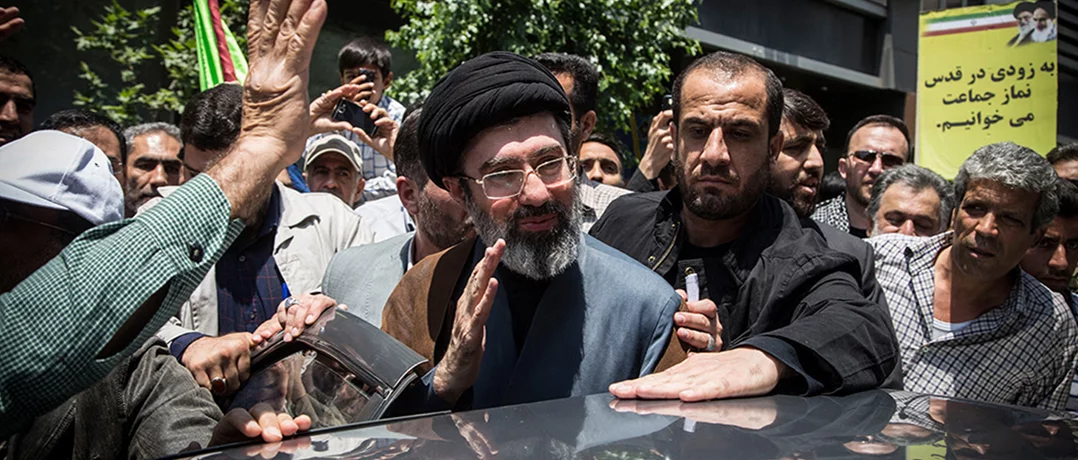
The death of Iran’s Supreme Leader, Ayatollah Ali Khamenei, in an Israeli airstrike at the outset of the ongoing war has triggered one of the most consequential political transitions in the history of the Islamic Republic.
As the country faces sustained attacks from the United States (US) and Israel, the question of succession has rapidly moved to the forefront of Iranian politics. Among the figures widely discussed as a potential successor is Mojtaba Khamenei, the late leader’s second son, a highly influential cleric who has long operated within the inner circles of power.
Although no official announcement has been made, Mojtaba Khamenei has emerged as a prominent contender to assume the position of supreme leader. His possible rise to the country’s most powerful office comes at a moment of extraordinary national crisis, raising questions about the future direction of Iran’s leadership, its regional strategy, and the internal dynamics of the Islamic Republic.
A secretive power broker
Mojtaba Khamenei has maintained a notably low public profile throughout his political life. Unlike many senior clerics in Iran, he has rarely delivered public sermons, addressed political gatherings, or sought visibility in state institutions. Yet behind the scenes, he has been widely regarded as one of the most influential figures within the Iranian establishment.
For years, diplomats and analysts have described him as a key gatekeeper within his father’s office. His role has often been compared to that played by Ahmad Khomeini, the son of Iran’s revolutionary founder Ayatollah Ruhollah Khomeini, who wielded significant influence during the early years of the Islamic Republic. In a similar fashion, Mojtaba reportedly functioned as a confidant, adviser, and intermediary between the supreme leader and powerful factions within the government and security apparatus.
This influence reportedly grew as his father’s authority consolidated over the decades. Diplomatic communications published in the late 2000s described Mojtaba as “the power behind the robes,” suggesting that he had developed extensive networks within Iran’s political and security institutions.
Rise in influence following the airstrike
The Israeli strike that killed Ali Khamenei not only eliminated the country’s long-time paramount leader but also elevated the political profile of his son. In addition to his father, Mojtaba’s wife, Zahra Haddad Adel, whose family has deep roots in Iran’s clerical elite, was also killed in the attack. Hardline factions within the Islamic Republic have already framed the deaths as martyrdom in the struggle against Western powers.
This narrative could strengthen Mojtaba’s standing among conservative clerics and security officials, as well as the IRGC (one of the most powerful institutions in Iran) who play a decisive role in determining the next leader. Iran’s constitution assigns the responsibility of selecting the supreme leader to the Assembly of Experts, an 88-member clerical body tasked with overseeing the leadership of the Islamic Republic.
As the assembly deliberates, the symbolic weight of the Khamenei family legacy, combined with Mojtaba’s longstanding connections within the regime, may bolster his candidacy.
Early life and background
Born in 1969 in the northeastern city of Mashhad, Mojtaba Khamenei grew up during the turbulent final years of the Iranian monarchy. His father was already a prominent cleric involved in opposition to Shah Mohammad Reza Pahlavi, and the family experienced harassment by the regime’s secret police.
Following the 1979 Islamic Revolution, the Khamenei family relocated to Tehran as the new theocratic system took shape. During the Iran-Iraq War in the 1980s, Mojtaba reportedly served with a unit affiliated with the Revolutionary Guard, an experience that helped forge lasting ties with the military establishment.
These connections would later prove politically significant. Many of the individuals who served alongside him during the war eventually rose to influential positions within Iran’s intelligence and security structures.
Despite never holding an elected or formally appointed government position, Mojtaba Khamenei has been closely associated with major political developments in Iran over the past 2 decades. Critics within the reformist camp have accused him of exerting behind-the-scenes influence over elections and state institutions.
He has also been linked to the suppression of protests following the disputed 2009 presidential election, when mass demonstrations, known as the Green Movement, challenged the re-election of President Mahmoud Ahmadinejad. Reformist politicians alleged that Mojtaba coordinated with security forces, particularly the Basij paramilitary units, to suppress the protests.
These allegations contributed to his designation under US sanctions in 2019, when Washington accused him of helping advance the regional and domestic policies associated with his father’s rule.
The power of the supreme leader
Whoever succeeds Ali Khamenei will inherit immense authority within Iran’s political system. The supreme leader occupies the highest position in the Islamic Republic, holding ultimate decision-making power over domestic and foreign policy.
The office also includes command of the armed forces and oversight of the Revolutionary Guard, which controls much of Iran’s ballistic missile program and oversees networks of allied groups across the Middle East. In addition, the leader wields considerable influence over the country’s judiciary, media institutions, and vast economic foundations. Assuming leadership at a time of war would place extraordinary responsibility on the successor.
From here, the potential rise of Mojtaba Khamenei to Iran’s supreme leadership would represent both continuity and transformation within the Islamic Republic. His possible appointment raises sensitive questions about the nature of power in Iran’s political system. A hereditary succession could evoke comparisons to the monarchy that the 1979 revolution sought to overthrow. Yet for hardline factions determined to preserve the ideological course of the Islamic Republic during wartime, Mojtaba Khamenei may represent a figure capable of consolidating authority and steering the country through one of the most volatile moments in its modern history.
-
-

-
The Beiruter
-
