

As artificial intelligence reshapes the music industry, can it truly replace human creativity? Maestro Harout Fazlian shares his perspective on emotion, originality and the future of composers in the age of AI.
More than notes: The human side of music in the AI era
More than notes: The human side of music in the AI era
By Yara Saliba | August 03, 2026

Reading time: 5 min
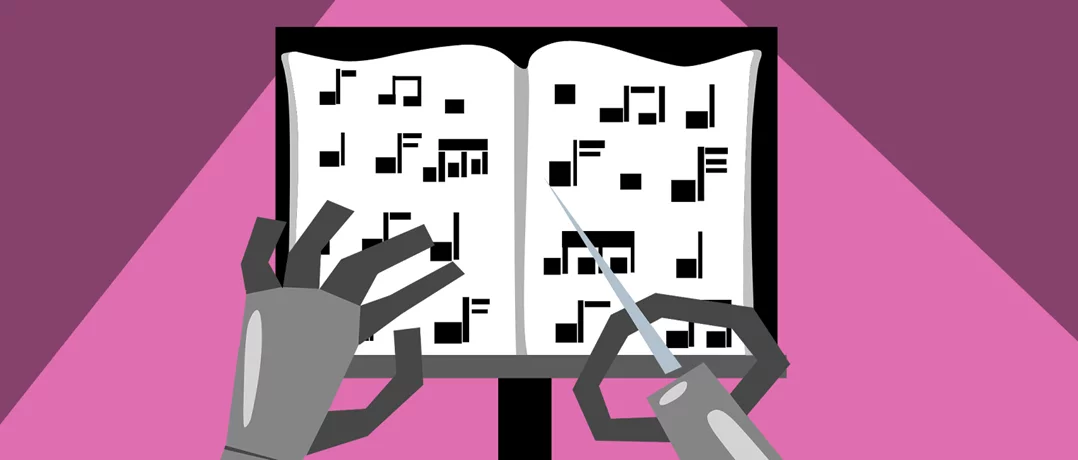
Artificial intelligence is rapidly transforming creative industries around the world, and music is no exception. Once limited to editing and production tools, AI can now compose melodies, generate lyrics, imitate artists' voices and even produce complete songs within minutes. As these technologies become increasingly sophisticated, they are reshaping the creative process and raising new questions about originality, artistic expression and the future of music itself.
Among those most directly affected by this transformation are composers, whose role lies at the heart of musical creation. Unlike traditional editing software, generative AI can now compose music, raising questions about creativity, originality and the future of the profession. To explore these issues, The Beiruter spoke with Maestro Harout Fazlian, Officier de l'Ordre des Arts et des Lettres, Principal Conductor of the Lebanese Philharmonic Orchestra and one of the Middle East's most renowned conductors.
Creation or imitation?
To illustrate his point, Maestro Fazlian points to Franz Schubert's famous Unfinished Symphony. Long before today's AI boom, computers were already being used to generate hypothetical third and fourth movements for the unfinished work by analyzing Schubert's compositions, melodic language and orchestration. The result closely resembled the Austrian composer's distinctive style, but, according to Maestro Fazlian, it was not an original creation. Rather than inventing something new, the computer drew on existing musical patterns and combined previously available data to produce a convincing imitation.
The soul behind the music
While Maestro Fazlian acknowledges that artificial intelligence will continue to evolve and may eventually be able to reproduce the subtle imperfections that make a performance sound more human, he believes there is one boundary AI cannot cross. "It is the human imperfection that makes art perfect," he says. Maestro Fazlian believes that even if AI learns to imitate those imperfections, it will never possess the soul, spirit and lived experiences that shape every artistic creation.
For Maestro Fazlian, music is inseparable from the person behind it. Every composition and every performance is influenced by a lifetime of memories, emotions and experiences, whether moments of joy, personal loss or even childhood traumas that remain buried in the subconscious. "Through our art, we express our life experiences," he explains. "A childhood experience, whether good or bad, may affect you subconsciously without you even realizing it, but it will eventually come out in your art." It is this deeply personal connection, he believes, that gives music its authenticity.
Although AI can be programmed to imitate emotional expression, Maestro Fazlian insists that imitation is fundamentally different from genuine feeling. "Can AI experience tears?" he asks. "Of course, it can be programmed to react to a sad situation, but it cannot understand why the tears exist." He recalls watching children playing in a playground, explaining that the joy and innocence he feels in that moment naturally inspire his artistic expression. "The feeling that I, as an artist and as a human being, get from seeing this, the AI will not be able to feel it." For him, emotional depth is what makes music truly human. AI may be a useful tool, but it can never replace the experience of live performance.
The music within
Despite his reservations, Maestro Fazlian does not dismiss artificial intelligence altogether. He believes it can serve as a useful tool by saving time: AI can quickly play back a newly written score, simulate an orchestral performance or test different musical nuances, allowing composers to hear how their work might sound before it reaches the stage.
Yet, for Maestro Fazlian, its role should remain technical rather than creative. He argues that the music of great composers such as Beethoven, Mozart and Tchaikovsky is inseparable from their personalities, life experiences and the circumstances that shaped them. Their work carries what he calls a "certain je ne sais quoi", an intangible quality that AI cannot recreate. "It can be copied, and it can maybe reproduce, but it will not be a recreation," he says.
For Maestro Fazlian, AI is an assistant, not a composer. While it can make the creative process more efficient, "a true artist will not need this, the music should already be in the head." AI can support creativity, he says, but imagination and artistic vision must remain human
The new competition
Looking ahead, Fazlian believes AI is likely to reduce opportunities for young composers, particularly in the commercial music industry. Unlike music created as artistic expression, commercial music is "only for consumption. You go, you listen, you have fun for that one hour, and you're done," he explains. According to Maestro Fazlian, "AI will generate a lot of very easy music because it's a formula," making it particularly suited to commercial production. Although he disagrees with this direction, he worries that it could leave fewer opportunities for composers who "need to write, learn and live off it."
Still, Maestro Fazlian does not believe composers who refuse to use AI will necessarily fall behind. Instead, he says it depends on how much they rely on it. While AI can be useful as an educational or experimental tool, using it to create music and claiming it as one's own "will show anyways." A composer grows by hearing music performed live, learning "what works, what does not work" and applying those lessons to future compositions. "If AI gives it to you and says, 'This is perfect. Go play it,' then you're not really advancing."
Who will compose tomorrow?
Ultimately, Maestro Fazlian does not see AI as a threat to great composers, believing that "the real ones will always exist." His concern lies instead with the next generation of musicians. As AI becomes a faster and cheaper alternative, he fears producers driven by commercial interests and financial considerations may increasingly choose technology over emerging talent, reducing opportunities for young composers to build their careers.
-
-
-
Yara SalibaJunior Writer/Translator
-
