



How Morocco's 2020 normalization deal with Israel has deepened Algeria's long-standing rivalry with Morocco, using the Polisario dispute and the 2026 Ceuta migrant crisis as evidence that Algiers now views Rabat's actions through the lens of a threatening Morocco-Israel axis.
Morocco Algeria and Israel: The geopolitics of regional rivalry
Morocco Algeria and Israel: The geopolitics of regional rivalry
By Peter Chouayfati | August 05, 2026

Reading time: 6 min
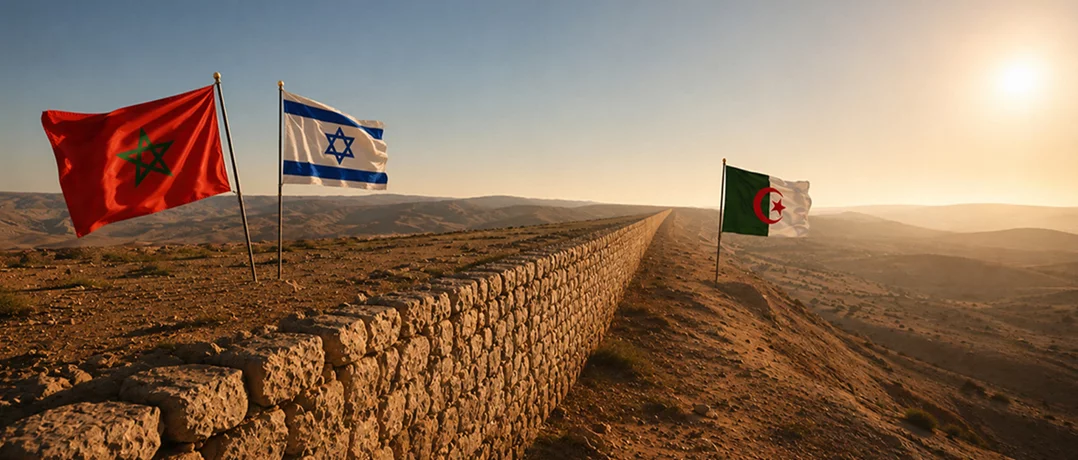
In December 2020, the United States brokered a deal in which Israel and Morocco agreed to establish ties, and in exchange the U.S. recognized Moroccan sovereignty over Western Sahara. The agreement laid out plans for diplomatic relations, direct flights, and expanded cooperation in trade, technology, agriculture, and energy, and opened the door to joint military arrangements between Morocco and Israel.
Algeria strongly objected to the agreement and viewed U.S. recognition of Moroccan sovereignty over Western Sahara, and Morocco's military presence in the territory, as a direct threat to its own security. Tensions escalated on August 24, 2021, when Algeria severed diplomatic relations with Morocco entirely, citing accusations that Morocco and Israel were aiding the Movement for the Self-Determination of Kabylia (MAK), a separatist group Algeria considers a terrorist organization.
Roots of a rivalry, sharpened by Israel
Algerian and Moroccan tensions date back to the end of French colonial rule as political and ideological differences, Algeria's revolutionary republicanism versus Morocco's monarchy, drove the two apart. That rivalry turned violent in the 1963 Sand War, and it carried into the Cold War, with Algeria aligning with the Soviet bloc while Morocco leaned on Western allies.
Israeli normalization has poured new fuel onto this old fire in three specific ways. First, Algeria views the Morocco-Israel security partnership, including intelligence sharing, as a direct encroachment that gives Israel a foothold on Algeria's western border historically free of outside military influence. Second, Algeria, as one of the Arab world's staunchest supporters of Palestinian statehood, sees the Accords as legitimizing Israeli policy without any corresponding progress for Palestinians, a framing it has used to justify deepening ties with Iran as a counterweight to what President Abdelmadjid Tebboune calls a Morocco-Israel axis. Third, Algeria has repeatedly accused Morocco, now emboldened by its Israeli alliance, of covertly backing the MAK as a destabilization tactic, mirroring Algeria's own long-running strategy of backing the Polisario Front against Morocco.
The Polisario now reframed through Israel
The Polisario is a militant group in pursuit of Western Saharan independence. Since the Front's founding in 1973, Algeria has been its principal backer, providing arms and political support. Algeria went on to oppose the Madrid Accords of 1975 that outlined the decolonization of Western Sahara and transferred administrative control to Morocco and Mauritania. But Israeli normalization has transformed Polisario from a bilateral Morocco-Algeria dispute into a three-way flashpoint. Because U.S. recognition of Moroccan sovereignty over Western Sahara was the direct price of Morocco's deal with Israel, Algeria now reads the entire Western Sahara file through the lens of the Accords: every diplomatic gain Morocco makes on the territory is, in Algiers' eyes, a gain purchased with Israeli backing. This is why Algeria's severance of relations in 2021 explicitly cited Moroccan Israeli collusion against Algerian interests rather than treating Western Sahara and Israel as separate issues.
This dynamic extends to Europe. As Professor Abd-el Kader Cheref writes for Al Jazeera, when France and Spain deepen ties with Morocco, particularly by endorsing its autonomy plan for Western Sahara, Algeria retaliates by cutting diplomatic or trade ties. It has never managed to force these governments to reverse course, but it can pressure them to recalibrate their wider regional relationships. Spain's Pedro Sánchez visited Algiers on July 20, 2026, attempting to repair relations that collapsed after Spain backed Morocco's autonomy plan in 2022, prompting Algeria to recall its ambassador and halt most non-gas trade. Even now, Sánchez hasn't reversed Spain's pro-Morocco stance, he's simply trying to rebuild the relationship with Algeria alongside it, underscoring that Algeria can exact a cost but not undo these alignments.
Ceuta: A second flashpoint with an Israeli shadow
The Ceuta crisis illustrates how the Morocco-Algeria-Israel triangle now plays out in real time. On July 30, 2026, the border between Morocco and the Spanish enclave of Ceuta effectively collapsed, with tens of thousands crossing within 24 hours and at least 57 people reported dead. Spain deployed its military, and the episode became both a humanitarian crisis and a diplomatic one, with Italy unilaterally closing its borders with Spain in response.
Though Morocco has never officially acknowledged using migration as leverage, the timing fits a pattern. A similar surge in May 2021 followed Spain's decision to admit Polisario leader Brahim Ghali for medical treatment, and within months Spain abandoned its historic support for a Western Saharan independence referendum in favor of Morocco's autonomy plan — a lesson, many believe, that pressure on the enclaves works. The July 2026 surge came just days after Sánchez's rapprochement visit to Algiers, which had produced plans for a Spain-Algeria summit and discussion of expanding gas flows through the Medgaz pipeline that bypasses Morocco entirely. The Ceuta surge thus reads as a possible signal that Spain's warming relationship with Algiers carries a cost.
What ties Ceuta back to the Israel dimension is the constellation of actors who quickly framed it in those terms. Sánchez is one of Europe's most consistently pro-Palestinian leaders, having called Israel's war on Gaza a genocide and refused to let joint U.S.-Spanish bases support the campaign against Iran. Morocco, by contrast, has been notably more accommodating to Israel, docking an Israeli warship and a U.S. arms shipment that Spain had turned away. As the Ceuta crisis unfolded, pro-Israel voices, from Yair Netanyahu to Israeli UN Ambassador Danny Danon, who publicly mocked Spain's "colonial enclaves", framed Ceuta and Melilla as hypocritical holdovers ripe for reclaiming. There is no evidence of Moroccan coordination with Israel on the border surge itself, but the convergence of interests, reinforced by Morocco's recent naming of a Western Sahara highway after Trump, has fueled speculation and left Spain-Israel relations noticeably colder.
Israeli normalization has not created the Morocco-Algeria rivalry, but it has reshaped and intensified it. What were once separate grievances, competition over Western Sahara, mutual accusations of backing separatist proxies, and Morocco's use of migration as diplomatic leverage, are now increasingly read by Algiers through a single lens: a Morocco-Israel axis that Algeria believes threatens its sovereignty, undermines the Palestinian cause, and emboldens Rabat's tactics against both Algeria and its European partners. The Polisario dispute and the Ceuta crisis, separated by decades and different terrain, have become linked evidence in Algeria's narrative that Israeli backing has made Morocco a more assertive, and more dangerous, regional rival.
-
-

-
Peter ChouayfatiPolitical Analyst and Researcher
-
