Morocco seeks a second consecutive FIFA World Cup quarter-final appearance as the Atlas Lions look to reinforce their status as the most successful Arab football nation in World Cup history.


Morocco seeks a second consecutive FIFA World Cup quarter-final appearance as the Atlas Lions look to reinforce their status as the most successful Arab football nation in World Cup history.

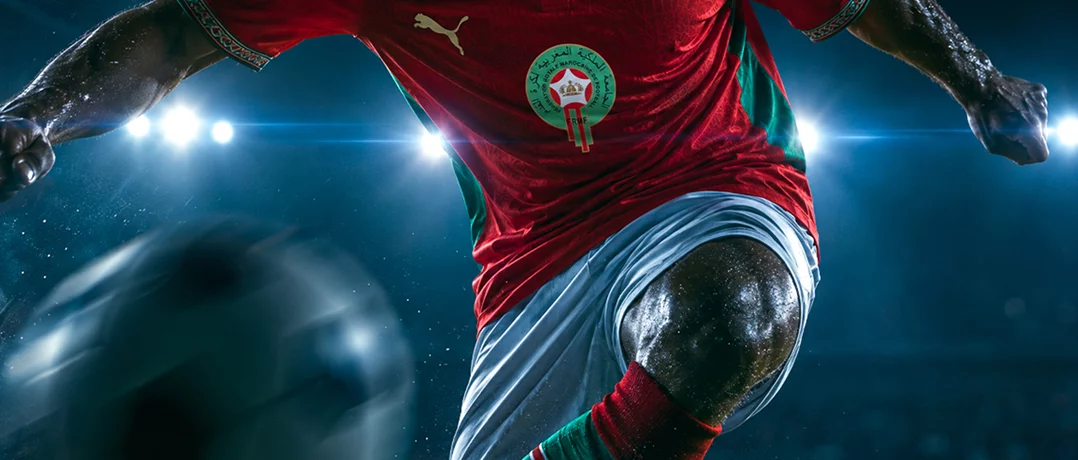
Morocco will attempt to write another glorious chapter in its World Cup history on Saturday evening. A victory over Canada in the Round of 16 would send the Atlas Lions into the quarter-finals for the second consecutive tournament, further cementing their status as both the greatest Arab football nation of the modern era and in history, as well as a side firmly established today among the world's top ten.
Morocco faces Canada on Saturday at 8:00 p.m. in Houston (USA), one of the three host countries of the 2026 FIFA World Cup. Their campaign so far has once again confirmed the country's outstanding footballing level. At the Arab level, Morocco are the only nation to have reached the knockout stage of the World Cup on three occasions (1986, 2022 and 2026), having also narrowly missed out on qualification from the group stage in 1998.
With seven World Cup appearances (1970, 1986, 1994, 1998, 2018, 2022 and 2026), Morocco are, alongside Saudi Arabia and Tunisia, the Arab nation with the most World Cup participations.
Following Egypt's appearance in 1934 (albeit in a tournament featuring only 16 teams) Morocco became the first Arab nation to reach the Round of 16 in 1986. Led by captain and goalkeeper Badou Zaki, who won the African Footballer of the Year award that same year, and midfielder Aziz Bouderbala, the Atlas Lions conceded only two goals in four matches before being eliminated by eventual finalists West Germany thanks to a late Lothar Matthäus free-kick.
Twelve years later in 1998, Morocco came agonizingly close to reaching the knockout stage for a second time. Despite producing an emphatic 3-0 victory over Scotland in their final group match, an unexpected 2-1 win for Norway over Brazil denied Mustapha Hadji, Noureddine Naybet and their teammates a place in the Round of 16.
In 2022, just as in 1986, defensive solidity proved to be Morocco's greatest strength. The Atlas Lions conceded only one goal in their opening five matches despite facing elite opposition such as Belgium, Croatia, Spain and Portugal. Their remarkable run ended only in the semi-finals with a 2-0 defeat to France, after becoming the first Arab and African nation ever to reach a World Cup semi-final.
Two of Morocco's standout performers from the 2022 campaign continue to be central figures in their successful 2026 World Cup run.
First is 27-year-old captain Achraf Hakimi, whose influence at right-back is extraordinary. His constant forward runs are never reckless but carefully timed and adapted to each match situation. Full-backs with such a significant attacking contribution often compromise their defensive responsibilities, but Hakimi is equally outstanding in one-on-one defending and remains extremely difficult to dribble. At club level, he has been one of the driving forces behind Paris Saint-Germain's European dominance, helping the French club win the last two UEFA Champions League titles.
The second is goalkeeper Yassine Bounou, one of the world's finest in his position. He has also developed a reputation as a penalty specialist, often employing his trademark technique of remaining upright for as long as possible to unsettle the taker before making only the minimal lateral movement needed to save the shot. He proved decisive in the penalty shootout against Spain in the 2022 Round of 16 and repeated the feat in this year's Round of 32 against the Netherlands on Tuesday.
Notably, every World Cup winner from 2006 to 2022 has relied on a goalkeeper who played a decisive role in securing the title: Gianluigi Buffon (2006), Iker Casillas (2010), Manuel Neuer (2014), Hugo Lloris (2018) and Emiliano Martínez (2022). Morocco therefore possess one of the essential ingredients traditionally associated with a deep World Cup run.
They have also benefited from the emergence of striker Ismael Saibari, who was voted the Dutch league's Player of the Season and will join Bayern Munich next season. Saibari scored against both Brazil and Scotland during the group stage before converting the decisive penalty in Morocco's shootout victory over the Netherlands.
Another key attacking player, Real Madrid forward Brahim Díaz, has so far underperformed in this tournament and will be eager to make amends in Saturday's Round of 16 clash against Canada.
In midfield, this World Cup has also marked the breakthrough of 18-year-old Lille midfielder Ayoub Bouaddi. The French-Moroccan binational chose to represent Morocco despite possessing the talent to eventually play in a World Cup for France in the future.
For four years (2022-2026), Morocco relied on Walid Regragui to guide this talented generation. Drawing on his extensive playing experience in Ligue 1 and Ligue 2, Regragui took charge only weeks before the 2022 World Cup and quickly succeeded in uniting the squad around his vision, leading Morocco to a historic semi-final.
The foundations laid earlier by Hervé Renard during the 2018 World Cup campaign and by Vahid Halilhodžić, who qualified Morocco for the 2022 tournament, should not be overlooked either, as both contributed significantly to the team's gradual development.
The man in charge for this World Cup, Mohamed Ouahbi, is the coach who led Morocco's Under-20 national team to the FIFA U-20 World Cup title in October 2025. Ouahbi has not hesitated to promote several young talents to the 2026 current World Cup squad, including Strasbourg winger Gessime Yassine, whom he coached during that victorious U-20 campaign.
This succession of highly competent coaches, each adding another layer to Morocco's footballing development, combined with a squad featuring several players among the very best in the world in their respective positions, largely explains Morocco's outstanding performances at the 2026 World Cup.
Across their first four matches of the tournament, excluding the 4-2 victory over modest opponents Haiti, Morocco have scored only three goals while conceding two. Their attacking output has therefore remained relatively modest despite creating a large number of scoring opportunities.
Against Brazil, Morocco were held to a 1-1 draw despite generating several chances to put the game beyond reach in the first half hour. In the Round of 32 against the Netherlands, they controlled large stretches of the match and again drew 1-1 before eventually prevailing in the penalty shootout.
Against these two high-level opponents, Morocco recorded an Expected Goals (xG) differential of 1.38 to 0.24 against the Netherlands and 1.37 to 1.26 against Brazil. Such xG margins generally indicate overall superiority, yet the final scorelines suggest Morocco lacked attacking efficiency across both matches. Defensively, they were also punished by the Netherlands, who created very little over 120 minutes but still managed to find the net.
Morocco will therefore need to be more clinical at both ends of the pitch against Canada on Saturday if they are to translate the superiority they have shown in possession and overall play into a convincing result on the scoreboard.
A victory over Canada would send Morocco into the World Cup quarter-finals for the second consecutive tournament, where a much tougher challenge could await in the shape of France.
