



An Israeli incursion via Mount Hermon into Lebanon introduces a new confrontation axis, enhancing surveillance and pressure on Hezbollah while raising risks of escalation.
Mount Hermon and the emerging Israel-Lebanon front
Mount Hermon and the emerging Israel-Lebanon front
By The Beiruter | March 31, 2026

Reading time: 4 min
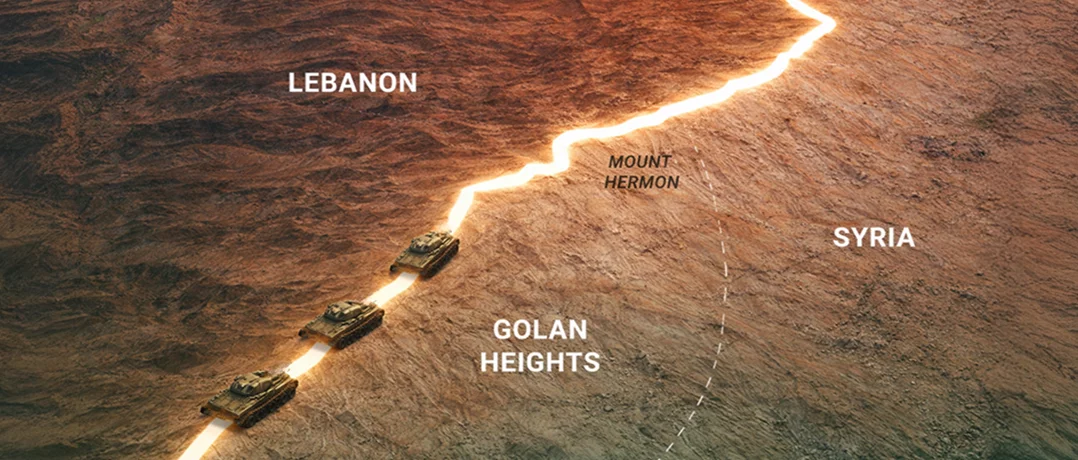
The reported Israeli incursion from the Syrian side of Mount Hermon (Jabal al-Sheikh) into Lebanese territory marks more than a localized military maneuver. Rather, it introduces a new operational axis that could reshape the geography of confrontation and alter the balances between Israel, Hezbollah, and, indirectly, Syria. This development reflects a broader transition from conventional pressure tactics to terrain-based maneuvering, with significant implications for regional stability.
Therefore, The Beiruter reached out to retired Lebanese General Naji Malaeb to gain crucial insights regarding the matter at hand.
A strategic mountain: Mount Hermon’s tactical significance
At the core of General Malaeb’s analysis lies the exceptional geographic significance of Mount Hermon. As the highest elevation in the region, it offers a notable advantage that translates directly into strategic superiority. Control over such terrain allows for advanced surveillance capabilities, enabling the monitoring of vast areas across Lebanon and Syria.
According to Malaeb, Israel has already established sophisticated observation systems on the mountain. These installations enhance its ability to detect missile launches and aerial threats, including those originating from distant actors such as Iran. The altitude ensures both accuracy and reliability in intelligence gathering, making Mount Hermon a critical area in Israel’s broader security architecture. Moreover, the mountain overlooks key regions, including parts of the Beqaa Valley and even the Syrian capital, Damascus.
Motivations behind the incursion
General Malaeb frames the incursion as serving multiple purposes, beginning with its psychological dimension. He argues that such operations help boost the morale of the Israeli military, particularly in light of the difficulties it has faced in advancing within southern Lebanon. By opening a new axis, even if limited in scale, Israel can project initiative and adaptability.
At the same time, the operation carries a tactical narrative: the claim that Hezbollah utilizes mountainous regions for launching missiles or maintaining hidden infrastructure. By entering and surveying these areas, Israel seeks to reinforce its position that it is targeting legitimate military objectives, while also attempting to disrupt or deter such activities.
However, Malaeb expresses skepticism regarding the practical necessity of this specific route for weapons transport. He notes that smuggling operations, if ongoing, are unlikely to rely on Mount Hermon’s terrain, suggesting that the incursion may be more about signaling and reconnaissance than about addressing a concrete logistical threat.
Limited operation or prelude to expansion?
A central question raised in the interview concerns whether this incursion represents the beginning of a more permanent military presence. Malaeb leans toward the interpretation that the operation remains limited in scope. He views that there is no immediate need for Israel to entrench itself in the area, particularly given its ability to deploy surveillance sensors without maintaining a continuous ground presence.
Such sensors could effectively monitor any suspicious activity, including potential smuggling routes or military movements, without exposing Israeli forces to the risks associated with long-term deployment in rugged terrain.
Nonetheless, Malaeb does not dismiss the possibility that the situation could evolve. Should the incursion turn into a sustained presence, it would carry far more serious implications, potentially marking the opening of a new front in the conflict.
Implications for Hezbollah
For Hezbollah, the incursion introduces a new layer of complexity. Even if limited, the operation creates pressure to respond or at least to reinforce positions in the affected area. This, in turn, risks dispersing the group’s resources and attention.
General Malaeb suggests that one of the goals behind such operations may be precisely this, thereby reducing the intensity of its engagement in southern Lebanon. By forcing a redistribution of forces, Israel could indirectly alleviate pressure on its existing fronts.
However, Hezbollah is not necessarily compelled to engage decisively in this region. The group retains the option of avoiding escalation, particularly if it assesses that the incursion does not pose an immediate strategic threat.
The risk of a new front and Syrian involvement
The most serious concern identified by General Malaeb is the potential for unintended escalation involving Syria. Because the incursion originates from Syrian territory, any response by Hezbollah could be interpreted as taking place within the country’s boundaries.
This creates a highly sensitive environment. If Syrian forces perceive such actions as violations of their sovereignty, it could lead to direct confrontation. Malaeb warns that this is the most dangerous aspect of the current situation: not the incursion itself, but the chain reaction it could trigger.
At present, however, he does not anticipate Syrian involvement. The Syrian position appears to favor avoiding entanglement in regional conflicts, and there is no indication that Damascus is seeking to open a new front. Maintaining this position remains crucial to preventing the conflict from expanding beyond its current scope.
Hence, based on General Naji Malaeb’s analysis, the Israeli incursion through Mount Hermon should be understood as a calculated and limited operation rather than a decisive transformation in the conflict; at least for now. Its primary objectives lie in enhancing surveillance, testing operational flexibility, and exerting psychological pressure on Hezbollah.
Yet, the broader significance of the move lies in its potential to evolve. Should it lead to sustained deployment or provoke a reaction that draws in additional actors, the consequences could extend far beyond the immediate area.
-
-

-
The Beiruter
-
