



Lebanese musician Nour Chehab is bringing the oud to new audiences while challenging traditional perceptions of women in Arab music.
Nour and the Oud

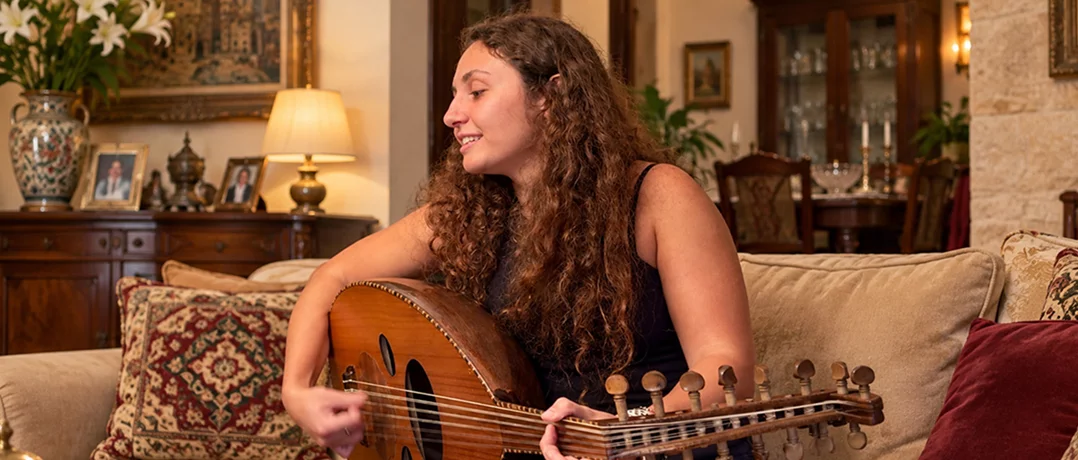
Nour Chehab’s music has always been her method of discovering new ways to express herself. A musician from Lebanon, Chehab began with the guitar at seven, later teaching herself piano, singing and other instruments before finding her way to the oud. Today, she is among a growing number of female musicians bringing the traditional instrument to new audiences, performing Lebanese classics while singing and sharing her music online.
Few instruments carry as much history as the oud. This pear-shaped, short-necked lute takes its name from the Arabic word for "wood." It is widely regarded as the ancestor of the European lute, and it travelled from the Middle East across the Islamic world and into Andalusia. Tradition credits the ninth-century musician Ziryab with refining it in Córdoba. Fretless and typically strung in pairs, the oud can produce the microtones that define Arabic maqam music, the notes that fall between the keys of a piano. That is why it has long been called the "king of instruments" in Arab music, and why it sits at the heart of the region's classical and popular repertoire. In Lebanon, its sound runs through the songs of Fairuz and generations of artists who followed.
For most of that history, the person holding the oud was usually a man. Nour Chehab is one of the musicians changing that picture.
A musician at heart
Chehab's path to the oud was a long one. "I learned some of the basics through guitar and I have some music theory knowledge, but then I continued on my own," she said of her largely self-taught approach. Piano and singing followed, and she kept picking up new instruments to try them out.
The uniqueness of the oud differs deeply from the guitar. "The oud is a much harder instrument," she noted. Part of the challenge is its origin. "It is an Eastern instrument; it is not a Western instrument at all." The missing frets make it harder still, "it is unfretted. Hence, it is very difficult to play."
But the difficulty comes with a reward. "You can hit more notes on the oud, notes that you do not find on the piano or the guitar," she explained, comparing it to the cello and violin. "It really does not resemble any other instrument." Her advice for beginners is to learn the guitar first to obtain the basics of how to hold and approach a string instrument.
The oud is also a bridge to home. "As a Lebanese artist, I really love playing this instrument," she noted. "You can play Lebanese sounds on it: Fairuz, Ziad, and many more." Playing those songs brings her closer to "Lebanon's culture and its musical culture, to what people used to have in the past." The oud, she added, "can bring you closer to the Arab identity of Lebanon."
A woman with an Oud
Audiences are used to seeing men play the oud, and Chehab does not treat that as a limit. "For me, there is nothing that a woman cannot do," she stated. "There is no fundamental barrier saying, 'No, the oud is something a woman cannot play.' Quite the opposite."
The reaction online has been warm. She often performs Lebanese songs and older classics while singing at the same time, something she described as unusual in Lebanon. "People are reacting with a lot of positive surprise because it is not something you see every day," she explained. "I am getting a lot of very nice feedback on social media."
Like many artists in Lebanon, Chehab keeps a day job. "You have to have some sort of income to be able to afford the things you want to do and to be able to live in this country," she expressed. Music, however, is quickly catching up. "We are reaching the point where I am making more from music than from my main job."
Social media was the turning point. She had played for a very long time, but posting videos changed everything. "It gave me the biggest push," she recalled. Concert invitations followed: "People would tell me, 'Come play here,' or 'We want you to do a concert here.'" Her long-term goal is clear. "I have wanted for a long time to make music my full-time career. So little by little, I am starting to see the path becoming clearer in front of me."
Chehab does not plan to stop at performing. She writes and composes, and she hopes to release more of her own songs and to write for other artists in Lebanon and the region. She also wants to blend languages. Lebanon has a large Francophone community and she hopes to introduce "using Lebanese Arabic and French languages in the same song" to the local industry.
Her five-year vision involves splitting her time between two homes: "I see myself doing concerts here and then going back to France," she noted, "and still writing and composing music for myself and for other people as well." With roots stretching back more than a thousand years, Nour is doing her very best to express the depth, beauty, and history of the instrument.
-
-

-
The Beiruter
-
