

Damascus prepares its first official Nowruz celebration, marking a historic shift toward Kurdish cultural recognition, national inclusivity, and post-Assad transformation.
Nowruz in Damascus: From ban to celebration

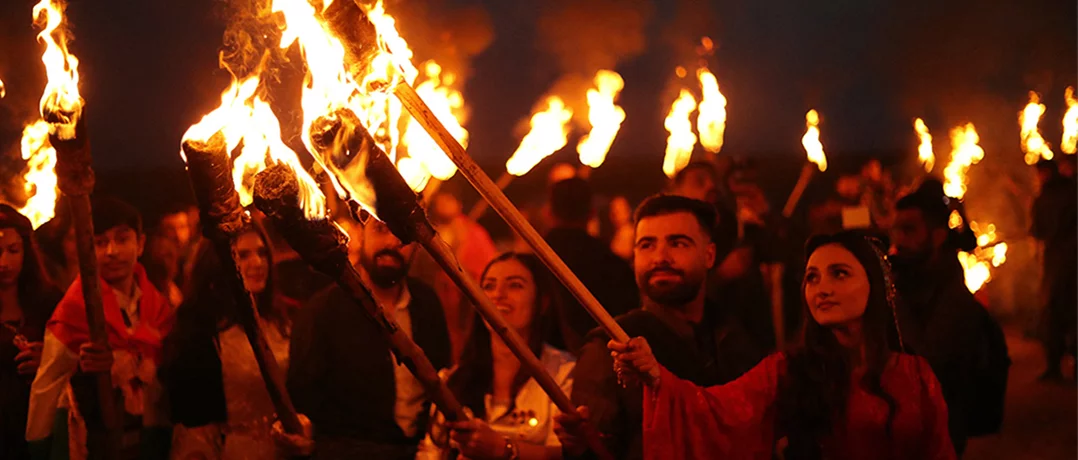
For the first time in modern Syrian history, the capital Damascus is preparing to host official celebrations of Nowruz, marking a profound cultural and political shift in the country’s evolving landscape.
Long suppressed under decades of centralized rule, Kurdish cultural expression is now gaining unprecedented recognition. This year’s celebrations, scheduled for 21 March 2026, symbolize more than the arrival of spring; they reflect a broader transformation in Syria’s national identity and its approach to diversity.
A new political era
The fall of the Assad regime on 8 December 2024 marked a turning point. Since then, Syria’s interim leadership has taken steps to redefine the relationship between the state and its diverse ethnic and cultural groups. In January 2026, President Ahmad al-Sharaa issued Decree No. 13, a landmark measure granting broader rights to Kurdish citizens.
The decree formally recognizes Nowruz as a national holiday, restores citizenship to previously stateless Kurds, and designates Kurdish as a national language. These measures represent a clear departure from decades of exclusionary policies and signal an effort to build a more inclusive political framework.
The inclusion of Nowruz in the official holiday calendar, alongside major national and religious occasions, further underscores this shift. Public institutions are scheduled to close for several days, allowing Syrians across the country to participate in the festivities.
Celebrations in the heart of the capital
This year’s events in Damascus are particularly significant. For the first time, Nowruz will be celebrated openly and with official backing in the capital. Preparations include a series of cultural and public events designed to reflect both Kurdish heritage and national unity.
A major concert is planned at Umayyad Square, one of the city’s most prominent landmarks. Additional performances, including a show by the Kurdish heritage group Ashti, will take place at the Damascus Opera House, while large-scale celebrations are expected at al-Fayhaa Stadium. Festivities will also extend to Kurdish-populated neighborhoods such as Rukn al-Din and Wadi al-Mashari.
Traditional Nowruz customs (lighting bonfires, performing folk dances, and wearing colorful attire) will be central to the celebrations. These practices, once confined to private spaces, will now unfold in the public sphere, reflecting a newfound cultural openness.
It should be noted that the festival, rooted in ancient Zoroastrian Persian culture and recognized by the United Nations (UN), symbolizes renewal, unity, cultural diversity, and the triumph of light over darkness, thus transcending religious, ethnic, and cultural boundaries across Iran, Central Asia, the Caucasus, the Balkans, and other regions.
Symbolism and political significance
Beyond its cultural importance, the official recognition of Nowruz carries deep political implications. Kurdish intellectuals and analysts have described the move as a message of reconciliation and a step toward rebuilding trust between communities.
The decree has been widely welcomed by Kurdish leaders and civil society figures, who view it as a long-overdue acknowledgment of their identity and rights. It also aligns with broader efforts by the interim government to promote pluralism and national cohesion during a fragile transitional period.
Syrian Foreign Minister (FM) Asaad al-Shaibani stressed that a “free Syria must embrace all its components,” framing the recognition of Nowruz as part of a larger vision for a diverse and inclusive state. The symbolism is further heightened by the coincidence of Nowruz with other national and religious observances, reinforcing themes of unity and renewal.
Challenges and future prospects
While the recognition of Nowruz marks a significant milestone, it also raises expectations for broader reforms. Questions remain about how these symbolic steps will translate into lasting political and constitutional changes, particularly regarding decentralization and minority rights.
Security considerations also remain a concern, especially in regions with complex political dynamics. However, local authorities have pledged to ensure safe and inclusive celebrations, reflecting a commitment to maintaining stability during this transitional phase.
For many observers, the true test will lie in whether this moment leads to sustained progress or remains a symbolic gesture. Nevertheless, the scale and openness of this year’s celebrations suggest a genuine shift in state policy.
A celebration once forbidden
For decades, public expressions of Kurdish identity in Syria were tightly restricted. Under the rule of the Baath Party and later Bashar al-Assad, Nowruz celebrations were banned or heavily controlled, viewed by authorities as a potential catalyst for separatism. Kurdish language, traditions, and even citizenship rights were systematically curtailed, particularly following the controversial 1962 census in the northeastern province of Hasakah, which rendered large numbers of Kurds stateless. Despite these constraints, Kurdish communities continued to celebrate Nowruz privately, preserving a tradition that dates back over 3,000 years.
In conclusion, the official celebration of Nowruz in Damascus represents a historic turning point for Syria. What was once a suppressed cultural expression is now being embraced as part of the nation’s identity. As Syrians gather to mark the arrival of spring, the festival takes on added meaning; signaling not only renewal in nature but also the possibility of a more inclusive and pluralistic future.
-
-

-
The Beiruter
-
