



During a visit to Lebanon’s southeastern Christian border villages with a humanitarian convoy led by the Maronite Patriarch, residents described why they remain despite escalating Israeli operations.
On Lebanon’s southeastern front, they stay
On Lebanon’s southeastern front, they stay
By Katharine Sorensen | April 10, 2026

Reading time: 9 min
Nine-year-old Elise has never left Kawkaba, and she does not plan to anytime soon.
She says she loves its people, its celebrations, and the summer camp held each year. It is an ordinary account of daily life in her village. But in the opening months of 2026, Kawkaba is anything but an ordinary place.
Situated in Lebanon’s southeastern border region, Kawkaba lies along the Marjeyoun plain, roughly five miles from Israel, ten miles from Syria, and a fifteen-minute drive from Khiam, a town that has seen sustained Israeli military activity in recent weeks. The area sits along the edge of the Mount Hermon, or Jabal al-Sheikh, corridor, a strategic highland zone that has emerged as a distinct front in the current war.
While much of the international focus has centered on the coastal and central sectors of southern Lebanon, fighting and surveillance along this southeastern axis have intensified in parallel, placing villages such as Kawkaba, Qlayaa, and Jdeidet Marjeyoun within direct range of escalation. Yet residents in these towns have largely refused to leave, choosing instead to remain in place despite the risks.
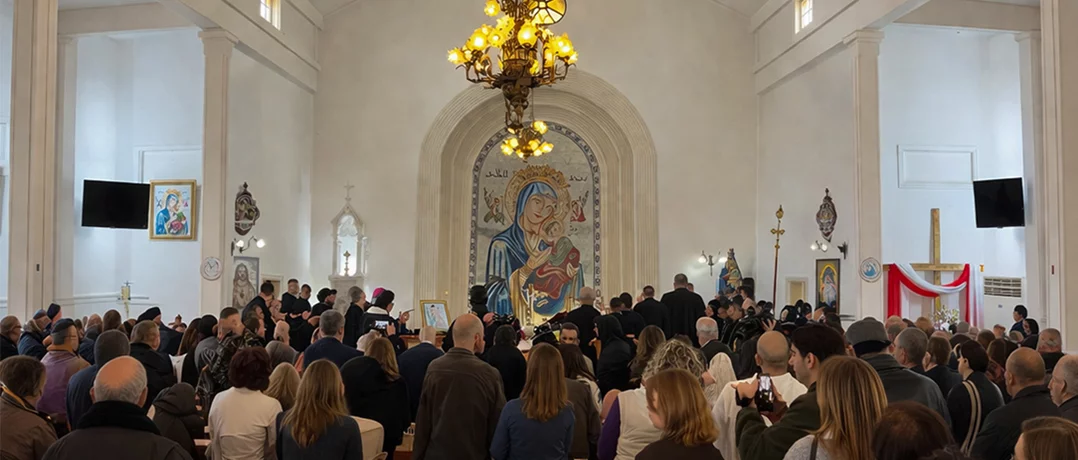
Access to these villages was made possible through a humanitarian convoy accompanying the Maronite Patriarch, who traveled through the region to conduct mass, deliver aid, and signal continued engagement with these predominantly Christian communities facing increasing isolation.
During the visit, Hussein Abu Achaghouri of Jdeidet Marjeyoun framed his decision to stay in stark, simple terms.
“How can I leave my neighbours, my towns, my life?” he said. “If I leave my house, I leave my soul.”
Living within range
Life in these border towns has been steadily altered by the proximity of conflict. For children, the effects are particularly acute. Studies of youth in conflict settings have found significantly elevated rates of anxiety, sleep disturbance, and post-traumatic stress symptoms, particularly in areas exposed to repeated violence.
Some children have devised simple ways to cope. Elise, for instance, explained that she reinterprets the loud noises as “storms, not bombs” so she does not get scared.
Others described “getting used to the sounds,” or treating them as part of daily life. Ralph, Edwin, and Peter insist that they are no longer afraid.
“This isn’t our first war, remember?” said Edwin.
That normalization, however, does not entirely eliminate fear.
“We used to wake up, go to school, and live our life peacefully,” high school student Serena from Qlayaa said. “But now we live with the fear of dying. People are afraid to sleep, because they don’t know if they will wake up the next day.”
And then there’s the disruption to education. For students at all three villages, school has transitioned to operating entirely online. Homework is received and sent over WhatsApp and other messaging platforms. Beyond the interruptions that poor connection poses, the separation from classmates and daily routines can be an isolating experience.
“I miss my friends, my teachers, my studies, and my classes,” said Vinny, an eleven-year-old from Kawkaba.
For many of these students, this is not the first time school has moved online. There was Covid, followed by the 2024 war, and now this war. This is not an isolated disruption, but a pattern with meaningful consequences. According to UNICEF, children in crisis zones often lose years of schooling, with repeated disruptions compounding long-term learning and developmental gaps.
For older residents, the economic impact is equally visible. In the southeastern border region, local activity has slowed sharply as insecurity restricts movement and reduces demand. At the national level, the cost is significant. According to Lebanon’s Ministry of Economy and Trade, the country has been losing an estimated $60 to $80 million per day since the escalation began.
In Qlayaa, George Rizk, a restaurant owner who had returned from Qatar to invest in the village, said he was forced to close his business. Rising costs, declining customers, and broader instability made it unsustainable.
“If the war finished, I cannot rebuild again. I lost everything in this war. And for what? For whom? For some people who want to make war just from nothing?” he said.
Bound to the land
And yet, despite the insecurity, economic hardship, and the uncertainty of daily life, many families have chosen to stay.
Property preservation is part of it. There is a concern that homes, if left unattended, could be damaged, occupied, or looted. That concern is not hypothetical. In recent weeks, Israeli operations have included the demolition of homes and infrastructure in several border villages further south, reinforcing fears that what is left behind may not remain intact. But the reasoning extends beyond material considerations.
In some cases, staying reflects a reversal of earlier departures. Jenna, an administrator at the local school in Jdeidet Marjeyoun, left with her family during the 2024 hostilities, worried about the impact on her young children. When they returned, she said her then ten-year-old son ran through the house, jumping on the bed and furniture in disbelief that they were finally home.
Less than two years later, faced with renewed escalation, the family made a different decision. “Whatever happens, we’re staying,” she said. “It’s our house, our country, our belongings, our land.”
Others frame it in terms of continuity.
Outside the church where Jenna attended the Patriarch’s mass, Hussein Abu Achaghouri stood smoking a cigarette. At 62, he has lived through Lebanon’s civil war, the 2006 war, the 2024 escalation, and now the current conflict. One of the village’s few Muslim residents, Abu Achaghouri dismissed the presence of sectarian tensions. Coexistence in the village has never been a problem, he insisted, describing the two communities as “family” who live side by side with little distinction. The culture of Marjeyoun, he said, emphasizes hospitality and openness to others.
“Look at me,” he joked, “I am a Muslim and I’m in church! I just came out for a cigarette.”
Although Abu Achaghouri estimated that perhaps as little as 40 percent of the village’s residents remained, he said he had “never” considered leaving, repeating the word for emphasis.
Clustered together outside the same church, a group of middle and high school students — Rita, Christian, Jad, Christian, and Peter — articulated a similar position. They spoke of a “duty” to stay, describing the land as something that could not be abandoned. It was, in their words, both “their life” and “their community,” and something they felt required their presence to endure.
There was also a shared understanding that no one beyond the townspeople would safeguard the land. In practice, state presence in these areas remains limited, with security forces stretched across multiple fronts and unable to sustain a continuous presence in every village.
“If we don’t protect our homes, who will?” said Rita.
Faith as a framework
Across these communities, faith provides a framework for making sense of the war.
For Elise, it is God who explains why the strikes have not come too close to home. Mireille, a resident of the area, credits her successful 2019 surgery to remove a cancerous brain tumour, which developed two years earlier, to the intervention of St. Charbel, Lebanon’s most widely revered and prominent saint.
“Maybe St. Charbel performed a miracle with me,” she said.
For others, faith is critical to how they respond to the current war’s pressures. “It’s hard,” said Théa of Qlayaa when describing the impact of the war. “But we have God. God is with us,” she added.
This faith, while personal in expression, is also central to these villages’ identity. Christian characterized the town of Jdeidet Marjeyoun as having “bold faith,” one that sustains the community through repeated crises.
“We went through so much, but we’re still faithful to God,” he said. In a setting of recurrent conflict, God, he explained, is often the sole constant and source of continuity.
This reliance on faith was one of the reasons behind the timing of the patriarch’s visit. As Israel has intensified operations along the southeastern front, particularly around the Mount Hermon corridor, villages south of the Zahrani and Litani rivers have found themselves increasingly cut off from the rest of the country. Strikes on roads and key transport routes have further disrupted access, complicating movement in and out of the area.
“The Patriarch’s visit gives a sense of relief that someone is looking out for us,” said Jenna.
What it means to stay
In southeastern border villages, the calculus is direct. Leaving carries risks to property, continuity, and the possibility of return. With Israel’s launch of Operation Eternal Darkness, which marked the deadliest and most expansive day of military activity since the start of the war, the situation is likely to continue to escalate, placing these villages at greater risk of damage or displacement.
But for the residents who have stayed, the land is not just where they live. It is their history, identity, and responsibility to remain.
They have never left their land. And they don’t plan to anytime soon.
-
-
-
Katharine SorensenReporterSpecializing in global affairs, technology and economics, with a focus on on-the-ground investigative reporting.
-
