

Annemarie Jacir's decade-in-the-making film explores a pivotal but often overlooked chapter of history whose consequences continue to reverberate across the region today.
Palestine 36 and the World before 1948

For many audiences, Palestinian history begins in 1948.
It is the year of the Arab-Israeli War, the year Israel was created, and, most critically, the year of the Nakba. Translated from Arabic as "catastrophe," the Nakba marked the forced displacement of more than 750,000 Palestinians and the destruction of more than 500 villages. In the decades since, it has become the dominant framework through which Palestine is understood. Palestinian history starts with this loss, and is narrated backward from it.
It is impossible, of course, to engage with modern-day Palestine without reckoning with that catastrophe. But what risks disappearing from such a view is the world that existed before it.
Palestine 36 attempts to recover that world.
“We always start talking about Palestine with ’48 and with Nakba and with the loss,” Palestine 36’s director, acclaimed Palestinian filmmaker Annemarie Jacir told The Beiruter.
I had never seen this moment on screen and I wanted to explore it.
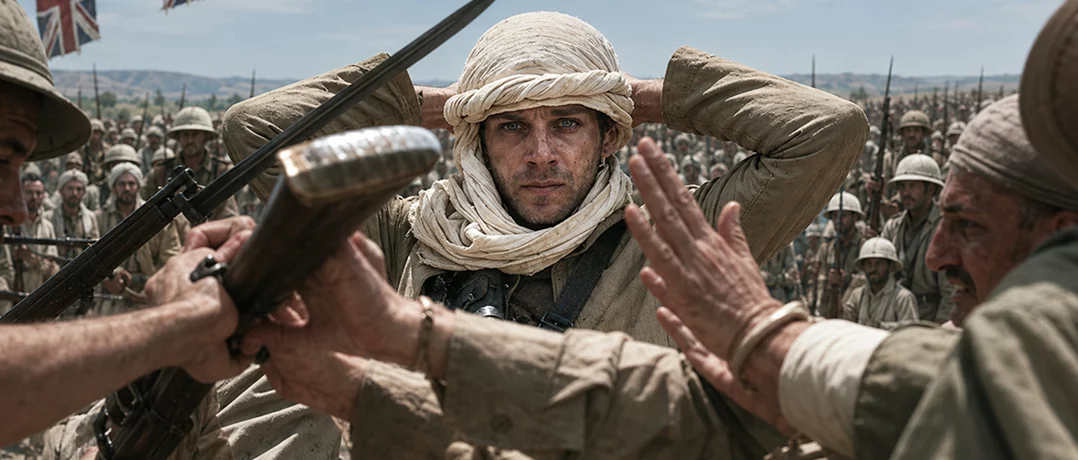
Set during the Palestinian Revolt of 1936–1939, twelve years before the Nakba, the film explores a pivotal chapter in Palestinian history that remains largely absent from public consciousness despite its lasting consequences for the region. The story follows a cast of fictional characters navigating life amid the growing tensions of British colonial rule and rising resistance. Farmers, port workers, journalists, children, laborers occupy the center of the story, not the political leaders or military commanders that history tends to center
For Jacir, that choice was deliberate.
“It’s not about the leaders or the political elite,” Jacir said. “It’s about regular, everyday people.”
Before the Nakba
One of the film's central achievements is that it presents Palestine as a vibrant society, before it became synonymous with displacement and occupation. As Jacir put it:
When we think about Palestine, especially now, we always think about destruction and loss.
In 1936, cities like Jerusalem, Jaffa, and Haifa were lively urban centers full of newspapers, cinemas, concerts, political salons, and growing commercial life. This is the world the characters of Palestine 36 inhabit. They do not know that their villages will be destroyed, that entire neighborhoods will be emptied, or that the political forces around them are moving inexorably toward partition and war.
But the audience does.
As the flourishing society unfolds on screen, the audience watches with the knowledge that within little more than a decade this world will disappear.
This temporal irony—the gap between what the characters experience and what the viewer knows—lends the film its particular kind of grief. It is not a film about loss alone, exactly. Rather, it is about the loss of potential and the loss of a life that is already ending without its inhabitants knowing it.
Revolt and the British empire
While discussions of Palestine today often center on the relationship between Palestinians and Israelis, Palestine 36 places Britain firmly at the center of the narrative. That, too, is intentional.
“We feel the slow burn of Zionism coming, but I wanted to keep the focus on the British,” Jacir said. “I think we really have let the British off the hook for their responsibility in all this.”
Following the collapse of the Ottoman Empire after World War I and the Sykes-Picot Agreement of 1916, Britain and France carved up much of the Arab world into spheres of influence.
Palestine came under British administration through the League of Nations Mandate. Simultaneously, the 1917 Balfour Declaration committed Britain to supporting the establishment of a “national home for the Jewish people” in Palestine—a commitment made without the consent of the Arab population that comprised the overwhelming majority of its inhabitants. By 1936, Palestinian frustrations over British rule, land sales, and rising Jewish immigration had reached a breaking point.
What began as a sixmonth general strike quickly became one of the largest anti-colonial uprisings in the modern Middle East.
“It started with Palestinian farmers, or fellahin, and quickly spread. It was an uprising across classes, across the whole country,” Jacir explained.
Britain responded with overwhelming force. At the revolt’s peak, more than 20,000 British troops were deployed across Palestine, supported by aircraft, armored vehicles, and auxiliary units. Curfews, mass arrests, home demolitions, administrative detention, collective punishment, and village searches became the tools of counterinsurgency. By the time the revolt was crushed in 1939, roughly 5,000 Palestinians had been killed, thousands more had been imprisoned or wounded, and much of the country's political leadership had been exiled, jailed, or forced into flight.
The revolt also coincided with the first formal proposal to partition Palestine. The 1937 Peel Commission recommended dividing the territory into separate Arab and Jewish states and transferring populations to create ethnically homogeneous areas. The proposal was never implemented, but many historians regard it as a critical precursor to what followed.
For Jacir, understanding this period is essential to understanding everything that followed.
“The blueprint for military occupation that the Israelis are using today, that blueprint is entirely set out in this period,” she said. "I was very aware I am making a period piece. But it doesn’t feel like a period piece, because the reality is so relevant. Everybody involved felt it was real".
Rebuilding a lost Palestine
History, however, was not content to remain on screen. And recreating a vanished Palestine proved almost as ambitious as depicting it.
The project spent nearly a decade in development, with years devoted to research, writing, and securing the necessary funding. Once financing finally came together, the challenge became finding locations capable of representing 1930s Palestine–a world that had, by design, largely been erased.
“None of that world exists anymore,” Jacir said, noting that more than 500 Palestinian villages were destroyed during and after the 1948 war, even as others were turned into Israeli settlements or became inaccessible to Palestinians.
After an extensive search, the production team found a partially standing village in the northern West Bank near Salfit and began restoring it. Production designer Nael Kanj insisted on rebuilding it using traditional methods—not as a film set to be dismantled, but as a genuine restoration. Craftsmen restored architectural details that had largely disappeared from contemporary life and the team planted historical crops including cotton and tobacco. Even the British military vehicles and equipment were rebuilt locally by a craftsman in Nablus.
If the undertaking sounds closer to a historical reconstruction than a conventional film production, it was.
“We knew we were working on a scale that had never really been attempted before in Palestine,” Jacir said.
After nearly a decade of preparation, production was scheduled to begin October 14, 2023. Everything was ready. The cast had arrived. Filming was just days away.
Then everything collapsed.
After October 7 and the outbreak of war in Gaza, the West Bank entered military lockdown. The restored village became inaccessible, as settlers overran the area and vandalized the cemetery. Insurance disappeared, movement restrictions intensified, and cast members found themselves stranded across the territory. It took Karim Daoud Anaya, the actor playing Yusef, three weeks to return home to Qalqilya. As Jacir explained:
“We were one week away from shooting when everything collapsed,” Jacir said. “We lost it all really.”
Even before October 2023, making a film under occupation meant navigating checkpoints, military restrictions, and settler activity during location scouting and production planning. After the war began, those obstacles multiplied dramatically,
Eventually, portions of the film were relocated to Jordan, but production continued.
For cast and crew members, many of whom had friends or relatives directly affected by the war, the emotional toll was immense. Gaza is only a short distance from much of the West Bank, and, as Jacir observed, the violence rarely felt remote.
“This team made the film during the genocide, at one of the darkest moments in our history,” Jacir said.
We made it because we believed in the story and we refuse to be erased.
Art as archive
Even after surviving the challenges of production, Palestine 36 faced a difficult journey to Lebanese screens. Basel Dalloul, head of the Dalloul Art Foundation, helped finally bring it to Beirut after initial delayed releases.
Home to one of the region's largest collections of modern and contemporary Arab art, the foundation has increasingly expanded its support beyond the visual arts to include cinema, literature, music, and other cultural initiatives.
“Our mission is to introduce and educate people about art and artists from this part of the world,” Dalloul told The Beiruter at the film’s first screening in Beirut at Metropolis Cinema.
Dalloul argued that culture often serves as a corrective to simplistic perceptions of the region, noting that audiences are frequently surprised by the diversity, sophistication, and creativity of Arab artists.
For Dalloul, Palestine 36 is not simply a historical drama but an act of cultural preservation. Like a painting, archive, or historical document, he noted, the film preserves a chapter of history that continues to shape the present while remaining absent from many contemporary discussions.
“It’s a moment in time and part of our collective history in this part of the world that was perhaps intentionally hidden,” he said.
Art can be very instrumental in archiving history and opening people’s eyes up to misconceptions.
Jacir herself spoke about the particular meaning of screening the film in Lebanon, whose own modern history emerged from the post-Ottoman partition of the region. The Lebanese had the French rather than the British, she noted, but both were manifestations of the same imperial project that carved up the Middle East in the aftermath of World War I.
Nearly ninety years later, Palestine 36 makes the past feel less distant than unfinished.
-
-

-
The Beiruter
-
