



Palm Sunday in Lebanon blends faith and tradition, where children, candles, and olive branches bring a sacred story to life across generations.
Palm Sunday: Lebanon's most tender procession

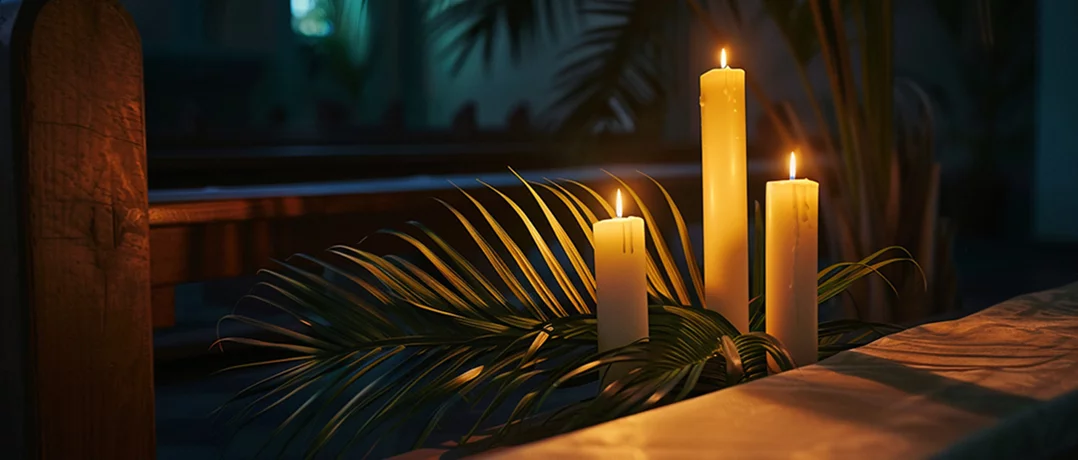
There is a particular kind of Sunday morning that belongs only to spring in Lebanon. The church bells arrive before the sun has fully committed to the day, and somewhere near the entrance of almost every village church, a child is being straightened up by a parent, candle pressed into small hands, a spray of olive branch tucked carefully alongside.
Palm Sunday in Lebanon is one of those rare occasions that manages to be at once deeply religious and deeply communal, a day when the sacred and the cultural fold into each other so naturally that it becomes impossible to separate them.
A Jerusalem story, retold in every village
The feast commemorates the entry of Jesus into Jerusalem, welcomed by crowds who laid palm branches at his path, a gesture of honor, of recognition, of hope. For Lebanese Christians across denominations, Catholic, Maronite, Orthodox, and others, it marks the beginning of Holy Week, the most solemn stretch of the liturgical year, and serves as the gateway to Easter.
But in Lebanon, the story does not stay inside the church walls. It spills out into the streets, down the stone steps of mountain villages, by the sound of hymns and the soft glow of candlelight in the hands of children who may not yet fully understand what they are celebrating, but who will remember it for the rest of their lives.
The children, the candles, the branches
If Palm Sunday in Lebanon has a defining image, it is this: a child dressed in their finest clothes, holding a decorated candle in one hand and a branch of olive or palm in the other, walking in procession with the rest of the congregation.
The dressing up is taken seriously. This is not a casual Sunday. Families prepare, sometimes days in advance, pressing clothes, polishing shoes, braiding hair. There is a tenderness to it that feels almost old-fashioned in the best possible sense, a collective agreement that some mornings deserve more care than others.
The branches themselves are central. Palm fronds and olive branches are brought to church to be blessed by the priest during the service, a blessing that carries weight well beyond the day itself. These branches are not discarded after the procession. They are kept, tucked behind a cross or an icon, preserved for an entire year. Come the following Ash Monday, the first day of Lent in the Eastern Christian calendar, it is these very branches, now dried, that are burned to produce the ashes used in the liturgy. The cycle is quiet and complete: this year's palms become next year's ashes, life folding into itself across the seasons.
Villages that live the story
In some Lebanese villages, Palm Sunday goes further than procession, it becomes performance. Communities, particularly in the mountains and the south, stage dramatic re-enactments of Christ's entry into Jerusalem. A figure on a donkey moves through the village streets while residents line the path, waving branches, singing, some scattering leaves and flowers on the ground in echo of that original welcome two thousand years ago. These living processions are not theater in the formal sense, but they carry the same essential power, the power of a community choosing to inhabit a story rather than merely observe it.
A feast that holds
Lebanon is a country can carry its traditions through difficulty. Palm Sunday has survived wars, displacement, emigration, and the particular modern erosion that empties old rituals of their meaning. It survives because it asks very little in the way of explanation and offers a great deal in the way of feeling. A candle. An olive branch. A child in good clothes standing in the morning light. Some traditions endure not because they are defended, but because they are simply the re-anchoring of our faith.
-
-

-
The Beiruter
-
