



Iran’s expulsion of French diplomats and disregard for diplomatic norms prompt a firm French response, deepening an already strained bilateral relationship.
Paris and Tehran in diplomatic showdown

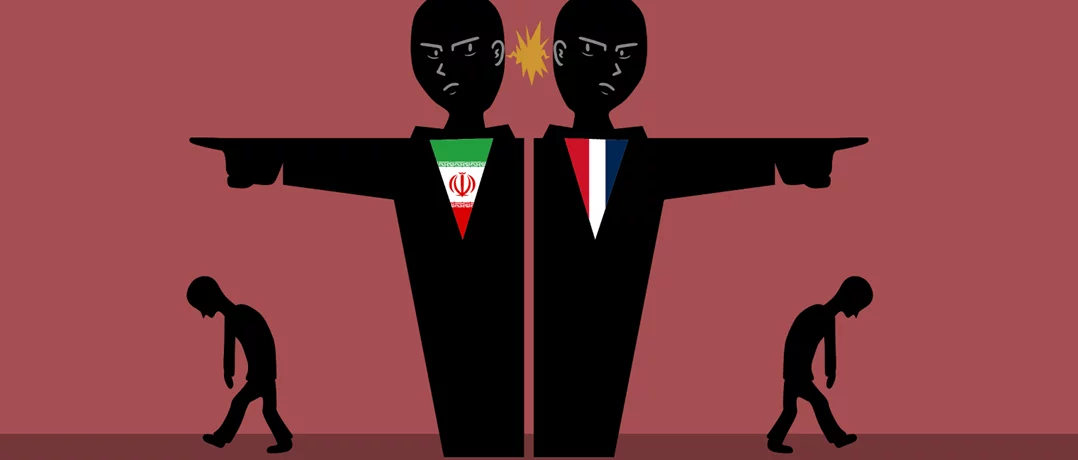
Illustration by Karim Dagher
Relations between France and Iran have entered another period of heightened tension after Paris announced the expulsion of two Iranian diplomats in response to Tehran’s decision to permanently bar two French embassy employees from returning to Iran. The latest dispute marks a significant deterioration in already fragile bilateral ties, raising fresh questions about the future of French-Iranian relations.
Coming at a time of heightened regional instability and persistent disagreements over Iran’s domestic and foreign policies, the confrontation underscores the deep mistrust that continues to define relations between the two countries. Beyond the immediate diplomatic fallout, the dispute has also reignited broader debates over diplomatic immunity, cultural engagement, and the limits of foreign diplomatic activity under international law.
A diplomatic dispute escalates
The current crisis intensified after Iran declared two French embassy employees persona non grata and prohibited them from returning to Tehran. In response, French Foreign Minister (FM) Jean-Noël Barrot announced that France would expel two Iranian diplomats stationed in Paris, describing Tehran’s actions as “unacceptable” and stressing that they would carry consequences.
French authorities argue that the embassy personnel were protected under the 1961 Vienna Convention on Diplomatic Relations, which grants diplomats immunity from detention and prosecution while carrying out their official duties. According to Paris, Iranian security forces violated these protections by detaining, interrogating, and intimidating the diplomats during the July incident.
Iran, however, has presented a very different version of events. Iranian officials claim the French representatives engaged in activities beyond their diplomatic mandate by supporting civil society initiatives and participating in what Tehran described as inappropriate political activities. Iranian authorities have accused France of interference and “foreign infiltration,” insisting that their actions were consistent with protecting national security.
The conflicting narratives have left little room for compromise and have prompted reciprocal diplomatic expulsions that further strain communication between the two countries.
The incident at the center of the crisis
The confrontation began during a meeting held at the home of Iranian graphic designer Aria Kasaei in Tehran. The gathering reportedly focused on Villa Zadig, a French-supported cultural initiative designed to promote artistic collaboration, creative exchanges, and residency programs between France and Iranian civil society.
Present at the meeting were two French embassy officials, including France’s cultural attaché, along with Iranian graphic designers Aria Kasaei and Elly Naghilou.
According to the French government, Iranian security personnel raided the meeting, detained the French diplomats for several hours, confiscated their mobile phones, and subjected them to interrogation despite their diplomatic status. French officials have further alleged that one diplomat suffered physical abuse and threats during the detention.
Iranian authorities reject those allegations, maintaining that the diplomats were only briefly questioned after being found at what they describe as an unauthorized gathering. Tehran insists the French officials had crossed the boundaries of diplomatic activity by engaging with groups viewed by the government as politically sensitive.
Arrest of Iranian graphic designers
While the diplomatic dispute has focused primarily on embassy personnel, the fate of the two Iranian graphic designers has become another major point of concern.
Supporters of Aria Kasaei and Elly Naghilou say both artists have remained in detention since the July meeting. According to statements released by individuals close to the designers, they had been working on the visual identity of the Villa Zadig cultural project when security forces arrested them.
Human rights advocates and supporters have called for the pair to receive access to independent legal representation and for their fundamental rights to be respected throughout the judicial process. They have also urged French authorities to seek greater transparency regarding their detention and to pursue diplomatic efforts aimed at securing their release.
The arrests have fueled broader concerns that Iranian authorities are tightening restrictions on cultural cooperation with foreign institutions, particularly in the aftermath of domestic unrest and growing regional tensions.
Diplomatic immunity at the heart of the dispute
A central issue in the confrontation is the interpretation of the 1961 Vienna Convention on Diplomatic Relations, the international treaty that governs diplomatic privileges and immunities.
France maintains that its embassy staff were carrying out legitimate diplomatic and cultural responsibilities and therefore enjoyed full diplomatic protection. From Paris’ perspective, their detention represented a serious breach of international law and an unacceptable attack on diplomatic norms.
Iran, by contrast, argues that diplomatic immunity does not protect foreign officials who allegedly exceed the limits of their accredited responsibilities. Iranian officials contend that the French diplomats were involved in activities supporting Iranian civil society in ways that amounted to political interference.
The disagreement reflects broader differences between Western governments and Iran regarding the role of foreign diplomatic missions in engaging with academics, artists, researchers, and civil society organizations (CSOs). It is worth noting that Tehran has previously disregarded and defied international law on several occasions, including its refusal to comply with the Lebanese government’s decision of recalling its ambassador to Beirut after he was proclaimed persona non grata due to his outright interference in internal Lebanese affairs.
A relationship marked by recurring crises
The latest dispute adds to years of often turbulent relations between Paris and Tehran, shaped by shifting geopolitical interests, ideological differences, and recurring diplomatic crises.
Although Paris initially hosted the exiled Shiite clergy Ayatollah Ali Khomeini, after Iran’s 1979 Islamic Revolution relations between the two countries deteriorated as the new Iranian leadership adopted an anti-Western foreign policy. Throughout the 1980s, tensions intensified over France’s support for Iraq during the Iran-Iraq War (1980-1988), the presence of Iranian opposition figures in France, and a series of terrorist attacks in Paris that French authorities linked to Iranian-backed networks. The period became known as one of the most difficult chapters in bilateral relations.
Although ties improved somewhat during the 1990s and early 2000s, driven by expanding trade and European diplomatic engagement with Tehran, disagreements over Iran’s nuclear program, regional influence, and human rights record continued to generate friction. France played a prominent role in international negotiations over Iran’s nuclear activities while simultaneously supporting sanctions whenever diplomatic efforts stalled.
More recently, relations have remained strained by concerns over Iran’s detention of foreign nationals, its support for armed groups across the Middle East, and repeated disputes over human rights and civil liberties. Despite maintaining diplomatic channels and occasional periods of dialogue, both countries have struggled to establish a stable and lasting partnership.
.-
-

-
The Beiruter
-
