



Manuella Guiragossian reflects on her father’s life, artistic legacy and enduring belief in humanity as a major centenary retrospective opens in Abu Dhabi.
Paul Guiragossian: Painting the human experience
Paul Guiragossian: Painting the human experience
By Patricia Khoder | November 01, 2026

Reading time: 5 min
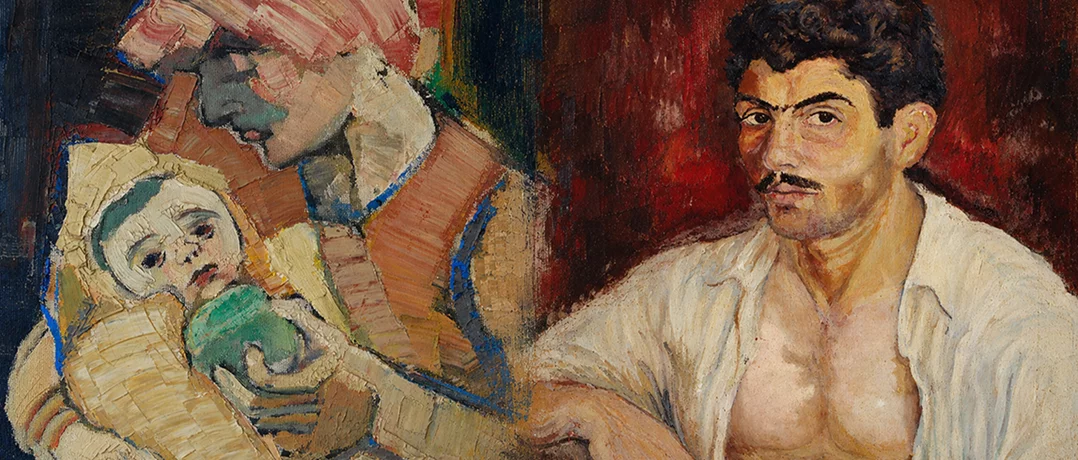
Paul Guiragossian: 100 Years of Art is the title of a major retrospective presented by the Bassam Freiha Art Foundation (BFAF) in Abu Dhabi to mark the centenary of the birth of Paul Guiragossian (1926–1993).
Speaking exclusively to The Beiruter, Manuella Guiragossian offers a personal account of her father's life, revealing the memories, experiences and artistic convictions that shaped one of Lebanon's most celebrated painters.
Dedicated to one of the most important figures in modern Lebanese and Middle Eastern art, this landmark exhibition will run from October 17, 2026, to January 17, 2027. Organized in collaboration with the Paul Guiragossian Foundation, it is co-curated by the artist’s daughter, Manuella Guiragossian, and Dr. Michaela Watrelot, BFAF’s head curator and director of exhibitions. Bringing together significant works drawn primarily from the artist’s estate, the exhibition offers a comprehensive exploration of his life and legacy.
Structured as a chronological journey, the exhibition traces Guiragossian's artistic evolution from his early years in an Armenian family shaped by displacement and migration, including the 1948 relocation from Jaffa to Lebanon, through to his global recognition as one of the most important painters from the region to emerge in the twentieth century.
From the figurative portraiture of his early years to the elongated silhouettes of his final decade, works on view show the evolution of his artistic language, built on his conviction that the human figure, however abstracted, 'will remain beautiful.
“For the first time, my father’s self-portrait is being shipped abroad. When Paul Guiragossian arrived in Lebanon from Palestine in 1948, he was 22 years old. He was a young painter, and he arrived by boat with his family. He had not packed all his belongings because, when they left Jaffa by boat, they had been told that they would be away for two weeks before returning home. He did not take his first self-portrait with him, and he regretted it for the rest of his life.
“Once in Lebanon, he painted a second self-portrait. He was so afraid of losing it that, he carried it under his arm whenever he went to an exhibition and would not let go of it until he reached the exhibition venue. After my father died in 1993, I followed his example every time we organized an exhibition in Lebanon: I, too, carried the self-portrait under my arm,” recalls Manuella Guiragossian, the painter’s youngest daughter and president of the Paul Guiragossian Foundation.
Born in Jerusalem into an Armenian family whose life had been profoundly marked by the tragedies of 1915, Paul Guiragossian experienced the consequences of exile from an early age. In Lebanon, he lived through the dark years of the Civil War (1975–1990). In 1974, he also suffered an accident that resulted in the amputation of his right leg.
His background shaped his lifelong engagement with the human condition, which found expression both in his paintings and in his everyday life. Despite the hardships he endured, he never lost faith in humanity’s capacity for renewal or its ability to nurture hope.
Above all, Guiragossian was a generous and prolific artist and intellectual.
His artistic output exceeded 5,000 works. He could sketch a drawing in just a few minutes and prepare an entire exhibition in as little as two weeks.
In 1973, while sitting at a café in Hamra, Guiragossian was approached by Berj Fazlian, who wanted to talk to him about Al-Mhatta (The Train Station), a play by Fairuz and the Rahbani brothers. Guiragossian immediately set about drawing the poster, depicting a train in motion. He did so on the spot, without a paintbrush and using a sheet of paper brought over from a nearby architect’s office.
That same year, he contributed a giant triptych to the set design of Idrab al-Harmieh (The Thieves’ Strike), a play by Oussama el-Aref that was staged at a theater in Hamra.
His work also extended to religious art. He created numerous religious paintings for churches across Lebanon, notably at the Armenian Catholicosate in Antelias, the Maronite Basilica of St. Elias in the same locality, and the Latin Church of St. Anthony of Padua in Sin el-Fil. He also designed the cover of Kyrie Eleison, an album by Ziad Rahbani.
Manuella Guiragossian also recalls an impromptu exhibition her father organized in Washington in 1970, following a trip to the United States made possible by a grant from the Exchange Visitor Program, sponsored by the U.S. Department of State.
Juliette, Paul’s wife, accompanied him on the trip. He invariably entrusted her with the proceeds from the sales of his paintings and exhibitions, and she insisted on bringing a series of his paintings with her to the United States.
Upon their arrival, the couple contacted Afifa Dirani, the cultural attaché at the Lebanese Embassy in Washington. However, as she was away from her office, she did not get in touch with them until the day before the Guiragossians were scheduled to return to Lebanon. She persuaded them to postpone their departure and decided with the couple that Paul would organize an exhibition.
Juliette turned to the Yellow Pages and searched for Armenians in Washington who might have a painting studio. She came across a woman who was passionate about painting and had a studio in her home. The woman agreed to host Paul for two weeks. Thanks to the mobilization of the Lebanese Embassy in Washington, Guiragossian was able to exhibit his work for two weeks at the prestigious Corcoran Gallery.
Paul Guiragossian’s circle of friends included many of the leading intellectuals of the time, among them Jalal Khoury, Adonis, Mahmoud Darwish, and Ounsi el-Hage. Alongside el-Hage, he was a member of the Cultural League, which held meetings in Rabieh during the Lebanese War. The league brought together a number of prominent intellectuals and public figures, including Raymond Gebara, Said Akl, and Charles Malik.
Manuella Guiragossian’s dream is to create a dedicated space where her father’s paintings can be exhibited permanently, along with a research center and archive devoted to Paul Guiragossian and making them accessible to the public.
-
-
-
Patricia KhoderJournalistFocusing on culture and entertainment.
-
