



Lebanon’s growing pole dancing community is challenging assumptions about strength, sexuality and respectability, creating a space where athleticism, sensuality and self-expression can exist together.
Pole, power and stigma

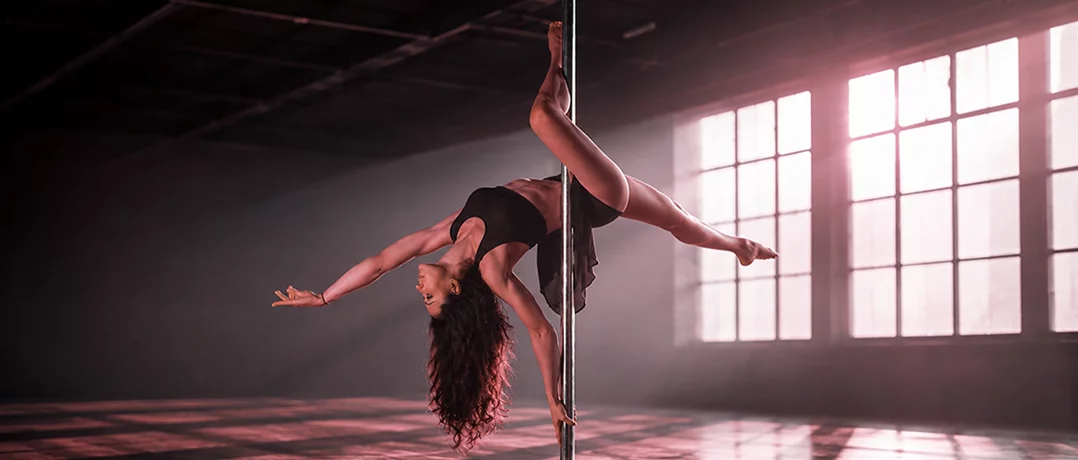
For many people in Lebanon, the words “pole dancing” still produce an almost immediate association: stripping. The athleticism, training and discipline involved can become secondary to the image of a woman moving around a pole and everything society has been taught to attach to it. Inside Lebanon’s growing pole community, dancers are not necessarily interested in escaping that history. Instead, some are asking a more complicated question: why should pole have to distance itself from sexuality in order to be respected? For Reem, an instructor at PoleFit Lebanon, pole dancing began almost accidentally. In 2019, a friend convinced her to attend a class in Beirut. She had always thought pole was impressive, but never imagined she could actually do it herself, thirty minutes into her first class, that changed.
“I got a sort of epiphany and I told myself, ‘This is what I’m going to do for the rest of my life.’” After around two years of practicing, her instructor, Lolypole, suggested that she consider teaching. Reem eventually began teaching in 2022, initially alongside jobs as a waitress and graphic designer. Pole was supposed to remain a side job, until she began questioning why the thing that made her happiest had to remain on the sidelines.
Pole does not need to erase its past
As pole has increasingly entered fitness studios and competitions internationally, there has sometimes been an effort to separate contemporary pole from stripping. Yet the modern Western form of recreational pole is closely connected to erotic dance and strip clubs, even as pole has developed into athletic, artistic and competitive forms. Reem does not believe gaining legitimacy should require pretending that connection does not exist. “Pole dancing comes from sex work. And it derives from the art of stripping.” She argues that acknowledging the dancers and marginalized communities who contributed to pole is part of respecting the discipline rather than diminishing it. “It doesn’t mean I am stripping. It doesn’t mean I am a sex worker, but it is important to acknowledge the history of it so that we do not erase culture and we do not erase history.” This tension extends far beyond Lebanon, as pole has moved into studios, competitions and performance spaces, debates have emerged internationally over whether presenting it primarily as fitness risks sanitizing the contribution of strippers to the modern discipline. In Lebanon, however, Reem believes the conversation becomes even more difficult because of the stigma surrounding both sex work and female sexuality.
The problem may not be the pole
For Reem, the reaction to pole dancing cannot be separated from the way women’s bodies are already scrutinized. Criticism often focuses on clothing, pole dancers commonly train in shorts and sports bras, something outsiders may interpret as deliberately provocative. Reem points to an obvious contradiction: other sports expose similar amounts of skin without receiving quite the same reaction. A gymnast wears shorts and a sports bra, a swimmer competes in a swimsuit, a ballet dancer wears a leotard. Yet, she said, “as soon as people see a vertical bar, they think about stripping.” That association makes pole different. But Reem believes the stigma is also part of a broader tendency to police what women do with their bodies.
“It’s a mix of pole being what it is today and also people, especially in our society today, always having things to say about what women do in their lives.” There is another contradiction at the center of this discomfort. Female sexuality is hardly absent from entertainment. Women’s bodies can be sexualized in films, advertisements, music videos and nightlife. Yet a woman choosing to express her own sensuality can suddenly become controversial. Reem sees a difference between sexuality being consumed and sexuality being controlled by the woman expressing it. She argues that women working in sexualized environments can be desired while simultaneously being denied respect, and that the judgement becomes even more visible when the woman involved is someone a person knows. In her words, it can become: “You can’t do this because this is for those we do not respect.” Pole therefore exposes something larger than attitudes toward a sport. It raises questions about which expressions of femininity society considers respectable and who is allowed to decide when a woman’s sexuality is acceptable.
Learning not to shrink
For Reem, one of pole’s most significant effects has little to do with performing for anyone else. She describes it as a way of reconnecting with the body. “We, as Arab women, tend to repress at a very young age because we are told that we should hide and we should shrink.” Pole reverses that instruction, students are required to become aware of what their bodies can lift, hold and endure. Strength and sensuality are not treated as opposites. Neither are femininity and physical power. Reem describes the experience as appreciating the body not simply for how it looks, but “for everything that it can also do.” That vulnerability is intensified by the nature of pole itself. Students train with much of their skin exposed and perform movements that can feel sensual or unfamiliar. Instead of pretending that vulnerability does not exist, Reem says classes acknowledge it. That, she believes, is part of why students become so close, “this is a place where you can belong, where you can exist, and nobody is going to say a single thing.” Pole can also offer something many people lose when they enter sport later in life: permission to be a beginner. Reem said most people she encounters do not necessarily start as children. Some begin in their 20s or 30s, while others start in their 40s and 50s. Students progress at different speeds, but she describes classes as unusually supportive and less focused on comparison.
From a taboo to a competition
Lebanon’s pole scene has also moved beyond individual studios. PoleFit Lebanon founder Laura Ayoub, known as Lolypole, founded the Lebanon Pole Championship, described by the competition itself as the first pole dancing competition in the country. The inaugural championship took place in 2022, with junior, amateur and semi-professional categories. According to Reem, the competition has attracted participants across generations. She recalled competitors ranging from a 12-year-old in 2022 to a 51-year-old, alongside growing participation from men and members of the queer community. For Reem, that diversity is connected to the environment the community has tried to create. The pole community, she says, has become a space where women and queer people can express parts of themselves that may be more difficult to express elsewhere. The stigma, however, has not disappeared, “we’ve still got a long way to go when it comes to opening up people’s minds in Lebanon, especially when it comes to pole dancing.”
But Reem does not seem particularly interested in waiting for everyone else to become comfortable. Pole dancing changed her relationship with her body and eventually changed the direction of her career. What began as a class she reluctantly attended for a friend became something around which she built a life. Perhaps that is what makes pole particularly challenging to traditional ideas about women and sexuality. It does not necessarily ask women to become less sensual in order to become stronger, or less feminine in order to become athletic. It allows those things to exist together. For women who have spent years being told to hide, cover themselves or make themselves smaller, simply taking up that space can become its own statement. As Reem put it, “I feel like a pole dancing class can change anybody’s life. It changed mine.”
