



Pope Benedict XVI’s Middle East Synod and Lebanon visit reflected his enduring vision for Christian presence, dialogue, peace, and coexistence.
Pope Benedict XVI’s enduring vision for the Middle East
Pope Benedict XVI’s enduring vision for the Middle East
By The Beiruter | October 10, 2026

Reading time: 5 min
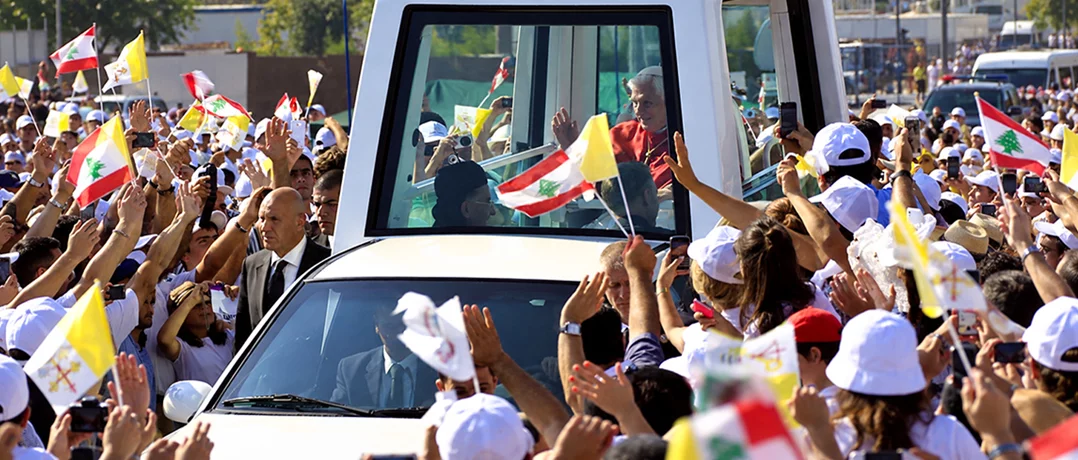
When Pope Benedict XVI announced the Special Assembly for the Middle East of the Synod of Bishops in 2009, the region was already experiencing long-standing conflicts, the decline of Christian communities through emigration, restrictions on religious freedom, and growing instability threatened the historic Christian presence in the land where Christianity was born.
In light of such uncertainty, the Vatican convened a unique gathering of bishops from across the Middle East under the theme “The Catholic Church in the Middle East: Communion and Witness,” inspired by the words of the Acts of the Apostles: “Now the company of those who believed were of one heart and soul” (Acts 4:32).
Held in Rome from 10 to 24 October 2010, the Synod sought not to intervene in regional politics but to strengthen the spiritual, pastoral, and communal life of Christians while encouraging dialogue with other Christian traditions, Judaism, Islam, and wider society. It reflected Pope Benedict XVI’s conviction that Christians must remain active contributors to the Middle East’s future despite the immense challenges confronting them.
The purpose and key messages of the special assembly
The Special Assembly for the Middle East of the Synod of Bishops was established with two primary objectives: strengthening the Christian identity of Middle Eastern communities and promoting greater unity among the region’s Catholic Churches.
The Synod sought to encourage Christians to rediscover their faith through Scripture, the sacraments, and a deeper understanding of their mission within societies facing profound political and social challenges.
At the same time, it aimed to reinforce ecclesial communion among the Maronite, Melkite Greek Catholic, Chaldean, Syriac, Armenian, Coptic, and Latin Churches. Their diversity was presented as a source of richness rather than division, demonstrating that unity could coexist while preserving distinct liturgical, theological, and cultural traditions. The Assembly also highlighted the importance of ecumenical cooperation with Orthodox and Protestant communities to strengthen the Christian presence in the region.
Furthermore, the Synod directly addressed the difficult circumstances confronting Middle Eastern Christians, including conflicts, discrimination, religious extremism, emigration, and demographic decline. Rather than encouraging withdrawal and isolation, it called Christians to remain active participants in their societies through education, social service, dialogue, and the promotion of justice and peace.
During the closing Mass on 24 October 2010, Pope Benedict XVI highlighted the Assembly’s central themes. He stressed that authentic prayer must be accompanied by solidarity with those suffering from oppression, violence, hardship, and injustice throughout the Middle East. He also called for deeper communion within the Church and greater recognition of the liturgical and spiritual heritage of Eastern Catholic communities. Most importantly, he presented peace and religious freedom as fundamental responsibilities. Peace, he argued, is both a divine gift and a human commitment, while freedom of conscience and worship must remain essential foundations for coexistence and Christian-Muslim dialogue across the Middle East.
Lebanon’s central role and Pope Benedict XVI’s historic 2012 visit
Although the Synod addressed the entire Middle East, Lebanon occupied a particularly significant place in its vision. Unlike most countries in the region, Lebanon has long represented a model of religious coexistence, constitutional pluralism, and the historic presence of multiple Christian communities alongside Muslim communities.
The Synod repeatedly presented Lebanon as an example of how Christians could contribute constructively to public life while maintaining dialogue with other religions. It also recognized the country’s importance as a refuge for many Eastern Christian traditions and as a bridge between East and West.
This significance became even more apparent when Pope Benedict XVI chose Lebanon (not Jerusalem, Jordan, Egypt, Syria, or another regional country) as the location where he would sign and officially promulgate the Post-Synodal Apostolic Exhortation Ecclesia in Medio Oriente (“The Church in the Middle East”) in September 2012, despite widespread security concerns resulting from the Syrian civil war (2011-2024) and regional unrest following the Arab Spring which erupted in 2010.
During the visit, he formally signed the Apostolic Exhortation that summarized the Synod’s conclusions and presented a pastoral roadmap for Christians throughout the Middle East. His speeches consistently highlighted coexistence, dialogue, reconciliation, and religious freedom.
Addressing Lebanon’s political leadership, he praised the country’s delicate pluralistic system while warning that any attempt to upset its communal balance would ultimately harm the entire nation. He reaffirmed Lebanon’s unique vocation as a place where Christians and Muslims could live together with mutual respect.
The Pope also encouraged Middle Eastern Christians not to abandon their homeland despite insecurity and economic hardship. Speaking to young people, he urged them to remain in their countries, participate actively in society, and become peacemakers rather than surrendering to despair or emigration.
His concluding Mass on Beirut’s waterfront gathered hundreds of thousands of faithful, during which he appealed once more for peace in Syria and reconciliation throughout the Middle East.
Pope Benedict XVI: The architect of the Middle East Synod
Born Joseph Ratzinger on 16 April 1927 in Marktl am Inn, Germany, Pope Benedict XVI experienced the hardships of the World War II (1939-1945) during his youth before studying philosophy and theology in Munich and Freising. Ordained a priest in 1951, he quickly established himself as one of the Catholic Church’s foremost theologians.
He served as an expert adviser during the Second Vatican Council before teaching theology at several German universities. In 1977 he became Archbishop of Munich and Freising and was created Cardinal later that year.
From 1981 until 2005, Cardinal Ratzinger headed the Congregation for the Doctrine of the Faith, becoming one of Pope John Paul II's closest collaborators. He also chaired the commission responsible for preparing the Catechism of the Catholic Church, published in 1992.
Following the death of John Paul II, Cardinal Ratzinger was elected Pope on 19 April 2005, taking the name Benedict XVI. Throughout his pontificate, he stressed the relationship between faith and reason, the importance of Christian unity, interreligious dialogue, and the preservation of Christianity’s historic roots in the Middle East.
More than 10 years after the Synod and Pope Benedict XVI’s visit to Lebanon, many of its themes remain remarkably relevant. Christians across the Middle East continue to confront political instability, migration, economic hardship, and questions surrounding religious freedom. Yet the Synod’s central message, that Christian communities should remain rooted in their homeland while serving as witnesses to reconciliation, dialogue, and hope, continues to shape the Church’s pastoral vision.
-
-

-
The Beiruter
-
