



FPV drones are reshaping insurgency by giving armed groups low-cost precision-strike capabilities once reserved for modern militaries.
Precision for the insurgent

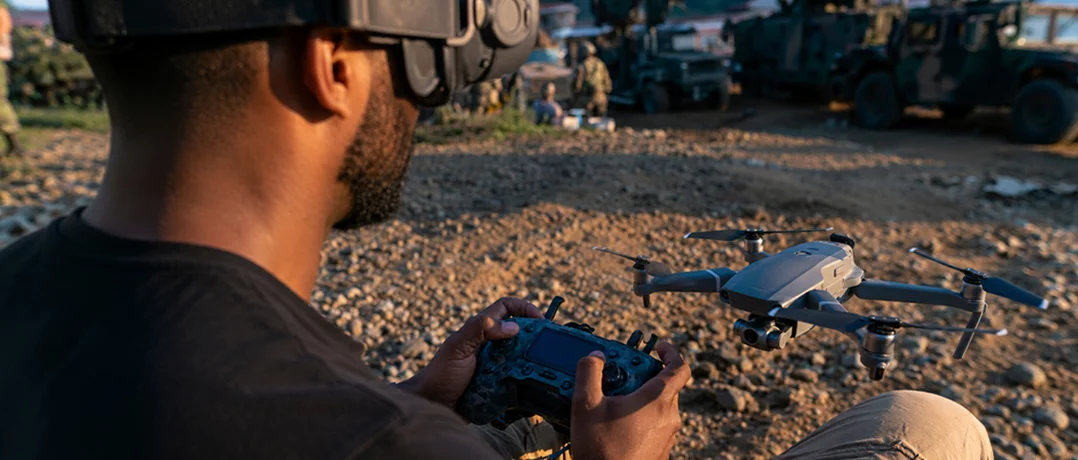
For much of modern history, insurgency has been shaped by an obvious imbalance. Armed groups could ambush convoys, plant bombs, fire rockets or disappear into difficult terrain, but the state usually retained the decisive technological advantages of modern warfare.
One of those advantages was precision. The ability to identify a target, follow it and strike it accurately from a distance belonged overwhelmingly to armies with access to aircraft, artillery, guided missiles and sophisticated surveillance systems.
Today, that divide is beginning to narrow. First-person-view drones are spreading rapidly across conflicts involving insurgents, and they are beginning to change what relatively small and poorly equipped forces can threaten on the battlefield.
Why FPVs fit insurgency so well
What makes the FPV particularly suited to insurgency is how easily it fits the way irregular forces already operate.
Insurgent organizations traditionally survive through dispersion, avoiding large formations and permanent infrastructure while keeping valuable weapons and personnel concealed. FPVs fit comfortably within that model, as small teams can operate and transport them without the logistical footprint or visible firing positions associated with heavier conventional weapons.
The advantages in weight and cost can be considerable: a 2025 U.S. Army War College study calculated that an individual FPV can weigh roughly one-third as much as a Javelin missile, allowing soldiers to carry at least twice as many, while the cost of a single Javelin could purchase more than 130 FPVs.
Their commercial origins add another advantage. Much of the underlying technology comes from civilian markets, making components comparatively easy to acquire, replace and modify, while airframes, communications systems and payloads can be adapted as battlefield requirements change.
Precision adds another advantage. The drone's camera allows the operator to continue steering during the approach, correcting its path and selecting a particular vehicle, position or piece of equipment. The result is a form of low-cost precision strike that can be pushed down to very small units. CNAS describes FPVs essentially as inexpensive anti-tank weapons capable of beyond-line-of-sight attacks, but with a range roughly six times that of the most advanced conventional anti-tank weapon.
That reach also changes the geography of the traditional ambush. Guerrilla warfare has long depended on predicting where an enemy will pass and placing fighters or explosives accordingly. A maneuverable FPV gives the attacker greater freedom to search for and pursue a target instead, making distance, terrain, walls and other forms of cover less reliable forms of protection.
FPVs can therefore be absorbed into existing insurgent structures without forcing armed groups to reorganize around a new weapons system
Their asymmetry also extends beyond the cost of the drone itself. Even an FPV that fails to destroy its target can force a stronger military to invest far more in detecting, disrupting and defending against the threat. Cheap and expendable drones can therefore impose an expensive defensive burden, compelling armies to protect personnel and equipment across an increasingly large part of the battlefield.
In 2026, the U.S. Congressional Budget Office estimated that a comprehensive layered defense against small drones for a single representative military installation would cost around $74 million upfront and another $5 million annually to support it.
Ukraine: The laboratory
The war in Ukraine transformed the FPV drone from a relatively limited battlefield tool into a weapon employed at industrial scale. RUSI estimates that Ukrainian drone production rose from 3,000–5,000 systems in 2022 to more than 2.2 million in 2024.
Just as important was the speed of adaptation. Civilian engineers and decentralized experimentation created a much faster cycle between battlefield experience and technical change, allowing FPV tactics and designs to evolve continuously.
The result was more than mass production. Ukraine became the principal laboratory for modern FPV warfare, developing a constantly evolving body of tactics, technical knowledge and operational experience that could be observed, copied and eventually carried into conflicts far beyond its borders.
A battlefield without borders
Colombia
Colombian media reports have documented military veterans returning from Ukraine with drone expertise, while Ukrainian recruiters have identified Colombians linked to illegal armed groups seeking skills in FPV warfare. The technology is entering an already rapidly changing conflict: ACLED recorded 149 armed-drone attacks in Colombia in 2025, up from 38 the previous year. By 2026, Human Rights Watch was documenting armed groups training even recruited children to operate explosive drones.
The Sahel
A similar evolution is underway among jihadist and rebel groups in the Sahel. JNIM, al-Qaeda's regional affiliate, expanded from fewer than ten recorded armed-drone strikes in 2024 to around 80 in 2025, according to ACLED. Meanwhile, the Azawad Liberation Front has incorporated FPV and other modified commercial drones into its operations in Mali, with researchers warning that technical knowledge is circulating between armed groups. A 2026 CSIS assessment, citing the United Nations, found that the group’s growing integration of drones had helped it reach a “new level of operational capability” in conducting complex attacks.
Myanmar
Myanmar provides perhaps the clearest example of what drones can offer an insurgency otherwise deprived of airpower. Resistance groups facing a military equipped with combat aircraft began modifying civilian drones after the 2021 coup, eventually adding FPV systems and turning some into one-way attack weapons. ACLED has recorded more than 2,100 resistance drone-strike events across over 600 locations, describing drones as effectively the resistance's entire “air force.”
Their impact became especially visible during Operation 1027 in late 2023, when resistance forces used drone swarms while overrunning military positions and seizing large areas of northern Shan State, dealing a humiliating defeat to the ruling junta.
Lebanon
Hezbollah offers an example of how quickly an armed group can move from experimenting with FPVs to adapting them against increasingly sophisticated defenses. The group was already using such systems on a limited scale in 2024. On 14 June of that year, Hezbollah used an explosive FPV against technical equipment at an Israeli military position, damaging a Drone Dome counter-drone system.
By 2026, however, Hezbollah had taken the technology considerably further. Since March, it has increasingly employed fiber-optic FPVs, whose physical connection to the operator makes conventional radio jamming far less effective. ACLED recorded 214 FPV attacks by Hezbollah between March and July, accounting for 21 percent of its attacks in Lebanon during that period.
The threat became significant enough for the IDF leadership to address it publicly. On 29 May, Chief of Staff Eyal Zamir described Hezbollah’s FPVs as a challenge and said operational and technological solutions were already being developed and deployed against them. The progression from limited FPV use in 2024 to fiber-optic systems two years later illustrates the next stage of the insurgent drone cycle: armed groups are modifying their drones in response to the defenses developed against them.
The insurgent weapon of the next war?
FPVs are not replacing artillery, anti-tank missiles or the infantryman. Their effectiveness still depends heavily on battlefield conditions and the ability of operators to overcome increasingly sophisticated defenses, while their limited destructive power means they remain better suited to complementing other weapons than replacing them.
But insurgencies have rarely depended on possessing the perfect weapon. Their advantage has often come from finding inexpensive systems capable of imposing disproportionate costs on a stronger opponent.
If the IED became the emblematic insurgent weapon of Iraq and Afghanistan, the FPV drone may become its successor. The IED allowed a weaker force to threaten expensive vehicles and constrain the movement of a superior army with relatively simple technology. The FPV preserves much of that asymmetric logic, but adds something the roadside bomb never possessed: mobility, range and precision.
-
-

-
Nami El KhazenJournalistFocusing on geopolitics and international affairs.
-
