

Lebanon’s electricity reform faces resistance from Union of Workers and Employees of EDL as electricity sector restructuring sparks debate over privatization, accountability, workers’ rights, and Law No. 462.
Privatization or not: EDL's Union of workers & employees resist
Privatization or not: EDL's Union of workers & employees resist
By The Beiruter | September 03, 2026

Reading time: 6 min
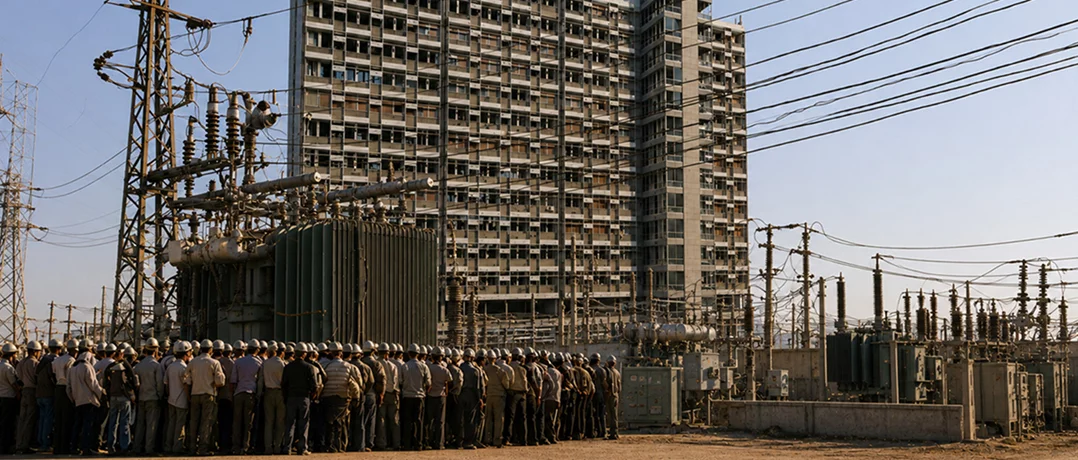
Lebanon’s long-delayed electricity reform process has entered a new phase of confrontation, as plans to restructure Electricité du Liban (EDL) face strong opposition from the institution’s labor unions.
In an interview with The Beiruter, Lebanese economy expert Patrick Mardini argued that the debate should not focus on whether privatization or private-sector participation is inherently positive or negative, but rather on how such reforms are designed and implemented.
A sector in need of structural reform
Lebanon’s electricity sector has struggled for years with chronic shortages, financial deficits, and repeated reform attempts that failed to produce sustainable results. According to Mardini, the current condition of EDL itself demonstrates the urgency of change.
Pointing to the country’s limited electricity supply as clear evidence of the sector’s shortcomings, he said that
The current situation of Electricité du Liban as an institution is not healthy.
For Mardini, maintaining the existing structure is no longer a viable option. Previous attempts to reform EDL as a public institution encountered significant resistance, making organizational restructuring necessary. “Electricité du Liban needs reform, and maintaining the current situation is not necessarily the best option,” he explained, adding that previous efforts to reform the institution “were, in reality, extremely resistant to reform.”
He considered transforming EDL into a company a step toward implementing Electricity Sector Regulatory Law No. 462 of 2002, which was approved by Parliament but remained largely unimplemented for more than 20 years. “The law was approved by Parliament but was never implemented,” Mardini said, arguing that successive governments and energy ministers introduced alternative plans instead of applying the existing legal framework.
Implementing the 2002 Electricity Sector Regulatory Law after 24 years
At the center of the current debate is Electricity Sector Regulatory Law No. 462 of 2002, which established a regulatory framework aimed at restructuring Lebanon’s electricity sector. The law envisioned separating electricity generation, transmission, and distribution while introducing competition and regulating private-sector participation.
Mardini stressed that while the legislation may require improvements, its effectiveness cannot be assessed without first putting it into practice. Indeed, Lebanon’s broader institutional problem has been the failure to enforce existing legislation.
We cannot know whether the law is good or bad before actually implementing it.
According to Mardini, the consequences of avoiding reform have been visible for years, including allegations of corruption, financial waste, poor collection systems, and controversies surrounding electricity production contracts. “We have seen everything from suspicions of corruption, waste, poor collection, and questionable deals surrounding power plants,” he said, linking these issues to the poor quality of electricity services experienced by citizens.
From private sector participation to private sector accountability
While opponents of privatization often argue that Lebanon risks surrendering a public service to private companies, Mardini noted that private-sector involvement already exists within the electricity sector.
Distribution Service Providers (DSPs), for example, are private companies responsible for managing electricity networks and collection in different regions. Private companies have also historically participated in power plant management and other electricity-related projects.
However, Mardini argued that previous approaches failed because private-sector involvement was introduced without sufficient accountability.
The issue is not whether privatization is good or whether public-private partnerships are good or bad. The real issue is how they are implemented.
According to him, responsibility must accompany authority. Under the current DSP model, companies receive payments for their services regardless of whether electricity bills are effectively collected, meaning that collection failures ultimately become a burden on EDL and the state.
Mardini believed the solution is to transform service providers into full electricity distribution companies.
Such companies would purchase electricity in bulk from producers and sell it directly to consumers. This would create a financial incentive to improve collection because unpaid bills would directly affect the company’s revenues. “If they cannot sell all of it, or if they cannot collect payment for part of it, then the company itself would lose money,” he explained.
Why employees could benefit from reform
One of the strongest arguments made by opponents of restructuring is that transforming EDL into a company could harm workers’ rights. Mardini rejected this argument, saying international experiences show that employees often become among the biggest beneficiaries of electricity-sector reform and moving toward more competitive electricity markets.
According to him, separating generation, transmission, and distribution would create multiple companies competing for skilled workers, increasing salaries, and employment opportunities. “Once you have five, six, or seven companies competing to produce electricity in the country, these companies will also compete to attract employees,” he said.
Mardini argued that EDL employees possess valuable technical knowledge and practical experience that private companies would seek to acquire.
Companies will compete to hire them and will offer them incentives that they currently do not have.
He compared the current situation to a monopoly where employees have limited alternatives. By introducing competition, workers would gain greater bargaining power and mobility. “This is like any sector. If you have a single company operating in a sector, that company imposes the conditions on the employees,” he said.
Despite his support for reform, Mardini acknowledged that workers’ concerns are understandable, noting that uncertainty often leads employees to resist major transformations.
People naturally fear change.
Mardini also distinguished between ordinary employees and a small number of individuals who may benefit from the current system through informal arrangements. According to him, resistance from such actors should not prevent broader reform, as it represents personal interests rather than the interests of the majority of workers.
Union opposition and the debate over Law No. 462/2002
The push to transform EDL into a company has recently triggered renewed opposition from the institution’s labor union. The Union of Workers and Employees of EDL announced its rejection of the proposed transformation, arguing that any restructuring based on Law No. 462/2002 would be invalid unless the legislation itself is amended.
The union said it had previously met with the Minister of Energy and Water Joe Saddi, who pledged that electricity-sector policy reforms would not be implemented without involving unions in proposed amendments.
The union also objected to presenting a draft decree transforming EDL into “Lebanon Electricity Company” before the Supreme Council for Privatization without prior consultation.
Law No. 462/2002, officially known as the Electricity Sector Regulatory Law, established the framework for private-sector participation, competition, and the creation of an independent electricity regulatory authority. It provides for the separation of generation, transmission, and distribution activities, licensing procedures, tariff regulation, and oversight mechanisms.
The law also created the foundation for an Electricity Regulatory Authority (ERA) responsible for supervising the sector, encouraging investment, ensuring service quality, and protecting consumer interests.
While supporters consider the law a cornerstone for modernizing Lebanon’s electricity sector, critics argue that its implementation requires amendments and stronger guarantees for workers and public oversight.
Nevertheless, after 24 years of waiting, the challenge facing Lebanon is no longer simply drafting reform laws, but finally applying them in a way that balances efficiency, public interest, and employee protection.
-
-

-
The Beiruter
-
