



The Quintet’s meeting with President Joseph Aoun reaffirmed international backing for Lebanon’s sovereignty and the Lebanese Armed Forces amid rising tensions.
Quintet Committee backs Lebanese sovereignty and security
Quintet Committee backs Lebanese sovereignty and security
By The Beiruter | March 03, 2026

Reading time: 4 min
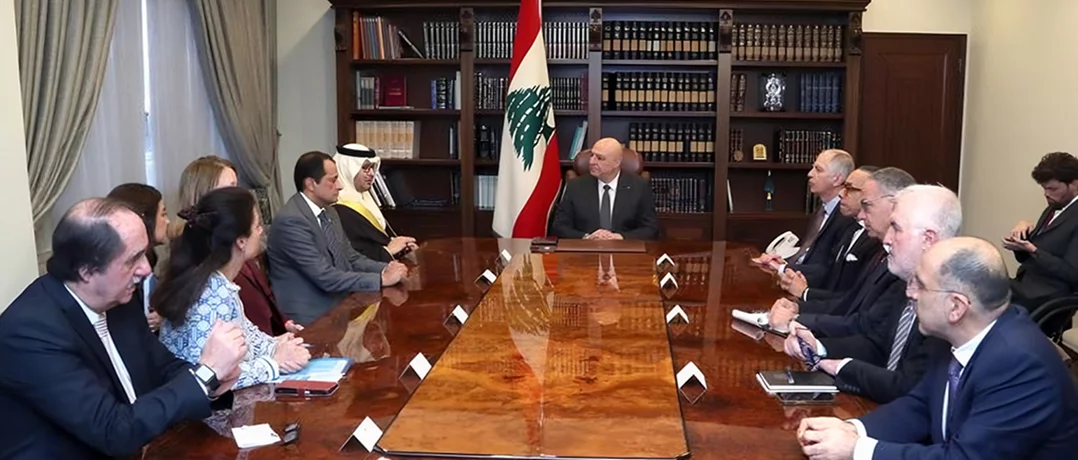
Against the backdrop of the recent escalation between Israel and Hezbollah, the Quintet Committee met Lebanon President Joseph Aoun at the Presidential Palace in Baabda, reaffirming its support for Lebanese sovereignty, state institutions, and the authority of the Council of Ministers.
Following the meeting, Egyptian Ambassador to Beirut Alaa Moussa delivered a series of statements underscoring the international community’s backing of Lebanon’s constitutional framework and its armed forces. His remarks reflected a unified message: Lebanon’s stability depends on reinforcing state authority, empowering the Lebanese Armed Forces (LAF), and containing escalating tensions before they spiral further.
Unified Lebanese leadership and institutional legitimacy
Speaking from Baabda Palace, Ambassador Moussa stressed that the Quintet members (which includes the ambassadors of the United States, France, the Kingdom of Saudi Arabia, Egypt, and Qatar) had discussed “the role of the army in light of recent developments” and expressed their full support for the Lebanese State. He confirmed the committee’s “complete backing of the decisions taken by the Council of Ministers,” highlighting that these decisions fall within the prerogatives of Lebanon’s constitutional institutions.
Crucially, Moussa stressed that there is no contradiction among Lebanon’s top leadership. He noted that Speaker of Parliament Nabih Berri supports the government’s decisions, and that the 3 presidencies are united in their positions for the coming phase. This message of unity is particularly significant in a country often marked by political fragmentation. By highlighting cohesion among the executive and legislative branches, the Quintet sought to reinforce the legitimacy of the government’s course of action.
According to Moussa, no party can oppose decisions taken collectively by the Cabinet. The State, he said, retains the authority to determine when and how these decisions are implemented, reaffirming the principle that war, peace, and security policy fall within institutional, not partisan, control.
The LAF at the center of the next phase
A central theme of the discussions was the role of the LAF in implementing the government’s decisions and safeguarding national stability. Moussa confirmed the Quintet’s commitment to supporting the army, both politically and materially.
He revealed that a conference to support the Lebanese Army, initially scheduled for 5 March 2026, had been postponed until April due to recent developments. The conference is expected to be held in France when circumstances permit. This delay, while procedural, underscores the seriousness of the current situation and the need for stabilization before broader international initiatives can proceed.
A final decision and a call for de-escalation
In his turn, President Aoun reportedly briefed the Quintet ambassadors on the Cabinet’s resolutions and the mechanisms through which they were reached, asserted that it was “a sovereign and final decision that cannot be reversed.” He also reiterated that the plan to consolidate arms under state authority remains ongoing, with the political cover granted to the army serving as clear evidence of the government’s determination to move forward. Meanwhile, Moussa further indicated that the army has been entrusted with handling the operational aspects of the government’s decisions. This delegation underscores the principle that the armed forces are the sole legitimate guarantor of security, acting under civilian authority and within the framework of the law.
While the political and security ramifications of this move are considerable, the stress from both Lebanese officials and international representatives has been on ensuring that the decision is implemented in a manner that preserves national stability.
Ambassador Moussa described the current environment as one that “involves a high degree of danger,” requiring swift and responsible action to contain escalation. He stressed that friendly nations, not limited to the Quintet members, must work collectively to calm tensions and shield Lebanon from further damage.
The Quintet’s role, as outlined during the meeting, extends beyond mere diplomatic endorsement. It includes active engagement with regional and international partners to prevent the deterioration of Lebanon’s internal situation and to avoid spillover effects across the region.
In conclusion, the meeting at Baabda Palace marks a fundamental moment in Lebanon’s ongoing struggle to reaffirm state authority amid complex security challenges. The Quintet Committee’s unequivocal support for the government’s decisions, the unity of Lebanon’s top leadership, and the central role entrusted to the LAF together form a coherent strategy aimed at reinforcing sovereignty and restoring stability.
At a time when the risks are considerable, the message delivered by Ambassador Alaa Moussa was clear: Lebanon’s institutions must be empowered, the army must be supported, and escalation must be contained. The path forward will not be without difficulty. Yet with unified domestic leadership and sustained international backing, Lebanon may find an opportunity not only to weather the current storm but to reassert state authority in safeguarding its own future.
Against the backdrop of the recent escalation between Israel and Hezbollah, the Quintet Committee met Lebanon President Joseph Aoun at the Presidential Palace in Baabda, reaffirming its support for Lebanese sovereignty, state institutions, and the authority of the Council of Ministers.
Following the meeting, Egyptian Ambassador to Beirut Alaa Moussa delivered a series of statements underscoring the international community’s backing of Lebanon’s constitutional framework and its armed forces. His remarks reflected a unified message: Lebanon’s stability depends on reinforcing state authority, empowering the Lebanese Armed Forces (LAF), and containing escalating tensions before they spiral further.
Unified Lebanese leadership and institutional legitimacy
Speaking from Baabda Palace, Ambassador Moussa stressed that the Quintet members (which includes the ambassadors of the United States, France, the Kingdom of Saudi Arabia, Egypt, and Qatar) had discussed “the role of the army in light of recent developments” and expressed their full support for the Lebanese State. He confirmed the committee’s “complete backing of the decisions taken by the Council of Ministers,” highlighting that these decisions fall within the prerogatives of Lebanon’s constitutional institutions.
Crucially, Moussa stressed that there is no contradiction among Lebanon’s top leadership. He noted that Speaker of Parliament Nabih Berri supports the government’s decisions, and that the 3 presidencies are united in their positions for the coming phase. This message of unity is particularly significant in a country often marked by political fragmentation. By highlighting cohesion among the executive and legislative branches, the Quintet sought to reinforce the legitimacy of the government’s course of action.
According to Moussa, no party can oppose decisions taken collectively by the Cabinet. The State, he said, retains the authority to determine when and how these decisions are implemented, reaffirming the principle that war, peace, and security policy fall within institutional, not partisan, control.
The LAF at the center of the next phase
A central theme of the discussions was the role of the LAF in implementing the government’s decisions and safeguarding national stability. Moussa confirmed the Quintet’s commitment to supporting the army, both politically and materially.
He revealed that a conference to support the Lebanese Army, initially scheduled for 5 March 2026, had been postponed until April due to recent developments. The conference is expected to be held in France when circumstances permit. This delay, while procedural, underscores the seriousness of the current situation and the need for stabilization before broader international initiatives can proceed.
A final decision and a call for de-escalation
In his turn, President Aoun reportedly briefed the Quintet ambassadors on the Cabinet’s resolutions and the mechanisms through which they were reached, asserted that it was “a sovereign and final decision that cannot be reversed.” He also reiterated that the plan to consolidate arms under state authority remains ongoing, with the political cover granted to the army serving as clear evidence of the government’s determination to move forward. Meanwhile, Moussa further indicated that the army has been entrusted with handling the operational aspects of the government’s decisions. This delegation underscores the principle that the armed forces are the sole legitimate guarantor of security, acting under civilian authority and within the framework of the law.
While the political and security ramifications of this move are considerable, the stress from both Lebanese officials and international representatives has been on ensuring that the decision is implemented in a manner that preserves national stability.
Ambassador Moussa described the current environment as one that “involves a high degree of danger,” requiring swift and responsible action to contain escalation. He stressed that friendly nations, not limited to the Quintet members, must work collectively to calm tensions and shield Lebanon from further damage.
The Quintet’s role, as outlined during the meeting, extends beyond mere diplomatic endorsement. It includes active engagement with regional and international partners to prevent the deterioration of Lebanon’s internal situation and to avoid spillover effects across the region.
In conclusion, the meeting at Baabda Palace marks a fundamental moment in Lebanon’s ongoing struggle to reaffirm state authority amid complex security challenges. The Quintet Committee’s unequivocal support for the government’s decisions, the unity of Lebanon’s top leadership, and the central role entrusted to the LAF together form a coherent strategy aimed at reinforcing sovereignty and restoring stability.
At a time when the risks are considerable, the message delivered by Ambassador Alaa Moussa was clear: Lebanon’s institutions must be empowered, the army must be supported, and escalation must be contained. The path forward will not be without difficulty. Yet with unified domestic leadership and sustained international backing, Lebanon may find an opportunity not only to weather the current storm but to reassert state authority in safeguarding its own future.
-
-

-
The Beiruter
-
