An intimate look at how displaced families in Beirut continue to observe Ramadan inside shelters, preserving faith, community, and tradition despite the disruptions of war.




An intimate look at how displaced families in Beirut continue to observe Ramadan inside shelters, preserving faith, community, and tradition despite the disruptions of war.

On the ground floor of the Evangelical school in Hamra, Samra, Léa, Rahb, and Nasira sit in a circle on mismatched plastic chairs, speaking quietly amongst themselves. The four women are still getting to know one another, having met only days earlier after arriving at the school-turned-shelter following their displacement. While Samra and Léa fled to the shelter from Dahiyeh during the first day of the war, Rahb and Nasira came later from Houla, a town in southern Lebanon near the Syrian border.
It’s 12:30pm, which, for many in Beirut, signals the start of the lunch hour. These women, however, are abstaining from food and drink to maintain their fast. It’s Ramadan after all, the holiest month in the Islamic calendar, and fasting from dawn until sunset is one of its central obligations.
The last several days, forced to evacuate unexpectedly from their homes, have been a disruptive experience for the four women. Yet despite the emotional and physical strain of displacement, Samra, Léa, Rahb, and Nasira continue to fast. War or no war, they say, Ramadan remains Ramadan.
Nearby, Khal, a middle-aged man from Baalbek whom the women fondly call the “shelter’s uncle,” leans in to offer a simple explanation.
“Fasting is a personal decision,” he said. “Everyone must do what they can.”
The conflict, however, has altered the rhythms of the holy month for thousands of Muslims who have been displaced from their homes. According to the most recent data released by Lebanon’s Disaster Risk Management Unit, the number of displaced people has surpassed 517,000. In a country of roughly 5.8 million people, that figure represents nearly 9 percent of the population.
Inside the Evangelical school shelter, what residents described as typically the “best month of the year” now feels markedly different.
Beyond the additional physical strain fasting can pose (many already begin the day hungry), spiritual practices have furthermore been disrupted.
Ramadan, the women note, centers around the principle of spirituality. Many Muslims devote part of each day to reading the Qur’an, often for several hours. Such a practice requires time, focus and a feeling of serenity and inner peace. This is hard to do in crowded shelters with the sounds of drones and strikes in the distance
As if on cue, the sound of a drone which had been buzzing in the background increased in volume, attracting half-curious glances upwards.
Yet despite displacement, the “community” of Ramadan, Samra said, remains strong in the shelter. Last night even featured a movie night. “Every person here is a neighbour for anyone,” she insisted.
For some of the shelter’s youngest residents, adjusting to Ramadan here still feels unfamiliar. Among them is 18-year-old Liana from Nabatieh, who is spending her first Ramadan away from home. And the experience has been disorienting.
“We are used to doing everything in a familiar environment at home,” she said. Before the month begins, Liana explained, her family would store food in the freezer to prepare for iftar meals. Now, these routines have disappeared, leaving families disconnected from their typical Ramadan meals.
This isn’t the first time Liana has been displaced due to war. October 2024 had similarly forced her family to flee north. But with the cessation of hostilities with the ceasefire in November 2024, Liana returned home. By the time Ramadan commenced several months later, she was back in a familiar setting.
Even the 2006 war between Israel and Hezbollah, which took place before Liana was born, unfolded during the summer months of July and August. Lebanon’s last wartime Ramadan was therefore during the civil war, more than three decades ago.
Removed from her usual fasting environment, the hours stretch slowly. “I feel every second,” Liana said. “It’s become really difficult.”
Like Samra, Léa, Rahb, and Nasira, however, Liana has found comfort in the community forming inside the shelter. “When we came here, we came together,” she said, gesturing to the women sitting nearby.
Moments later, thirteen-year-olds Abbas, Hassan, and Hassan burst through the door in a game of tag. When asked about their favorite Ramadan dishes, a cascade of food names followed.
“Tabbouleh,” “koura,” “kibbeh,” “warak anab,” and “everything at Suhoor,” the three boys called out.
“It’s not difficult at all,” Hassan said. “Easy,” Abbas added.
Several displaced residents, however, said they had been forced to break their fast during the most chaotic days of their displacement. Under Islamic practice, those missed days can later be made up through additional fasting, a process known as qaḍā, meaning some expect to observe several extra days even after Ramadan ends.
For many in the shelter, the fast continues as best it can.
Beyond the shelter walls, the atmosphere of Ramadan has shifted across the surrounding neighborhood as well. For Maha, who has lived all her life in the Kraytem neighborhood adjacent to Hamra, this Ramadan has taken on a different atmosphere.
Certain traditions persist. “Ramadan has a specific spirit that will never go away,” she said. “Thinking about our community, gathering together, this can never be taken away.”
What has changed, however, is the post-iftar ritual of evening walks and the preparation for Eid. As Maha recalled, at this time of year the streets of Hamra and the Corniche are typically bustling with families going out after iftar to celebrate breaking the fast. Particularly as Eid approaches, the number of people shopping late into the night multiplies, as Muslims begin buying new shoes, dresses, and decorations for the upcoming festivities.
Watching people be happy, seeing Hamra become the hub of everyone going out, this has totally disappeared.
“The feeling of guilt is terrible,” she said. “You feel guilty even leaving the house. How am I supposed to go out after iftar when there is so much suffering?”
Like the women in the shelter, Maha has also struggled to maintain the same spiritual routines. Preoccupied with the conflict, it has become difficult to enter the calm, focused state needed to read the Qur’an.
“Peace of mind does not exist during wartime,” she said. “I am distracted all the time thinking of things outside my control.”
The disruption of Ramadan is also being felt in Beirut’s shops and bakeries. In Lebanon, Ramadan is closely associated with food, particularly its sweets. Rachel, whose father founded Chidiac, one of Beirut’s best-known Arabic sweets shops, described the holy month as typically the busiest sales season of the year.
Since the outbreak of the war, however, their downtown storefront has drawn fewer customers than usual, though deliveries have increased as many Beirut residents have left the city for the mountains in search of safety.
“Mafroukeh bi-fustuq, osmalieh, knafeh, karabij,” she listed, motioning toward the display.
Everything in Ramadan is made with ashta.
Now, the cases are still filled with Ramadan sweets, even as the crowds have thinned. Inside the shop, the familiar flavors of the season remain unchanged.
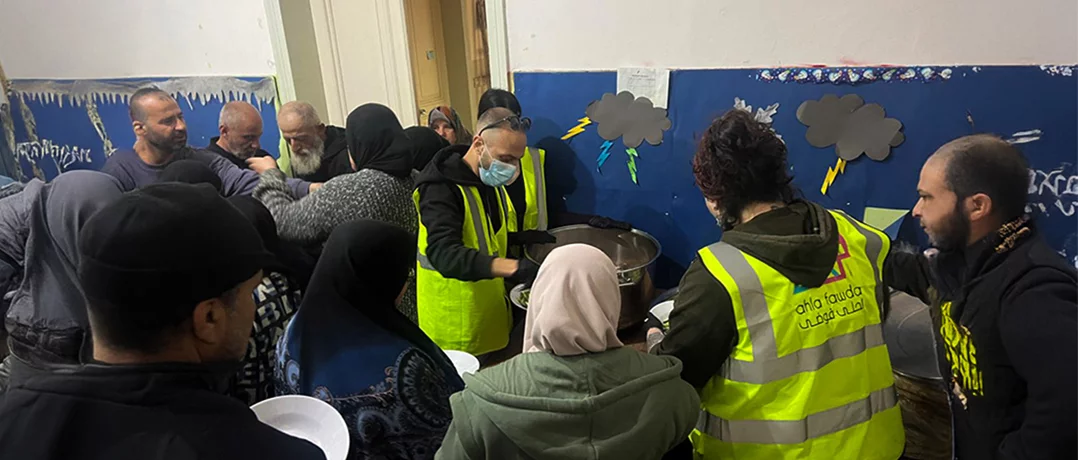
Back at the Evangelical school, the school bell rings, announcing the start of the evening meal. It’s 5:15pm, so around half an hour before the official iftar time. It’s an “early iftar,” one of the volunteers explained.
Some of the shelter’s residents, including Samra, Léa, Rahb, and Nasira, will wait the additional thirty minutes before they take their meal. Most of the other displaced file into the school corridor, collecting their plate and cutlery before they fall into line.
Once they reach the serving table, volunteers from a local NGO serve “two portions” of rice and “one portion” of a fattouche-like salad. There is flexibility, however, as the volunteers will modify servings to accommodate individual requests.
Hassan walked past with a plate piled high with rice and a small serving of salad. “Ktir tayeb (very tasty),” he said, as he flashed a thumbs up.
As official numbers of displaced persons remain in flux, one of the volunteers Ziad noted that the group was currently conducting head counts at the shelters via plates distributed. In future days, he explained, the organization will allocate a cook and cleaner to each school, providing the ingredients for the meal and letting the shelter residents prepare the meals themselves.
After fifteen minutes, the rush of the initial iftar distribution had subsided and around the room, small groups began to eat together.
With the conflict in Lebanon showing little sign of abating, it is likely the rest of Ramadan will be spent under similar circumstances. Across Lebanon, the holy month is being observed in quieter, more uncertain ways. And for many, it is unfolding far from home, under extreme circumstances. Still, the traditions of the season persist
The spirit of Ramadan remains strong in Lebanon. Ramadan mubarak.