



The use of white phosphorus and other munitions in southern Lebanon has left lasting contamination in the soil and water, threatening agriculture, ecosystems and the livelihoods of local communities.
Reading the chemical traces of war on the environment
Reading the chemical traces of war on the environment
By The Beiruter | November 10, 2026

Reading time: 4 min
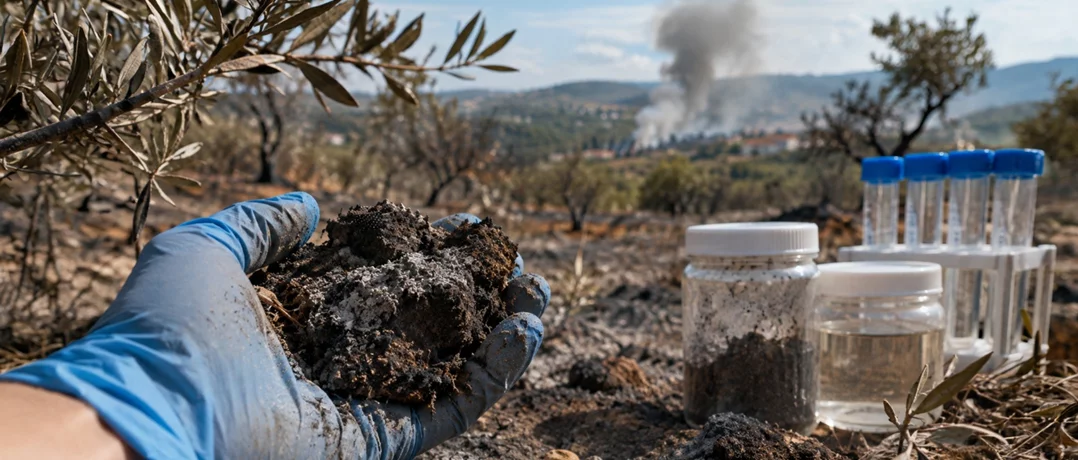
In the villages of southern Lebanon, the damage often shows up as pale,
charred ground where orchards once stood. The deeper damage is chemical, and it
outlasts the fighting.
Since October 2023, Lebanese authorities and researchers have documented the
use of white phosphorus, along with other munitions, across the south.
Lebanon’s National Council for Scientific Research counted 175 white phosphorus
attacks in the first months alone, igniting fires across more than 600 hectares
of farmland. The Israeli military denies using the shells to start fires,
stating that smokescreen munitions are not intended for that purpose.
“White phosphorus is a reactive element,” Mireille Sayegh, a chemist who
studies conflict-related contamination told The Beiruter. “It ignites on
contact with oxygen, which is why it burns so fiercely. In open air it largely
oxidizes, so people assume the threat ends when the flames die. That assumption
is wrong.”
The problem begins when the material lands somewhere without much oxygen.
Researchers at the Conflict and Environment Observatory found that phosphorus
buried in soil with low oxygen, or sitting in water, may not fully oxidize and
can remain a risk to people and wildlife. Early measurements point to heavy
loading. In January 2024, Lebanon’s Ministry of Environment reported phosphorus
in samples from bombed areas at about 900 times normal levels. A later round of
testing at eight sites found concentrations reaching 40,000 parts per million.
“Plants need phosphorus, but only in balance,” Sayegh stated. “Flood a soil
with it and you disrupt how roots absorb other nutrients. Crops struggle. The
land looks intact, yet it stops producing.” A United Nations report on Lebanon
likewise found that white phosphorus further reduces soil fertility and
increases acidity. Rain then carries the contamination onward. “Soil is a
slow-moving river,” Sayegh observed. “What sits at the surface migrates
downward toward groundwater, and sideways into streams. In the south, people
depend on that groundwater.”
Once phosphorus reaches water, biology takes over. Excess phosphorus feeds
algae, producing blooms that strip oxygen from the water and can kill fish.
High concentrations can bioaccumulate in fish and in birds of prey. “This is
the chain that worries me most,” she added. “A pollutant that enters a stream
is eaten by small organisms, then fish, then the birds that eat the fish. At
each step the concentration climbs. A single strike can become a decades-long ecological
problem.”
Metals, rubble and the road back
Phosphorus is only one layer. Explosions disperse metals from shell casings,
and the picture grew starker as testing expanded. The Turabna-Janoub monitoring
project, reported in May 2026, compared new soil samples from the Nabatieh and
Marjayoun districts with historical samples from 2001. It found significant
increases in the median concentrations of four weapon-linked heavy metals, with
lead up roughly 1.5 times. A separate 2026 study by the American University of
Beirut and the Lebanese University detected cadmium and nickel above safety
thresholds in bombed areas.
“Heavy metals do not degrade,” Sayegh emphasized. “Organic pollutants can
break down over time. A metal like cadmium simply stays, binding to soil
particles, entering crops through the roots, and ending up on someone’s table.”
The living landscape has also taken heavy losses. Lebanese state figures for
the 2024 war put the damage at about 1,910 hectares of prime farmland, 47,000
olive trees and roughly 1,200 hectares of oak forest. In a region where small
family plots make up the bulk of agriculture, that means lost income as well as
lost trees. The World Bank estimated environmental damage from October 2023
through late 2024 at $221 million, mainly through degraded natural resources
and disrupted solid waste management.
Then came the 2026 war. Lebanon’s Environment Ministry, working with the
national research council, described the damage in April 2026 as “ecocide.”
Reported estimates put the rubble from bombed buildings at around 16 million
tons, and researchers warn it may contain asbestos, heavy metals and phosphorus
residues. A ministry assessment found that 78 percent of southern farmers had
stopped working, mostly because of displacement.
“Rubble is not inert,” Sayegh cautioned. “Every rainfall leaches something
out of it. If nobody manages it, contamination spreads long after the cameras
leave.” Recovery will be slow. Sayegh outlined what scientists consider
essential. The first step is mapping hot spots, since contamination is patchy
rather than uniform, then testing groundwater, treating or removing the worst
soil, and replanting. Unexploded ordnance complicates every step.
“We cannot clean what we have not measured, and we cannot measure what we
cannot safely reach,” she concluded. “The first task is documentation. The
second is giving farmers the means to return.”
-
-

-
The Beiruter
-
